QUESTION IMAGE
Question
- how does wilsons moral diplomacy affect americas relationship with the russian empire?
the united states enters the war - on april 2, 1917, wilson addressed a special session of congress, reminding lawmakers of the loss of life caused by german u-boats, as well as attacks that damaged free trade with other countries. afterwards, wilson delivered the central issue of his speech:
neutrality is no longer feasible practical... where the peace of the world is involved... the world must be made safe for democracy. its peace must be planted upon the tested foundations of political liberty... the right is more precious than peace, and we shall fight for the things which we have always carried nearest our hearts - for democracy, for the right of those who submit to authority to have a voice in their own governments.
- woodrow wilsons war message, address to congress, 1917
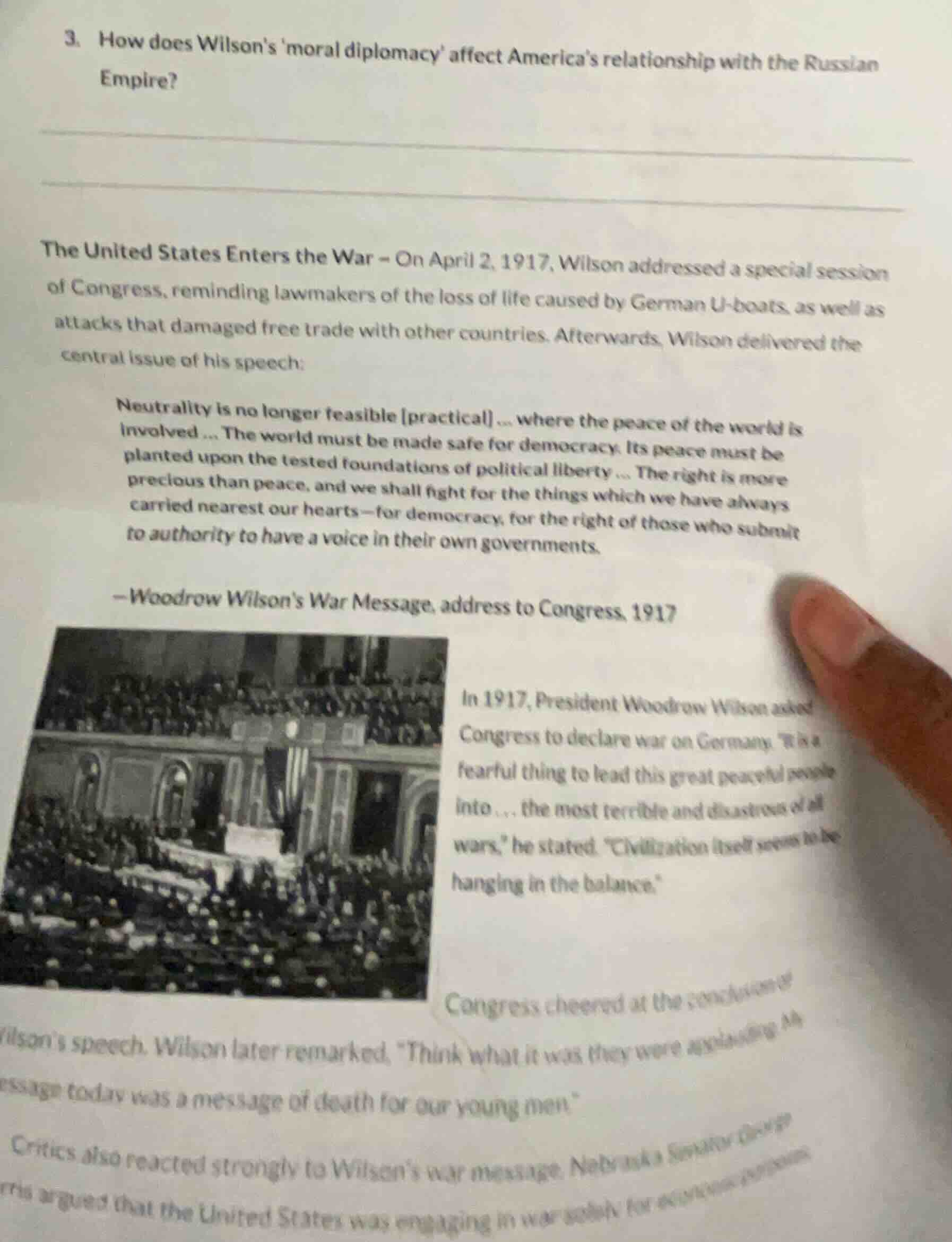
in 1917, president woodrow wilson asked congress to declare war on germany. it is a fearful thing to lead this great peaceful people into... the most terrible and disastrous of all wars, he stated. civilization itself seems to be hanging in the balance.
congress cheered at the conclusion of wilsons speech. wilson later remarked, think what it was they were applauding. my message today was a message of death for our young men.
critics also reacted strongly to wilsons war message. nebraska senator george norris argues that the united states was engaging in war solely for...
Wilson's moral diplomacy centered on promoting democracy and self-determination globally. The Russian Empire was an autocratic monarchy, which clashed with the core principles of moral diplomacy. This ideological divide created tension: Wilson refused to align with the autocratic Russian regime fully, even as the U.S. entered WWI. When the Russian Revolution began later in 1917, Wilson's focus on self-determination led him to eventually shift U.S. stance away from supporting the imperial government, as it did not represent the democratic values he championed in his moral diplomacy framework.

Snap & solve any problem in the app
Get step-by-step solutions on Sovi AI
Photo-based solutions with guided steps
Explore more problems and detailed explanations
Wilson's moral diplomacy, focused on advancing democracy and self-determination, created tension with the autocratic Russian Empire. The ideological clash meant the U.S. did not fully align with the Russian imperial government. When the 1917 Russian Revolution unfolded, Wilson's commitment to his moral diplomacy principles led to a U.S. shift away from supporting the Russian Empire, as it failed to embody the democratic values he prioritized.