QUESTION IMAGE
Question
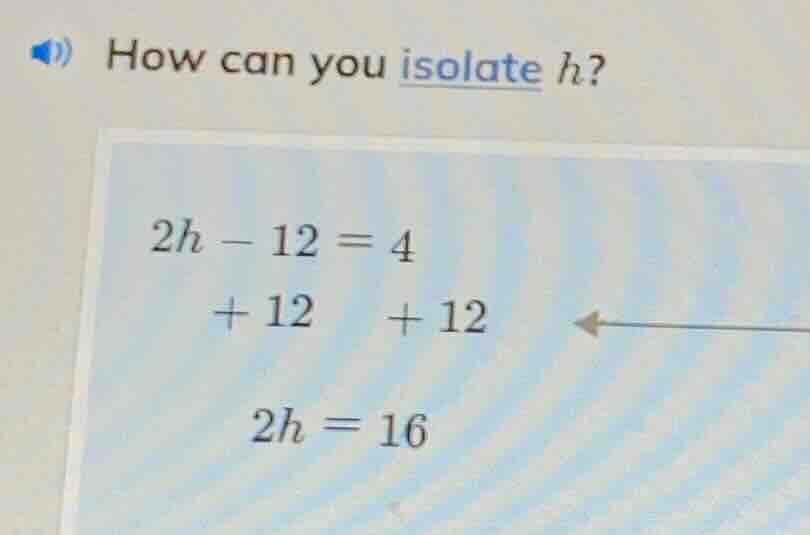
how can you isolate h?
2h - 12 = 4
+ 12 + 12
2h = 16
Step1: Add 12 to both sides
We start with the equation \(2h - 12 = 4\). To isolate the term with \(h\), we use the addition property of equality. We add 12 to both sides of the equation:
\(2h - 12 + 12 = 4 + 12\)
Simplifying both sides, the \(-12\) and \(+12\) on the left cancel out, and on the right we have \(4 + 12 = 16\), so we get \(2h = 16\).
Step2: Divide both sides by 2
Now that we have \(2h = 16\), we want to isolate \(h\) completely. We use the division property of equality and divide both sides of the equation by 2:
\(\frac{2h}{2}=\frac{16}{2}\)
Simplifying both sides, the 2 in the numerator and denominator on the left cancel out, and on the right \(\frac{16}{2}=8\), so we get \(h = 8\).

Snap & solve any problem in the app
Get step-by-step solutions on Sovi AI
Photo-based solutions with guided steps
Explore more problems and detailed explanations
First, add 12 to both sides of the equation \(2h - 12 = 4\) to get \(2h = 16\). Then, divide both sides by 2, so \(h = 8\). (The process shown in the image did the first step, and the second step to fully isolate \(h\) is dividing both sides by 2.)