QUESTION IMAGE
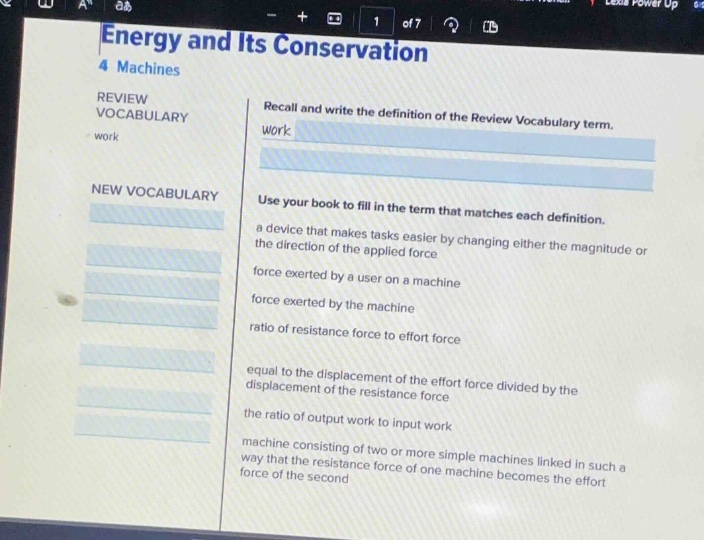
Question
Question was provided via image upload.
Brief Explanations
For the "work" vocabulary term (REVIEW VOCABULARY), in physics (a subfield of Natural Science), work is defined as the product of the force applied on an object and the displacement of the object in the direction of the force, mathematically \( W = F \cdot d \cos\theta \), where \( W \) is work, \( F \) is force, \( d \) is displacement, and \( \theta \) is the angle between the force and displacement vectors. For the NEW VOCABULARY:
- A device that makes tasks easier by changing force/magnitude: Machine.
- Force by user on machine: Effort Force.
- Force by machine: Resistance Force (or Load Force).
- Ratio of resistance to effort force: Mechanical Advantage (\( MA=\frac{F_{resistance}}{F_{effort}} \)).
- Displacement of effort over resistance displacement: Velocity Ratio (\( VR = \frac{d_{effort}}{d_{resistance}} \)).
- Ratio of output to input work: Efficiency (\( \eta=\frac{W_{output}}{W_{input}} \times 100\% \)).
- Machine with two+ simple machines: Compound Machine.

Snap & solve any problem in the app
Get step-by-step solutions on Sovi AI
Photo-based solutions with guided steps
Explore more problems and detailed explanations
- Review Vocabulary (work): In physics, work is done when a force causes displacement, \( W = Fd\cos\theta \) (where \( F \) is force, \( d \) is displacement, \( \theta \) is the angle between them).
- New Vocabulary:
- Machine
- Effort Force
- Resistance Force (Load Force)
- Mechanical Advantage
- Velocity Ratio
- Efficiency
- Compound Machine