QUESTION IMAGE
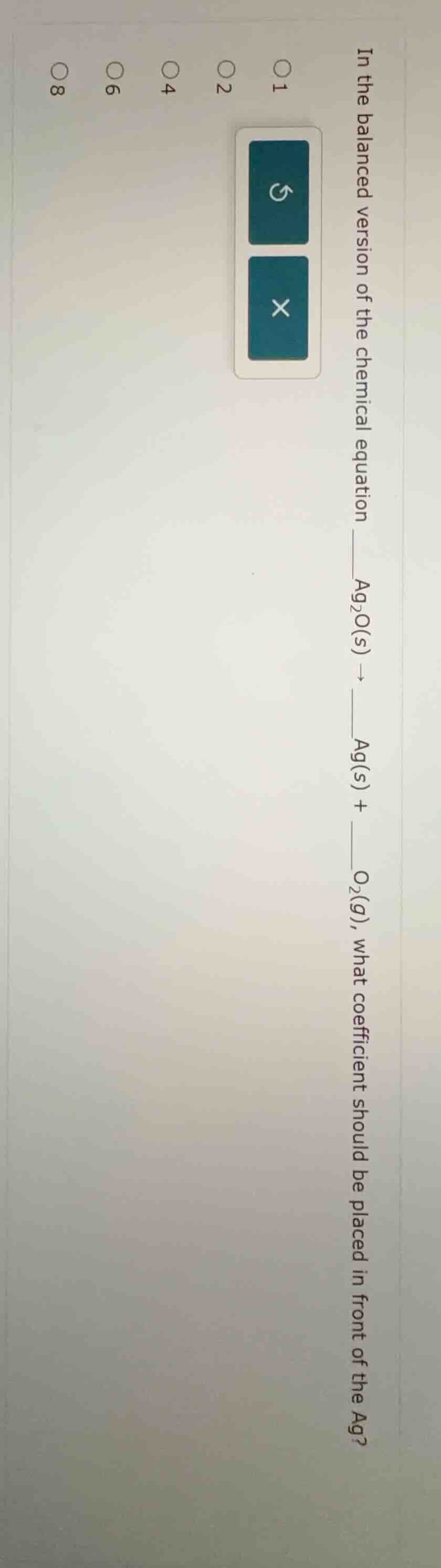
Question
Question was provided via image upload.
Step1: Balance O atoms
In \( \text{Ag}_2\text{O} \), there is 1 O atom, and in \( \text{O}_2 \), there are 2 O atoms. To balance O, we need 2 \( \text{Ag}_2\text{O} \) (so 2 O atoms) and 1 \( \text{O}_2 \) (2 O atoms? Wait, no: \( 2\text{Ag}_2\text{O} \) has 2 O, and \( \text{O}_2 \) has 2 O. Wait, let's re - do. Let the equation be \( a\text{Ag}_2\text{O}
ightarrow b\text{Ag} + c\text{O}_2 \).
For O: \( a = 2c \) (since each \( \text{Ag}_2\text{O} \) has 1 O, and each \( \text{O}_2 \) has 2 O).
For Ag: \( 2a=b \) (each \( \text{Ag}_2\text{O} \) has 2 Ag).
Let's choose \( c = 1 \), then \( a=2 \) (from \( a = 2c \)). Then from \( 2a=b \), \( b = 4 \).
So the balanced equation is \( 2\text{Ag}_2\text{O}(s)
ightarrow4\text{Ag}(s)+1\text{O}_2(g) \). Wait, no, wait: Wait, \( \text{Ag}_2\text{O} \) decomposes to \( \text{Ag} \) and \( \text{O}_2 \). Let's balance step by step.
Original equation: \( \text{Ag}_2\text{O}(s)
ightarrow\text{Ag}(s)+\text{O}_2(g) \)
First, balance O: There are 1 O on left, 2 on right. So multiply \( \text{Ag}_2\text{O} \) by 2: \( 2\text{Ag}_2\text{O}(s)
ightarrow\text{Ag}(s)+\text{O}_2(g) \)
Now O is balanced (2 O on left, 2 on right). Now balance Ag: Left has \( 2\times2 = 4 \) Ag, so multiply \( \text{Ag} \) by 4: \( 2\text{Ag}_2\text{O}(s)
ightarrow4\text{Ag}(s)+\text{O}_2(g) \)
So the coefficient in front of Ag is 4? Wait, no, wait the question is about the coefficient of Ag. Wait, maybe I made a mistake. Wait, let's check again.
Wait, the unbalanced equation: \( \text{Ag}_2\text{O}
ightarrow \text{Ag} + \text{O}_2 \)
Let's use the hit - and - trial method.
Start with O: The number of O atoms on the left is 1 (in \( \text{Ag}_2\text{O} \)), on the right is 2 (in \( \text{O}_2 \)). So we need to make the number of O atoms equal. The least common multiple of 1 and 2 is 2. So we put a coefficient of 2 in front of \( \text{Ag}_2\text{O} \) (so that we have 2 O atoms on the left) and a coefficient of 1 in front of \( \text{O}_2 \) (so that we have 2 O atoms on the right).
Now the equation becomes: \( 2\text{Ag}_2\text{O}
ightarrow\text{Ag}+\text{O}_2 \)
Now, for Ag: On the left, we have \( 2\times2 = 4 \) Ag atoms. So we need to put a coefficient of 4 in front of \( \text{Ag} \) on the right.
So the balanced equation is \( 2\text{Ag}_2\text{O}(s)
ightarrow4\text{Ag}(s)+\text{O}_2(g) \)
So the coefficient of Ag is 4. Wait, but the options are 1,2,4,6,8. So 4 is an option.
Wait, maybe I messed up the initial step. Let's do it with variables.
Let the coefficients be \( x\text{Ag}_2\text{O}
ightarrow y\text{Ag}+z\text{O}_2 \)
For O: \( x = 2z \)
For Ag: \( 2x=y \)
Let \( z = 1 \), then \( x = 2 \), and \( y=4 \). So \( y = 4 \), which is the coefficient of Ag.

Snap & solve any problem in the app
Get step-by-step solutions on Sovi AI
Photo-based solutions with guided steps
Explore more problems and detailed explanations
4