QUESTION IMAGE
Question
Question was provided via image upload.
To solve the fill - in - the - blanks related to the greenhouse effect and ozone depletion, we use our knowledge of environmental science concepts:
Greenhouse Effect Blanks:
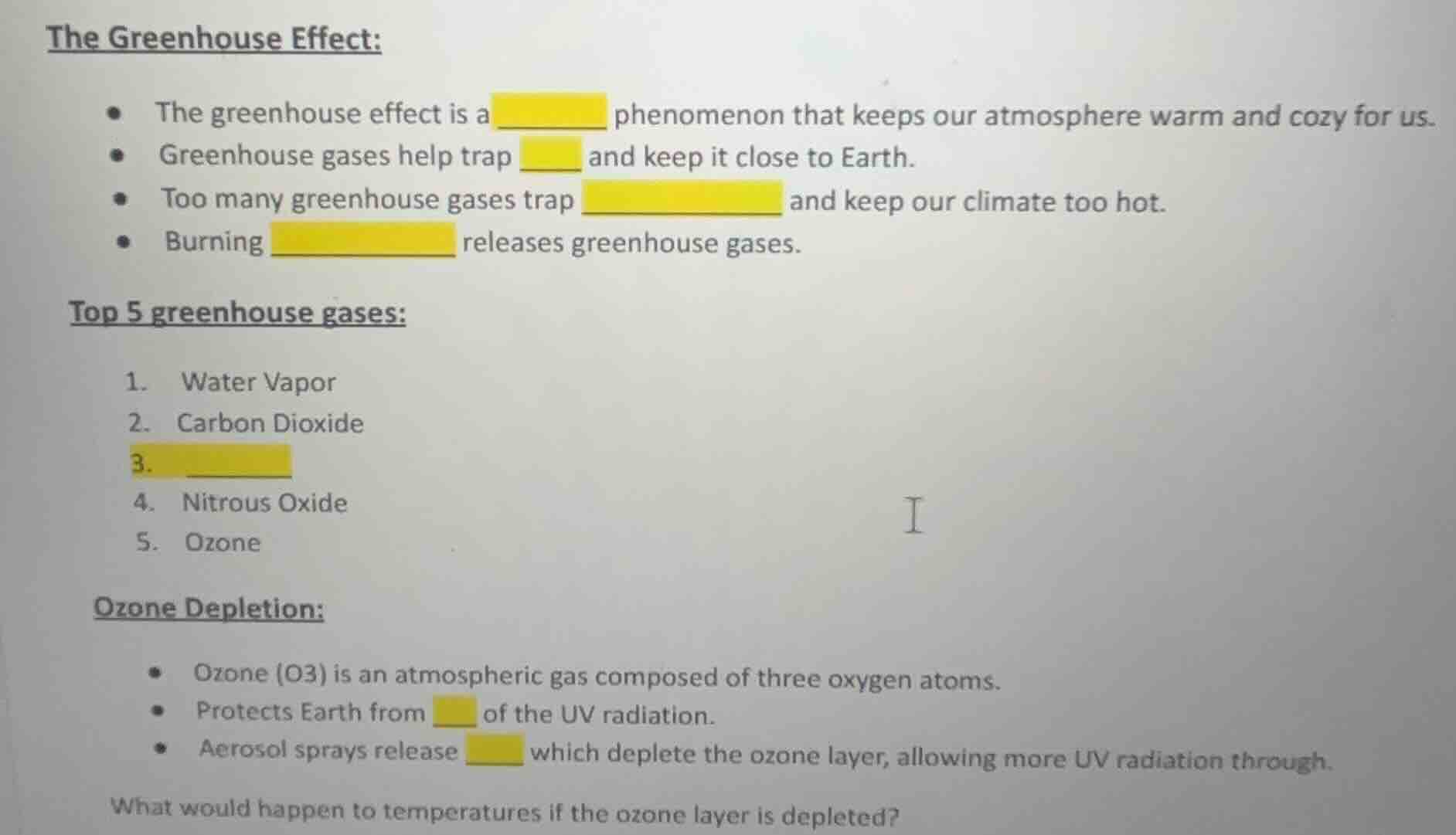
- The greenhouse effect is a natural phenomenon. It occurs naturally as greenhouse gases in the atmosphere (like water vapor, carbon dioxide) trap heat. So the first blank is "natural".
- Greenhouse gases help trap heat (or infrared radiation). The sun's energy reaches the Earth, some is reflected, and some is absorbed and re - emitted as heat. Greenhouse gases trap this heat. So the second blank is "heat" (or "infrared radiation").
- Too many greenhouse gases trap too much heat. An excess of these gases leads to a greater amount of heat being trapped, causing global warming. So the third blank is "too much heat".
- Burning fossil fuels (like coal, oil, gas) releases greenhouse gases. Fossil fuel combustion is a major source of carbon dioxide and other greenhouse gases. So the fourth blank is "fossil fuels".
Top 5 Greenhouse Gases - Third Gas:
The top 5 greenhouse gases are Water Vapor, Carbon Dioxide, Methane (CH₄), Nitrous Oxide, and Ozone. Methane is a significant greenhouse gas, for example, it is released from livestock, landfills, and natural gas production. So the third gas is "Methane".
Ozone Depletion Blanks:
- Ozone (O₃) protects Earth from most (or a large amount) of the UV radiation. The ozone layer absorbs a large portion of the harmful ultraviolet radiation from the sun. So the first blank here is "most" (or "a large amount").
- Aerosol sprays release CFCs (Chlorofluorocarbons) which deplete the ozone layer. CFCs were commonly used in aerosol sprays, refrigerants, etc., and they break down ozone molecules in the stratosphere. So the second blank is "CFCs (Chlorofluorocarbons)".
Question: What would happen to temperatures if the ozone layer is depleted?
If the ozone layer is depleted, more ultraviolet (UV) radiation will reach the Earth's surface. UV radiation carries energy, and an increase in the amount of UV radiation reaching the surface will lead to an increase in the amount of heat absorbed at the surface. This will cause temperatures at the Earth's surface to increase (in the regions where the ozone depletion is significant). Also, the depletion of the ozone layer can disrupt the atmospheric circulation patterns, which can have complex effects on temperature, but the primary direct effect related to radiation is an increase in surface temperature due to more UV radiation (which is converted to heat) reaching the surface.
Final Answers for Blanks:
- Greenhouse effect: natural, heat, too much heat, fossil fuels
- Top 5 greenhouse gases (3rd): Methane
- Ozone depletion: most, CFCs (Chlorofluorocarbons)
- Temperature with ozone depletion: Temperatures at the Earth's surface would increase (due to more UV radiation reaching the surface and being converted to heat).

Snap & solve any problem in the app
Get step-by-step solutions on Sovi AI
Photo-based solutions with guided steps
Explore more problems and detailed explanations
To solve the fill - in - the - blanks related to the greenhouse effect and ozone depletion, we use our knowledge of environmental science concepts:
Greenhouse Effect Blanks:
- The greenhouse effect is a natural phenomenon. It occurs naturally as greenhouse gases in the atmosphere (like water vapor, carbon dioxide) trap heat. So the first blank is "natural".
- Greenhouse gases help trap heat (or infrared radiation). The sun's energy reaches the Earth, some is reflected, and some is absorbed and re - emitted as heat. Greenhouse gases trap this heat. So the second blank is "heat" (or "infrared radiation").
- Too many greenhouse gases trap too much heat. An excess of these gases leads to a greater amount of heat being trapped, causing global warming. So the third blank is "too much heat".
- Burning fossil fuels (like coal, oil, gas) releases greenhouse gases. Fossil fuel combustion is a major source of carbon dioxide and other greenhouse gases. So the fourth blank is "fossil fuels".
Top 5 Greenhouse Gases - Third Gas:
The top 5 greenhouse gases are Water Vapor, Carbon Dioxide, Methane (CH₄), Nitrous Oxide, and Ozone. Methane is a significant greenhouse gas, for example, it is released from livestock, landfills, and natural gas production. So the third gas is "Methane".
Ozone Depletion Blanks:
- Ozone (O₃) protects Earth from most (or a large amount) of the UV radiation. The ozone layer absorbs a large portion of the harmful ultraviolet radiation from the sun. So the first blank here is "most" (or "a large amount").
- Aerosol sprays release CFCs (Chlorofluorocarbons) which deplete the ozone layer. CFCs were commonly used in aerosol sprays, refrigerants, etc., and they break down ozone molecules in the stratosphere. So the second blank is "CFCs (Chlorofluorocarbons)".
Question: What would happen to temperatures if the ozone layer is depleted?
If the ozone layer is depleted, more ultraviolet (UV) radiation will reach the Earth's surface. UV radiation carries energy, and an increase in the amount of UV radiation reaching the surface will lead to an increase in the amount of heat absorbed at the surface. This will cause temperatures at the Earth's surface to increase (in the regions where the ozone depletion is significant). Also, the depletion of the ozone layer can disrupt the atmospheric circulation patterns, which can have complex effects on temperature, but the primary direct effect related to radiation is an increase in surface temperature due to more UV radiation (which is converted to heat) reaching the surface.
Final Answers for Blanks:
- Greenhouse effect: natural, heat, too much heat, fossil fuels
- Top 5 greenhouse gases (3rd): Methane
- Ozone depletion: most, CFCs (Chlorofluorocarbons)
- Temperature with ozone depletion: Temperatures at the Earth's surface would increase (due to more UV radiation reaching the surface and being converted to heat).