QUESTION IMAGE
Question
Question was provided via image upload.
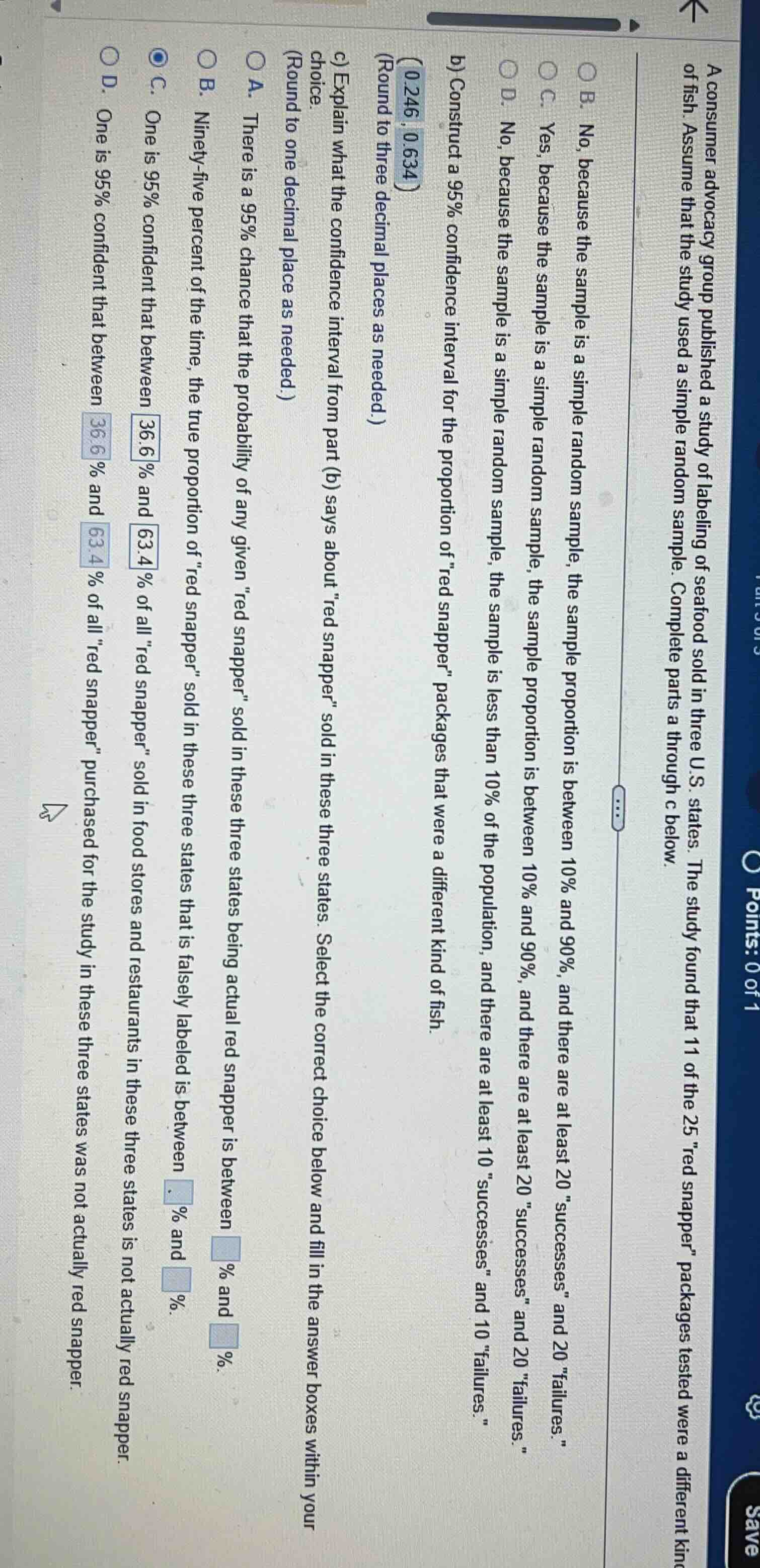
Step1: Check confidence interval conditions
First, identify the sample proportion $\hat{p} = \frac{11}{25} = 0.44$.
Check $n\hat{p} = 25\times0.44 = 11$ and $n(1-\hat{p}) = 25\times0.56 = 14$. Both are $\geq10$, and it is a simple random sample.
Step2: Calculate margin of error
For 95% confidence, $z^* = 1.96$.
Margin of error $E = z^*\sqrt{\frac{\hat{p}(1-\hat{p})}{n}} = 1.96\times\sqrt{\frac{0.44\times0.56}{25}}$
$= 1.96\times\sqrt{\frac{0.2464}{25}} = 1.96\times0.0993 = 0.1946$
Step3: Compute confidence interval
Lower bound: $\hat{p} - E = 0.44 - 0.1946 = 0.2454 \approx 0.246$
Upper bound: $\hat{p} + E = 0.44 + 0.1946 = 0.6346 \approx 0.634$
Step4: Interpret the confidence interval
A 95% confidence interval means we are 95% confident the true proportion falls within the interval.

Snap & solve any problem in the app
Get step-by-step solutions on Sovi AI
Photo-based solutions with guided steps
Explore more problems and detailed explanations
a. C. Yes, because the sample is a simple random sample, the sample proportion is between 10% and 90%, and there are at least 20 "successes" and 20 "failures."
b. $(0.246, 0.634)$
c. C. One is 95% confident that between 36.6% and 63.4% of all "red snapper" sold in food stores and restaurants in these three states is not actually red snapper.