QUESTION IMAGE
Question
Question was provided via image upload.
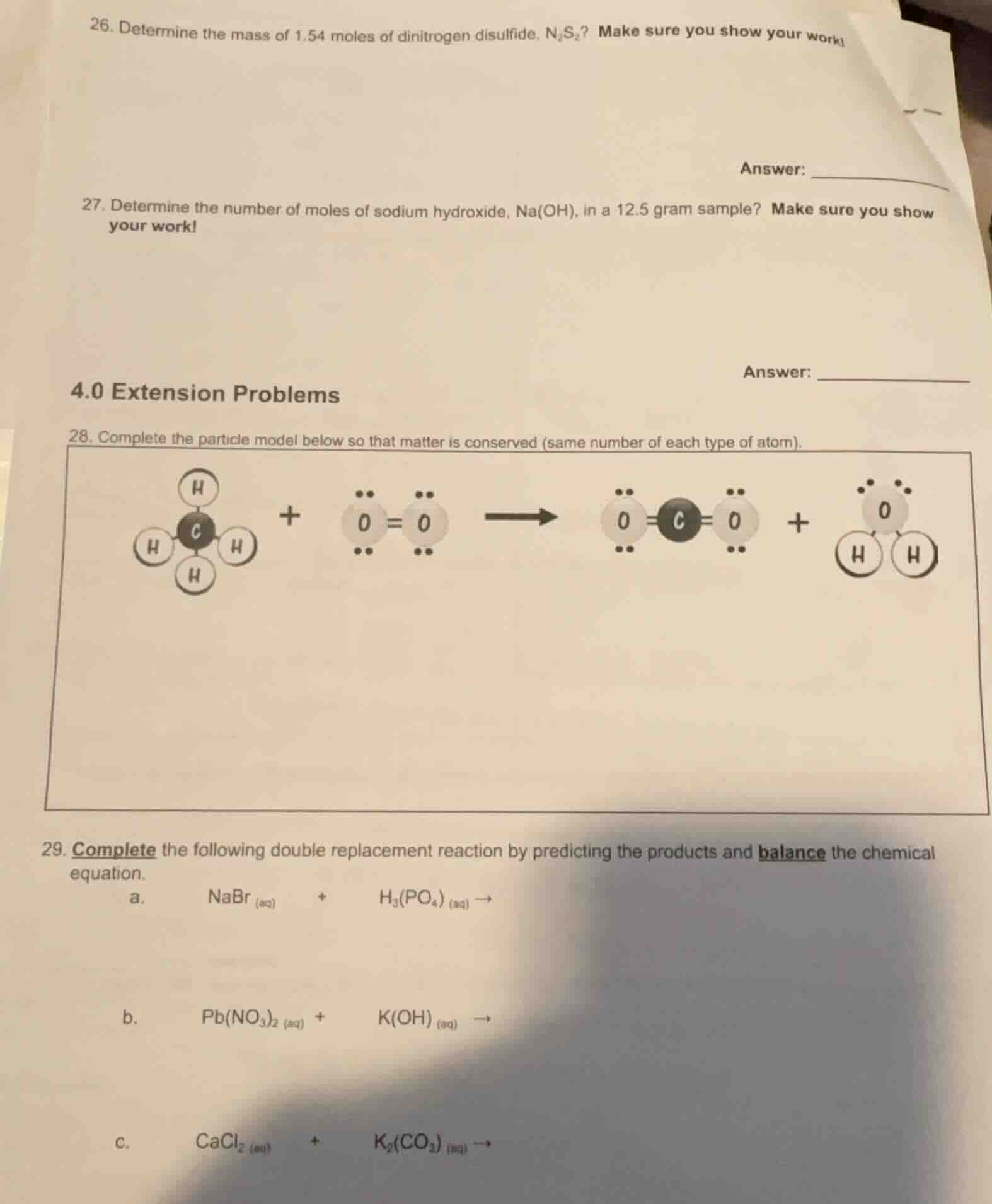
Question 26:
Step1: Find molar mass of \( N_2S_2 \)
Molar mass of \( N \): \( 14.01 \, g/mol \), molar mass of \( S \): \( 32.07 \, g/mol \).
Molar mass of \( N_2S_2 = 2\times14.01 + 2\times32.07 = 28.02 + 64.14 = 92.16 \, g/mol \).
Step2: Calculate mass using \( m = n \times M \)
Given \( n = 1.54 \, mol \), \( M = 92.16 \, g/mol \).
\( m = 1.54 \, mol \times 92.16 \, g/mol \approx 141.93 \, g \).
Step1: Find molar mass of \( NaOH \)
Molar mass of \( Na \): \( 22.99 \, g/mol \), \( O \): \( 16.00 \, g/mol \), \( H \): \( 1.008 \, g/mol \).
Molar mass of \( NaOH = 22.99 + 16.00 + 1.008 = 39.998 \, g/mol \approx 40.00 \, g/mol \).
Step2: Calculate moles using \( n = \frac{m}{M} \)
Given \( m = 12.5 \, g \), \( M = 40.00 \, g/mol \).
\( n = \frac{12.5 \, g}{40.00 \, g/mol} = 0.3125 \, mol \).
- Count atoms on reactant side:
- \( CH_4 \): 1 C, 4 H; \( O_2 \): 2 O (from 1 \( O_2 \) molecule? Wait, no—wait the diagram: Left side: 1 \( CH_4 \) (1 C, 4 H) + 1 \( O_2 \) (2 O). Wait, no, let's re-examine the diagram. Wait, the reactants: \( CH_4 \) (1 C, 4 H) and \( O_2 \) (let's count the \( O_2 \) molecules. Wait the \( O_2 \) is a double bond, so 1 \( O_2 \) molecule (2 O). Products: \( CO_2 \) (1 C, 2 O) and \( H_2O \) (1 O, 2 H). Wait, no—wait the product side: 1 \( CO_2 \) (1 C, 2 O) and 1 \( H_2O \) (1 O, 2 H). Wait, that can't be. Wait, no—wait the diagram: Let's count atoms:
- Reactants:
- \( CH_4 \): C=1, H=4.
- \( O_2 \): Let's see the \( O_2 \) structure: the diagram shows \( O=O \) with two lone pairs on each O. So 1 \( O_2 \) molecule (O=2).
- Products:
- \( CO_2 \): C=1, O=2.
- \( H_2O \): O=1, H=2.
Wait, that's not balanced. Wait, no—maybe the number of \( O_2 \) and \( H_2O \) molecules is wrong. Wait, the correct reaction is \( CH_4 + 2 O_2
ightarrow CO_2 + 2 H_2O \). So in the diagram, the reactant \( O_2 \) should be 2 molecules (so 4 O), and product \( H_2O \) should be 2 molecules (so 2 O and 4 H). Wait, the diagram as drawn: reactants: 1 \( CH_4 \), 1 \( O_2 \); products: 1 \( CO_2 \), 1 \( H_2O \). That's unbalanced. So to balance, we need:
- Reactants: 1 \( CH_4 \), 2 \( O_2 \) (so 4 O).
- Products: 1 \( CO_2 \), 2 \( H_2O \) (so 2 O from \( CO_2 \), 2 O from 2 \( H_2O \); 4 H from 2 \( H_2O \)).
But the diagram shows 1 \( O_2 \) and 1 \( H_2O \). So we need to adjust the number of \( O_2 \) and \( H_2O \) molecules. Wait, the diagram: Let's look at the symbols. The \( O_2 \) is a single molecule (O=O), and \( H_2O \) is a single molecule (O with two H). So to balance:
- C: 1 (reactant) = 1 (product, \( CO_2 \)) → balanced.
- H: 4 (reactant, \( CH_4 \)) → needs 4 H in products. Each \( H_2O \) has 2 H, so need 2 \( H_2O \) molecules (2×2=4 H).
- O: Reactant \( O_2 \): let \( x \) be number of \( O_2 \) molecules. Product \( CO_2 \) has 2 O, 2 \( H_2O \) has 2×1=2 O. Total O: 2 + 2 = 4. So \( x \times 2 = 4 \) → \( x = 2 \).
So in the diagram, the reactant \( O_2 \) should be 2 molecules (so two \( O=O \) structures), and product \( H_2O \) should be 2 molecules (two \( H_2O \) structures). Wait, but the diagram as drawn has 1 \( O_2 \) and 1 \( H_2O \). So to balance, we need to add another \( O_2 \) molecule (so total 2 \( O_2 \)) and another \( H_2O \) molecule (total 2 \( H_2O \)).
Wait, the problem says "complete the particle model so that matter is conserved". So we need to draw the correct number of each molecule. Let's re-express:
- Reactants: 1 \( CH_4 \), 2 \( O_2 \) (so two \( O=O \) molecules).
- Products: 1 \( CO_2 \), 2 \( H_2O \) (so two \( H_2O \) molecules).
So in the diagram, the \( O_2 \) should be 2 molecules (so add one more \( O_2 \) molecule to the reactant side), and the \( H_2O \) should be 2 molecules (add one more \( H_2O \) molecule to the product side).
Wait, the original diagram:
- Reactants: \( CH_4 \) (1) + \( O_2 \) (1) → Products: \( CO_2 \) (1) + \( H_2O \) (1).
To balance:
- C: 1 = 1 ✔️
- H: 4 vs. 2 → need 2 \( H_2O \) (4 H)
- O: 2 vs. 2 (from \( CO_2 \)) + 2 (from 2 \( H_2O \)) = 4 → need 2 \( O_2 \) (4 O)
So the particle model should have:
- Reactants: 1 \( CH_4 \), 2 \( O_2 \) molecules (so two \( O=O \) structures).
- Products: 1 \( CO_2 \), 2 \( H_2O \) molecules (so two \( H_2O \) structures).
So in the diagram, we need to add one more \( O_2 \) mol…

Snap & solve any problem in the app
Get step-by-step solutions on Sovi AI
Photo-based solutions with guided steps
Explore more problems and detailed explanations
Approximately \( 142 \, g \) (or \( 141.93 \, g \))