QUESTION IMAGE
Question
Question was provided via image upload.
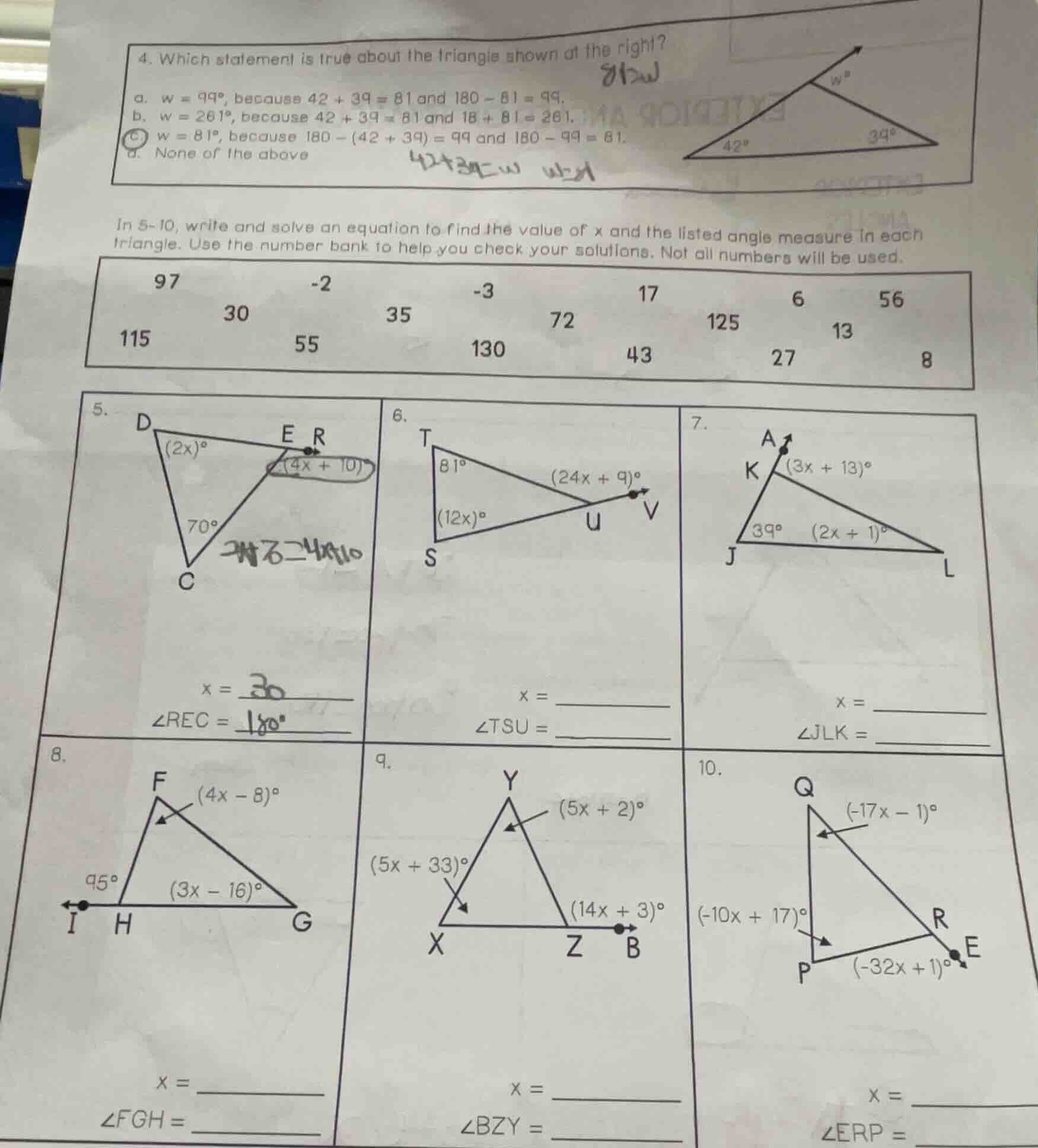
Problem 4
To determine the measure of \( w^\circ \), we use the fact that the sum of the interior angles of a triangle is \( 180^\circ \), and a linear pair of angles also sums to \( 180^\circ \). The two given interior angles are \( 42^\circ \) and \( 39^\circ \). First, find the third interior angle: \( 180 - (42 + 39) = 99^\circ \). Then, \( w \) and this \( 99^\circ \) angle form a linear pair, so \( w = 180 - 99 = 81^\circ \)? Wait, no—wait, looking at the options:
Wait, option a: \( w = 99^\circ \), because \( 42 + 39 = 81 \) and \( 180 - 81 = 99 \). Wait, maybe I misread the diagram. If \( w \) is an exterior angle? Wait, no, the diagram shows a triangle with angles \( 42^\circ \), \( 39^\circ \), and the third angle, and \( w \) is adjacent to the third angle. Wait, the sum of interior angles is \( 180 \). So \( 42 + 39 + \text{third angle} = 180 \), so third angle is \( 99 \). Then \( w \) and the third angle are supplementary (linear pair), so \( w = 180 - 99 = 81 \)? But option a says \( w = 99 \). Wait, maybe the diagram is different. Wait, the options:
a. \( w = 99^\circ \), because \( 42 + 39 = 81 \) and \( 180 - 81 = 99 \).
b. \( w = 261^\circ \), which is wrong (sum of angles can't exceed 180 for a triangle, and linear pair is 180).
c. \( w = 81^\circ \), because \( 180 - (42 + 39) = 99 \) and \( 180 - 99 = 81 \).
Wait, maybe the diagram has \( w \) as the exterior angle? Wait, no—wait, if \( w \) is an exterior angle, then it's equal to the sum of the two non-adjacent interior angles. So \( w = 42 + 39 = 81 \)? But option a says 99. Wait, maybe the diagram is a triangle with angles 42, 39, and the third angle, and \( w \) is the third angle? Wait, that would be \( 42 + 39 + w = 180 \), so \( w = 99 \). Ah, that must be it. So the diagram shows \( w \) as one of the interior angles? Wait, the user's diagram: "a triangle with angles 42°, 39°, and w°"? No, the diagram has 42°, 39°, and \( w \) is adjacent. Wait, the options:
a. \( w = 99^\circ \), because \( 42 + 39 = 81 \) and \( 180 - 81 = 99 \). So that's correct: sum of 42 and 39 is 81, so the third angle (w) is 180 - 81 = 99. So option a is correct. Wait, but the user marked option c. Wait, maybe I misread. Let's re-express:
For a triangle, sum of interior angles is \( 180^\circ \). So if two angles are 42 and 39, the third is \( 180 - 42 - 39 = 99 \). So if \( w \) is that third angle, then \( w = 99 \), which is option a. So the correct answer is a.
We have triangle \( DCE \) with \( \angle D = 2x \), \( \angle C = 70^\circ \), and \( \angle DEC = 4x + 10 \)? Wait, no—wait, the diagram shows \( \angle REC = 4x + 10 \), and \( \angle D = 2x \), \( \angle C = 70^\circ \), and \( \angle DEC \) and \( \angle REC \) are supplementary (linear pair), so \( \angle DEC + \angle REC = 180^\circ \). Also, in triangle \( DCE \), \( \angle D + \angle C + \angle DEC = 180^\circ \), so \( 2x + 70 + \angle DEC = 180 \), so \( \angle DEC = 110 - 2x \). But \( \angle DEC + (4x + 10) = 180 \), so \( (110 - 2x) + (4x + 10) = 180 \). Simplify: \( 120 + 2x = 180 \), so \( 2x = 60 \), \( x = 30 \). Then \( \angle REC = 4(30) + 10 = 130^\circ \)? Wait, but the number bank has 130. Wait, maybe I messed up. Wait, the equation: \( 2x + 70 = 4x + 10 \) (exterior angle theorem: exterior angle equals sum of two remote interior angles). Yes! The exterior angle theorem: \( \angle REC \) is an exterior angle to triangle \( DCE \), so it equals the sum of the two non-adjacent interior angles, \( \angle D \) and \( \angle C \). So \( 4x + 10 = 2x + 70 \). Solve: \( 4x - 2x = 70 - 10 \), \( 2x = 60 \), \( x = 30 \). Then \( \angle REC = 4(30) + 10 = 130^\circ \).
Step 1: Apply Exterior Angle Theorem
\( 4x + 10 = 2x + 70 \)
Step 2: Solve for \( x \)
\( 4x - 2x = 70 - 10 \)
\( 2x = 60 \)
\( x = 30 \)
Step 3: Find \( \angle REC \)
\( \angle REC = 4(30) + 10 = 130^\circ \)
In triangle \( TSU \), \( \angle T = 81^\circ \), \( \angle S = 12x \), and \( \angle TUV = 24x + 9 \) is an exterior angle. By exterior angle theorem, \( \angle TUV = \angle T + \angle S \), so \( 24x + 9 = 81 + 12x \). Solve for \( x \):
Step 1: Set up equation
\( 24x + 9 = 81 + 12x \)
Step 2: Solve for \( x \)
\( 24x - 12x = 81 - 9 \)
\( 12x = 72 \)
\( x = 6 \)
Step 3: Find \( \angle TSU \) (which is \( 12x \))
\( 12(6) = 72^\circ \)

Snap & solve any problem in the app
Get step-by-step solutions on Sovi AI
Photo-based solutions with guided steps
Explore more problems and detailed explanations
a. \( w = 99^\circ \), because \( 42 + 39 = 81 \) and \( 180 - 81 = 99 \)