QUESTION IMAGE
Question
Question was provided via image upload.
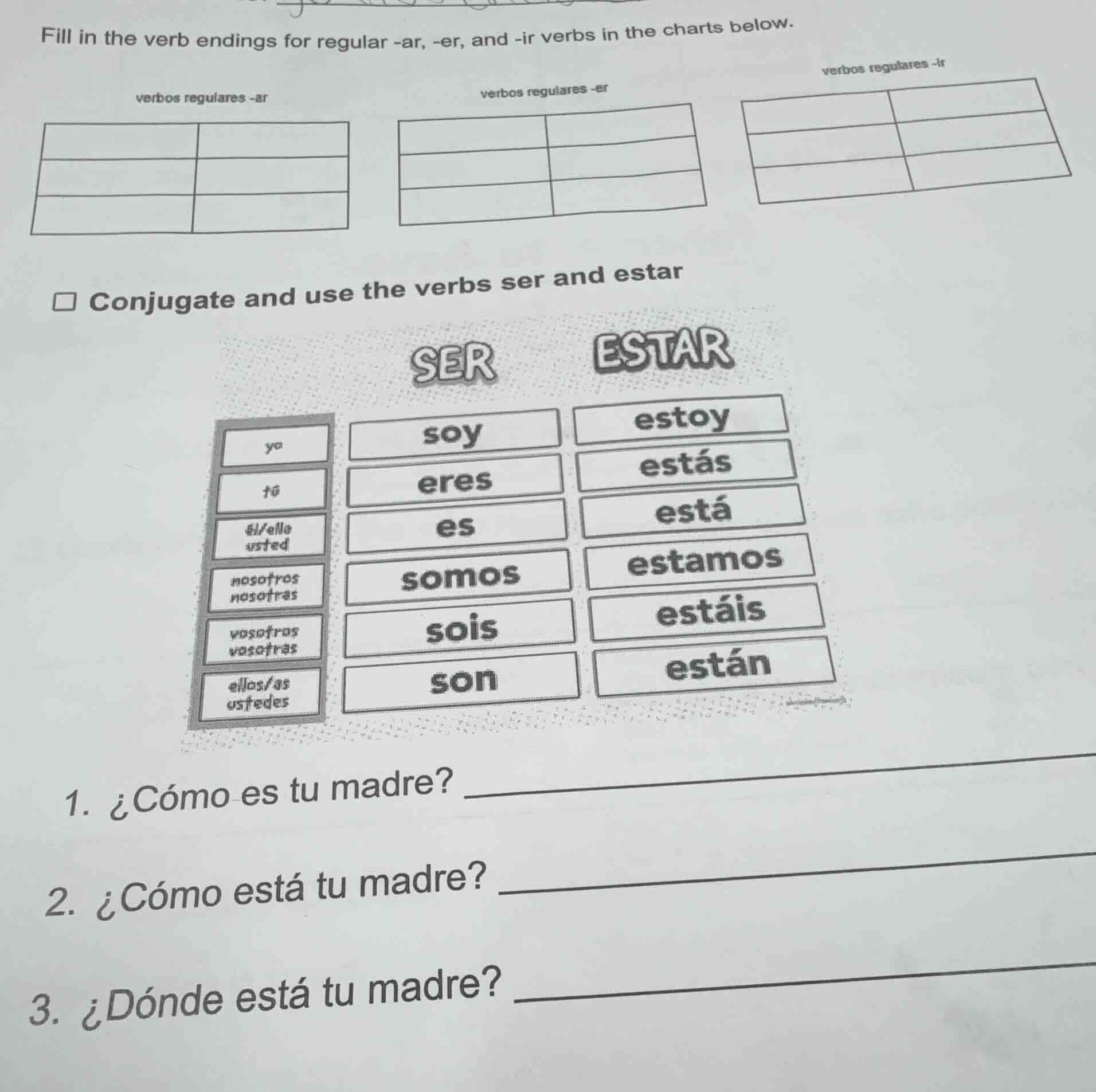
For filling verb endings (regular -ar, -er, -ir verbs in Spanish):
Verbos regulares -ar (Regular -ar verbs)
| Subject Pronoun | Verb Ending |
|---|---|
| tú | -as |
| él/ella/usted | -a |
| nosotros/nosotras | -amos |
| vosotros/vosotras | -áis |
| ellos/ellas/ustedes | -an |
Verbos regulares -er (Regular -er verbs)
| Subject Pronoun | Verb Ending |
|---|---|
| tú | -es |
| él/ella/usted | -e |
| nosotros/nosotras | -emos |
| vosotros/vosotras | -éis |
| ellos/ellas/ustedes | -en |
Verbos regulares -ir (Regular -ir verbs)
| Subject Pronoun | Verb Ending |
|---|---|
| tú | -es |
| él/ella/usted | -e |
| nosotros/nosotras | -imos |
| vosotros/vosotras | -ís |
| ellos/ellas/ustedes | -en |
For conjugating and using ser and estar (example answers for the questions, assuming we provide sample responses):
- ¿Cómo es tu madre? (What is your mother like? - asking about inherent characteristics, use ser)
Example: Mi madre es amable y trabajadora. (My mother is kind and hard - working.)
- ¿Cómo está tu madre? (How is your mother? - asking about temporary state, use estar)
Example: Mi madre está bien, gracias. (My mother is well, thank you.)
- ¿Dónde está tu madre? (Where is your mother? - asking about location, use estar)
Example: Mi madre está en la cocina. (My mother is in the kitchen.)
Final Answers (for verb endings tables filled):
Verbos regulares -ar table filled:
| Verb Ending | |
|---|---|
| tú | -as |
| él/ella/usted | -a |
| nosotros/nosotras | -amos |
| vosotros/vosotras | -áis |
| ellos/ellas/ustedes | -an |
Verbos regulares -er table filled:
| Verb Ending | |
|---|---|
| tú | -es |
| él/ella/usted | -e |
| nosotros/nosotras | -emos |
| vosotros/vosotras | -éis |
| ellos/ellas/ustedes | -en |
Verbos regulares -ir table filled:
| Verb Ending | |
|---|---|
| tú | -es |
| él/ella/usted | -e |
| nosotros/nosotras | -imos |
| vosotros/vosotras | -ís |
| ellos/ellas/ustedes | -en |
For the questions, the example answers are as provided above (e.g., "Mi madre es amable y trabajadora." for question 1, etc.).

Snap & solve any problem in the app
Get step-by-step solutions on Sovi AI
Photo-based solutions with guided steps
Explore more problems and detailed explanations
For filling verb endings (regular -ar, -er, -ir verbs in Spanish):
Verbos regulares -ar (Regular -ar verbs)
| Subject Pronoun | Verb Ending |
|---|---|
| tú | -as |
| él/ella/usted | -a |
| nosotros/nosotras | -amos |
| vosotros/vosotras | -áis |
| ellos/ellas/ustedes | -an |
Verbos regulares -er (Regular -er verbs)
| Subject Pronoun | Verb Ending |
|---|---|
| tú | -es |
| él/ella/usted | -e |
| nosotros/nosotras | -emos |
| vosotros/vosotras | -éis |
| ellos/ellas/ustedes | -en |
Verbos regulares -ir (Regular -ir verbs)
| Subject Pronoun | Verb Ending |
|---|---|
| tú | -es |
| él/ella/usted | -e |
| nosotros/nosotras | -imos |
| vosotros/vosotras | -ís |
| ellos/ellas/ustedes | -en |
For conjugating and using ser and estar (example answers for the questions, assuming we provide sample responses):
- ¿Cómo es tu madre? (What is your mother like? - asking about inherent characteristics, use ser)
Example: Mi madre es amable y trabajadora. (My mother is kind and hard - working.)
- ¿Cómo está tu madre? (How is your mother? - asking about temporary state, use estar)
Example: Mi madre está bien, gracias. (My mother is well, thank you.)
- ¿Dónde está tu madre? (Where is your mother? - asking about location, use estar)
Example: Mi madre está en la cocina. (My mother is in the kitchen.)
Final Answers (for verb endings tables filled):
Verbos regulares -ar table filled:
| Verb Ending | |
|---|---|
| tú | -as |
| él/ella/usted | -a |
| nosotros/nosotras | -amos |
| vosotros/vosotras | -áis |
| ellos/ellas/ustedes | -an |
Verbos regulares -er table filled:
| Verb Ending | |
|---|---|
| tú | -es |
| él/ella/usted | -e |
| nosotros/nosotras | -emos |
| vosotros/vosotras | -éis |
| ellos/ellas/ustedes | -en |
Verbos regulares -ir table filled:
| Verb Ending | |
|---|---|
| tú | -es |
| él/ella/usted | -e |
| nosotros/nosotras | -imos |
| vosotros/vosotras | -ís |
| ellos/ellas/ustedes | -en |
For the questions, the example answers are as provided above (e.g., "Mi madre es amable y trabajadora." for question 1, etc.).