QUESTION IMAGE
Question
Question was provided via image upload.
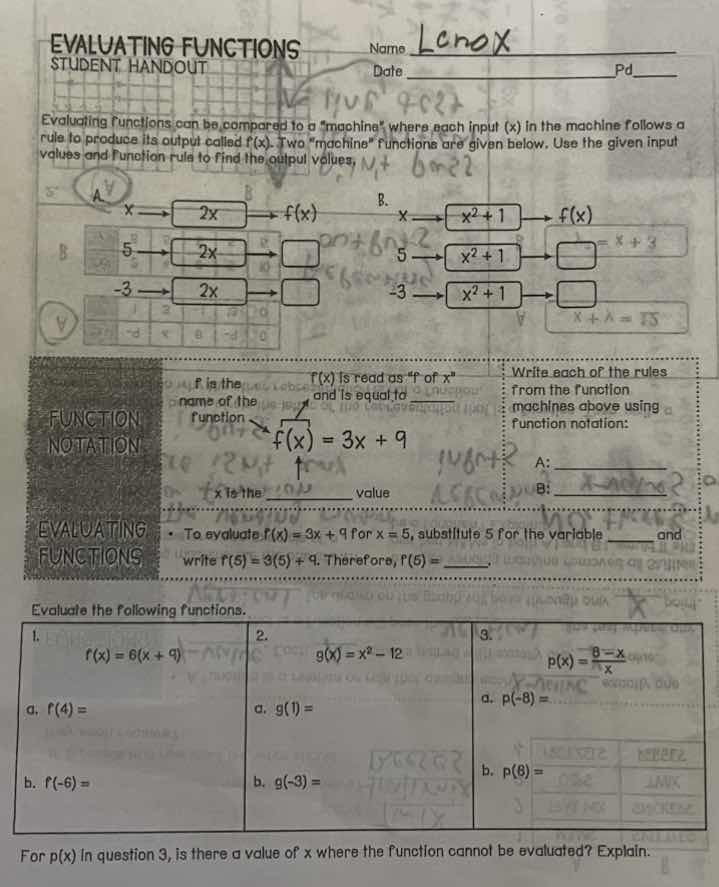
Part A (Function Machines)
Machine A: \( x \to 2x \to f(x) \)
- For \( x = 5 \):
Step1: Substitute \( x = 5 \) into \( 2x \)
\( 2 \times 5 = 10 \)
- For \( x = -3 \):
Step2: Substitute \( x = -3 \) into \( 2x \)
\( 2 \times (-3) = -6 \)
Machine B: \( x \to x^2 + 1 \to f(x) \)
- For \( x = 5 \):
Step1: Substitute \( x = 5 \) into \( x^2 + 1 \)
\( 5^2 + 1 = 25 + 1 = 26 \)
- For \( x = -3 \):
Step2: Substitute \( x = -3 \) into \( x^2 + 1 \)
\( (-3)^2 + 1 = 9 + 1 = 10 \)
Function Notation
- Machine A: \( f(x) = 2x \)
- Machine B: \( f(x) = x^2 + 1 \)
Evaluating \( f(x) = 3x + 9 \) for \( x = 5 \)
Step1: Substitute \( x = 5 \) into \( 3x + 9 \)
\( f(5) = 3(5) + 9 \)
Step2: Calculate the result
\( 3(5) + 9 = 15 + 9 = 24 \)
Evaluating the Given Functions
1. \( f(x) = 6(x + 9) \)
- a. \( f(4) \):
Step1: Substitute \( x = 4 \) into \( 6(x + 9) \)
\( f(4) = 6(4 + 9) \)
Step2: Simplify inside the parentheses
\( 4 + 9 = 13 \)
Step3: Multiply by 6
\( 6 \times 13 = 78 \)
- b. \( f(-6) \):
Step1: Substitute \( x = -6 \) into \( 6(x + 9) \)
\( f(-6) = 6(-6 + 9) \)
Step2: Simplify inside the parentheses
\( -6 + 9 = 3 \)
Step3: Multiply by 6
\( 6 \times 3 = 18 \)
2. \( g(x) = x^2 - 12 \)
- a. \( g(1) \):
Step1: Substitute \( x = 1 \) into \( x^2 - 12 \)
\( g(1) = 1^2 - 12 \)
Step2: Calculate \( 1^2 \)
\( 1^2 = 1 \)
Step3: Subtract 12
\( 1 - 12 = -11 \)
- b. \( g(-3) \):
Step1: Substitute \( x = -3 \) into \( x^2 - 12 \)
\( g(-3) = (-3)^2 - 12 \)
Step2: Calculate \( (-3)^2 \)
\( (-3)^2 = 9 \)
Step3: Subtract 12
\( 9 - 12 = -3 \)
3. \( p(x) = \frac{8 - x}{x} \)
- a. \( p(-8) \):
Step1: Substitute \( x = -8 \) into \( \frac{8 - x}{x} \)
\( p(-8) = \frac{8 - (-8)}{-8} \)
Step2: Simplify the numerator
\( 8 - (-8) = 8 + 8 = 16 \)
Step3: Divide by -8
\( \frac{16}{-8} = -2 \)
- b. \( p(8) \):
Step1: Substitute \( x = 8 \) into \( \frac{8 - x}{x} \)
\( p(8) = \frac{8 - 8}{8} \)
Step2: Simplify the numerator
\( 8 - 8 = 0 \)
Step3: Divide by 8
\( \frac{0}{8} = 0 \)
Function Evaluation Restriction for \( p(x) = \frac{8 - x}{x} \)
A function with a denominator cannot have a denominator of zero (since division by zero is undefined). For \( p(x) = \frac{8 - x}{x} \), the denominator is \( x \). Setting \( x = 0 \) makes the denominator zero, so \( p(x) \) is undefined at \( x = 0 \).

Snap & solve any problem in the app
Get step-by-step solutions on Sovi AI
Photo-based solutions with guided steps
Explore more problems and detailed explanations
Yes, \( x = 0 \) makes the function undefined (division by zero is not allowed).
Final Answers (Key Parts)
- Machine A Outputs: \( 10, -6 \)
- Machine B Outputs: \( 26, 10 \)
- Function Notation: \( \boldsymbol{f(x) = 2x} \) (A), \( \boldsymbol{f(x) = x^2 + 1} \) (B)
- \( f(5) = 24 \)
- 1a. \( \boldsymbol{78} \); 1b. \( \boldsymbol{18} \)
- 2a. \( \boldsymbol{-11} \); 2b. \( \boldsymbol{-3} \)
- 3a. \( \boldsymbol{-2} \); 3b. \( \boldsymbol{0} \)
- Restriction: \( x = 0 \) (function undefined)