QUESTION IMAGE
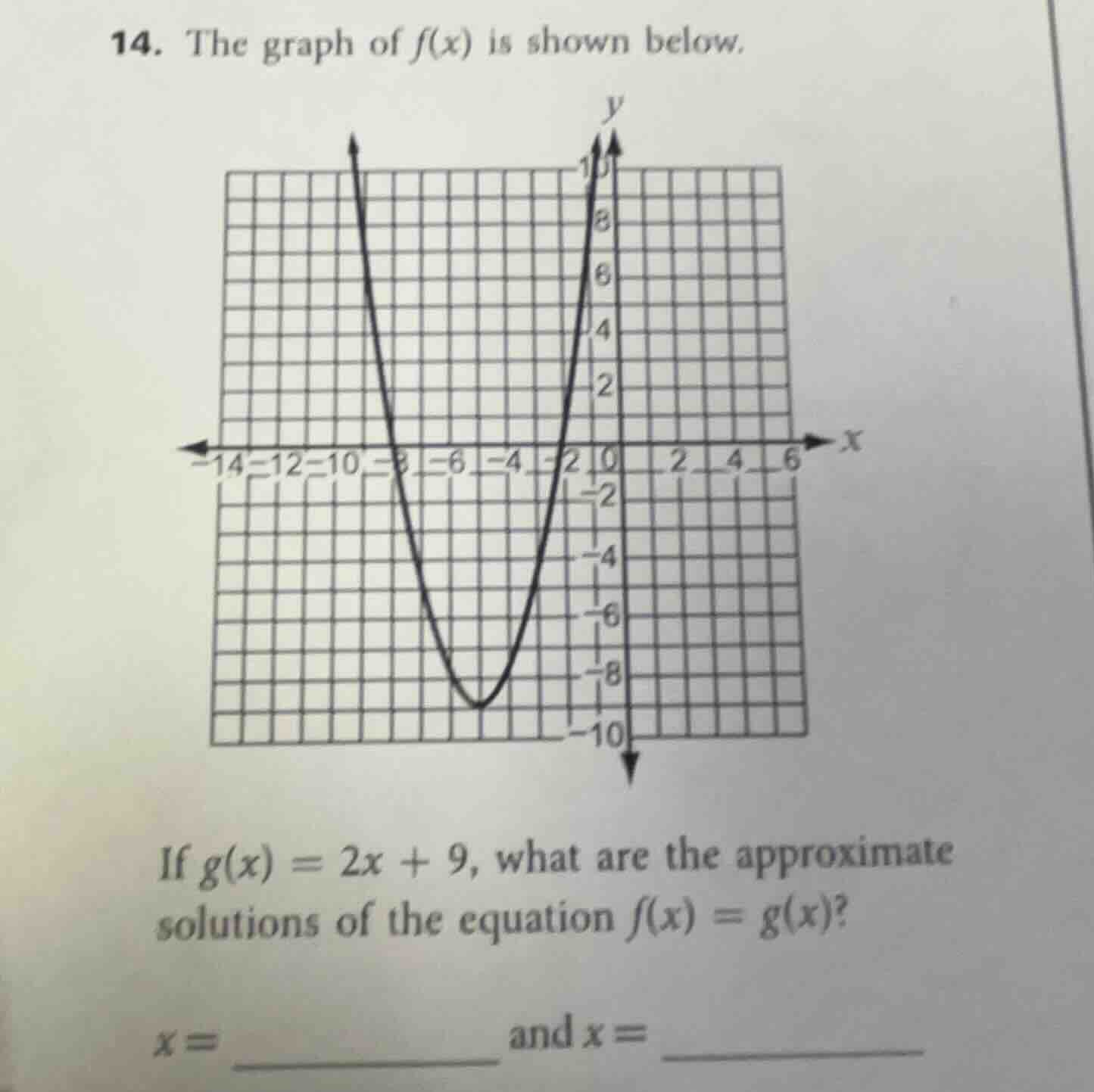
Question
Question was provided via image upload.
Step1: Understand the problem
We need to find the approximate solutions to \( f(x) = g(x) \), which means finding the \( x \)-values where the graph of \( f(x) \) intersects the graph of \( g(x) = 2x + 9 \). First, we can analyze the graph of \( f(x) \) (a parabola) and the line \( g(x) = 2x + 9 \).
Step2: Analyze the graph of \( f(x) \)
From the graph, \( f(x) \) is a parabola opening upwards with roots at \( x = -8 \) and \( x = -2 \) (since it crosses the \( x \)-axis at these points). The vertex of the parabola seems to be at \( (-5, -9) \) approximately (by looking at the grid).
Step3: Analyze the line \( g(x) = 2x + 9 \)
The line \( g(x) = 2x + 9 \) has a slope of 2 and a y-intercept at \( (0, 9) \).
Step4: Find intersection points
To find where \( f(x) = g(x) \), we can either solve the system algebraically or estimate from the graph. Let's estimate from the graph.
First, let's find two points on \( g(x) \):
- When \( x = 0 \), \( g(0) = 9 \)
- When \( x = -2 \), \( g(-2) = 2(-2) + 9 = 5 \)
- When \( x = -4 \), \( g(-4) = 2(-4) + 9 = 1 \)
- When \( x = -5 \), \( g(-5) = 2(-5) + 9 = -1 \)
- When \( x = -8 \), \( g(-8) = 2(-8) + 9 = -7 \)
Now, let's look at the graph of \( f(x) \):
- At \( x = -5 \), \( f(-5) \approx -9 \) (vertex)
- At \( x = -2 \), \( f(-2) = 0 \)
- At \( x = -8 \), \( f(-8) = 0 \)
We need to find where the parabola \( f(x) \) and the line \( g(x) \) intersect. Let's check approximate \( x \)-values:
- Let's check \( x = -5 \): \( g(-5) = -1 \), and from the graph, \( f(-5) \approx -9 \), so not equal.
- Let's check \( x = -2 \): \( g(-2) = 5 \), and \( f(-2) = 0 \), not equal.
- Let's check \( x = -4 \): \( g(-4) = 1 \), and from the graph, \( f(-4) \) is at the vertex? Wait, no, the vertex is at \( x = -5 \). Wait, maybe better to look for intersection points.
Wait, maybe the parabola equation: since it has roots at \( x = -8 \) and \( x = -2 \), the equation of \( f(x) \) can be written as \( f(x) = a(x + 8)(x + 2) \). Using the vertex \( (-5, -9) \) to find \( a \):
\( -9 = a(-5 + 8)(-5 + 2) \)
\( -9 = a(3)(-3) \)
\( -9 = -9a \)
\( a = 1 \)
So \( f(x) = (x + 8)(x + 2) = x^2 + 10x + 16 \)
Now, set \( f(x) = g(x) \):
\( x^2 + 10x + 16 = 2x + 9 \)
Simplify:
\( x^2 + 8x + 7 = 0 \)
Factor:
\( (x + 1)(x + 7) = 0 \)
Wait, that gives roots at \( x = -1 \) and \( x = -7 \). But that contradicts the graph? Wait, maybe my estimation of the vertex was wrong. Wait, let's re-examine the graph.
Wait, the graph of \( f(x) \) in the picture: when \( x = -8 \), it crosses the x-axis, when \( x = -2 \), it crosses the x-axis. So the axis of symmetry is at \( x = \frac{-8 + (-2)}{2} = -5 \), so vertex at \( x = -5 \). Let's plug \( x = -5 \) into \( f(x) \): from the graph, at \( x = -5 \), the y-value is -9 (since it's 9 units below the x-axis). So \( f(-5) = -9 \). Then, using \( f(x) = a(x + 8)(x + 2) \), plug in \( x = -5 \), \( f(-5) = a(3)(-3) = -9a = -9 \), so \( a = 1 \). So \( f(x) = (x + 8)(x + 2) = x^2 + 10x + 16 \). Then, setting \( f(x) = g(x) \):
\( x^2 + 10x + 16 = 2x + 9 \)
\( x^2 + 8x + 7 = 0 \)
\( (x + 1)(x + 7) = 0 \)
So roots at \( x = -1 \) and \( x = -7 \). But let's check with the graph. Wait, maybe the graph in the picture is different. Wait, the graph in the picture: when \( x = 0 \), \( f(0) \) is 8 (since it's at (0,8) on the y-axis). Wait, I made a mistake earlier. Let's re-express \( f(x) \) correctly.
Looking at the graph: when \( x = 0 \), \( f(0) = 8 \) (since it's at (0,8) on the y-axis). When \( x = -2 \), \( f(-2) = 0 \) (crosses x-axis at (-2,0)). When…

Snap & solve any problem in the app
Get step-by-step solutions on Sovi AI
Photo-based solutions with guided steps
Explore more problems and detailed explanations
\( x = -7 \) and \( x = -1 \)