QUESTION IMAGE
Question
Question was provided via image upload.
Step1: Find \( A \cap B \)
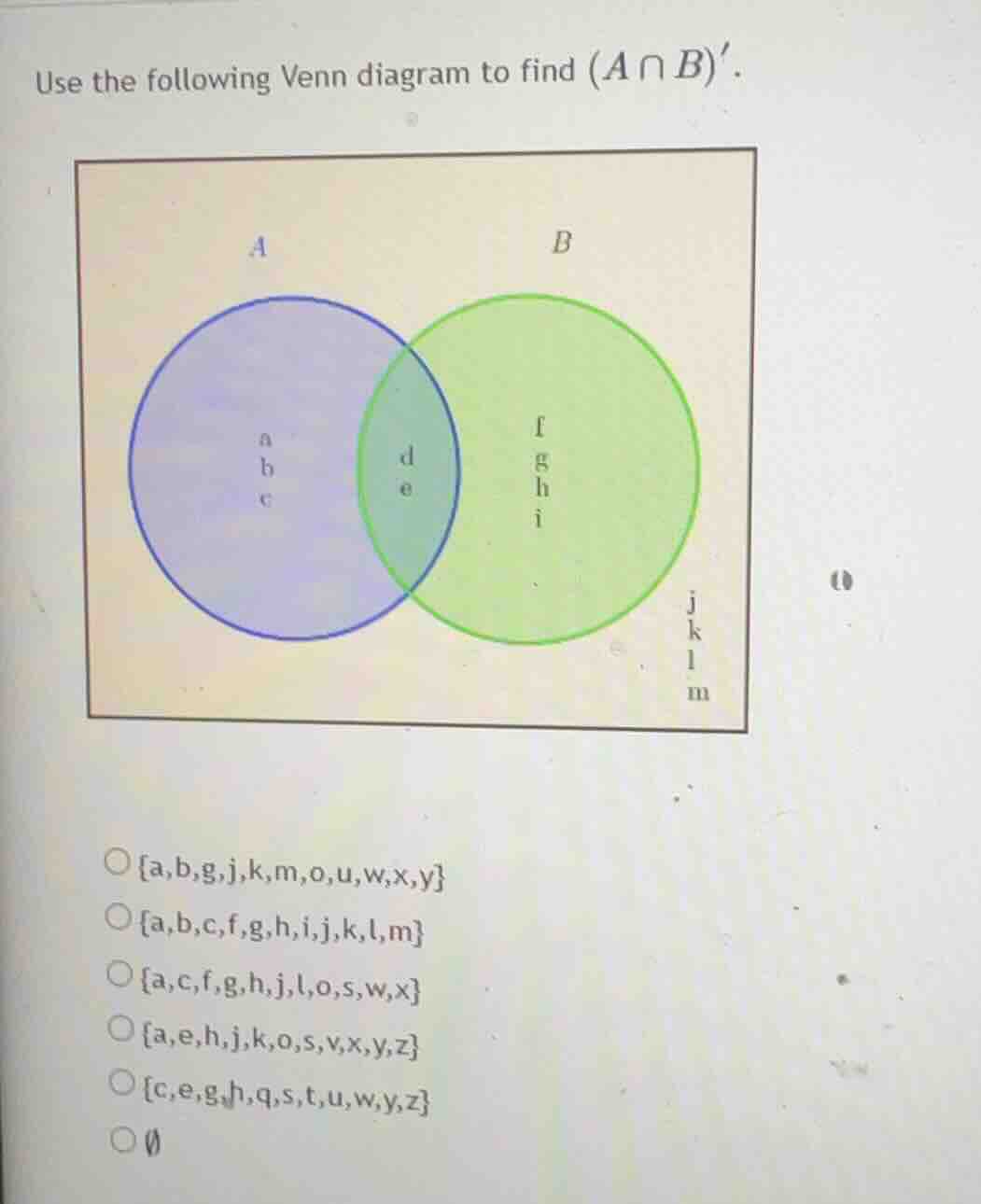
The intersection \( A \cap B \) contains elements common to both \( A \) and \( B \). From the Venn diagram, \( A \cap B = \{d, e\} \).
Step2: Find the complement of \( A \cap B \)
The universal set (the rectangle) contains all elements: \( \{a, b, c, d, e, f, g, h, i, j, k, l, m\} \) (assuming the other options with extra letters are distractors, and we use the elements in the diagram). The complement \( (A \cap B)' \) is all elements not in \( A \cap B \). So we remove \( d, e \) from the universal set. The universal set elements are \( a, b, c, f, g, h, i, j, k, l, m \) (wait, no, let's re - examine the diagram: Circle A has \( a, b, c, d, e \); Circle B has \( d, e, f, g, h, i \); the rectangle (universal set) has all these plus \( j, k, l, m \). So universal set \( U=\{a, b, c, d, e, f, g, h, i, j, k, l, m\} \). \( A\cap B = \{d, e\} \), so \( (A\cap B)'=U - (A\cap B)=\{a, b, c, f, g, h, i, j, k, l, m\} \).

Snap & solve any problem in the app
Get step-by-step solutions on Sovi AI
Photo-based solutions with guided steps
Explore more problems and detailed explanations
\(\{a,b,c,f,g,h,i,j,k,l,m\}\) (matching the second option: \(\{a,b,c,f,g,h,i,j,k,l,m\}\))