QUESTION IMAGE
Question
Question was provided via image upload.
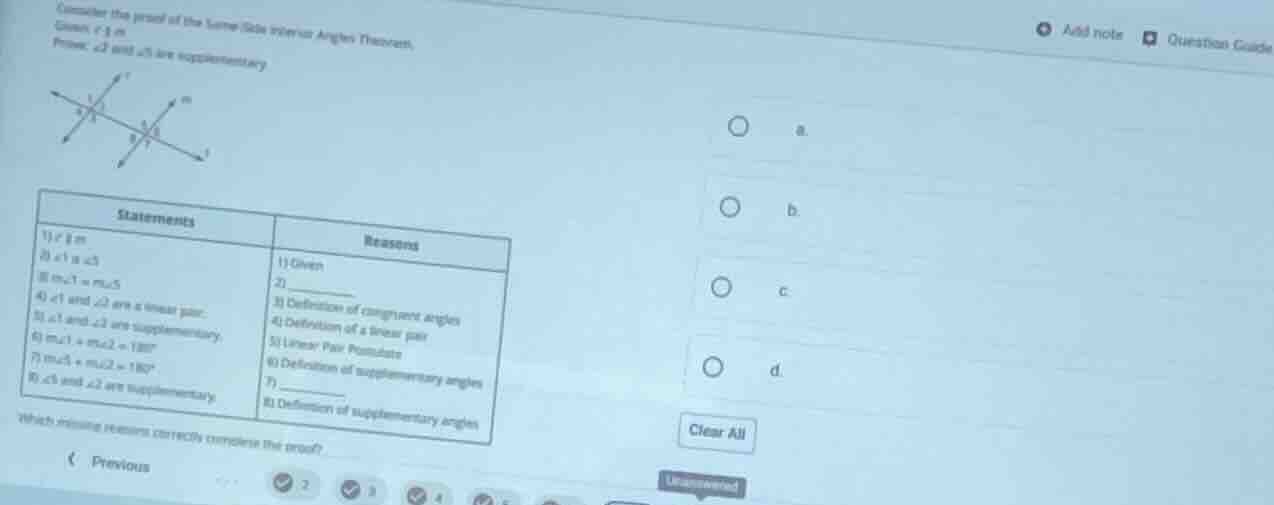
To solve this proof about the Same - Side Interior Angles Theorem, we analyze each missing reason:
Step 1: Reason for Statement 2 ($\angle1\cong\angle5$)
When two parallel lines ($l\parallel m$) are cut by a transversal, the corresponding angles are congruent. This is the Corresponding Angles Postulate. So the reason for $\angle1\cong\angle5$ (Statement 2) is the Corresponding Angles Postulate.
Step 2: Reason for Statement 7 ($m\angle5 + m\angle2=180^{\circ}$)
We know from Statement 3 that $m\angle1 = m\angle5$ (by definition of congruent angles) and from Statement 6 that $m\angle1 + m\angle2=180^{\circ}$. By the Substitution Property (substituting $m\angle1$ with $m\angle5$ in the equation $m\angle1 + m\angle2 = 180^{\circ}$), we get $m\angle5+m\angle2 = 180^{\circ}$.
If we assume the options are related to these two missing reasons:
- For the first missing reason (Statement 2), the correct reason is the Corresponding Angles Postulate.
- For the second missing reason (Statement 7), the correct reason is the Substitution Property.
Since the problem is about a geometry proof (sub - field of Mathematics: Geometry), and we are dealing with angle relationships in parallel lines cut by a transversal.
If we consider the options (even though the options are not fully visible, based on the proof structure):
- The reason for Statement 2 is the Corresponding Angles Postulate.
- The reason for Statement 7 is the Substitution Property.
Assuming the options are labeled as per the proof steps:
- For the first blank (Statement 2's reason), if the options include "Corresponding Angles Postulate", that is the answer.
- For the second blank (Statement 7's reason), if the options include "Substitution Property", that is the answer.
If we have to choose from the given (partial) options and assume the first missing reason (Statement 2) and second (Statement 7):
If the options are like:
a. Corresponding Angles Postulate
b. Some other postulate
c. Substitution Property
d. Some other property
Then for the first missing reason (Statement 2), the answer is a. Corresponding Angles Postulate and for the second (Statement 7), the answer is c. Substitution Property.
(Note: Since the options are not fully visible, this is based on the standard proof of Same - Side Interior Angles Theorem. The Same - Side Interior Angles Theorem states that if two parallel lines are cut by a transversal, then each pair of same - side interior angles are supplementary. The proof involves corresponding angles, linear pair postulate, and substitution property.)

Snap & solve any problem in the app
Get step-by-step solutions on Sovi AI
Photo-based solutions with guided steps
Explore more problems and detailed explanations
To solve this proof about the Same - Side Interior Angles Theorem, we analyze each missing reason:
Step 1: Reason for Statement 2 ($\angle1\cong\angle5$)
When two parallel lines ($l\parallel m$) are cut by a transversal, the corresponding angles are congruent. This is the Corresponding Angles Postulate. So the reason for $\angle1\cong\angle5$ (Statement 2) is the Corresponding Angles Postulate.
Step 2: Reason for Statement 7 ($m\angle5 + m\angle2=180^{\circ}$)
We know from Statement 3 that $m\angle1 = m\angle5$ (by definition of congruent angles) and from Statement 6 that $m\angle1 + m\angle2=180^{\circ}$. By the Substitution Property (substituting $m\angle1$ with $m\angle5$ in the equation $m\angle1 + m\angle2 = 180^{\circ}$), we get $m\angle5+m\angle2 = 180^{\circ}$.
If we assume the options are related to these two missing reasons:
- For the first missing reason (Statement 2), the correct reason is the Corresponding Angles Postulate.
- For the second missing reason (Statement 7), the correct reason is the Substitution Property.
Since the problem is about a geometry proof (sub - field of Mathematics: Geometry), and we are dealing with angle relationships in parallel lines cut by a transversal.
If we consider the options (even though the options are not fully visible, based on the proof structure):
- The reason for Statement 2 is the Corresponding Angles Postulate.
- The reason for Statement 7 is the Substitution Property.
Assuming the options are labeled as per the proof steps:
- For the first blank (Statement 2's reason), if the options include "Corresponding Angles Postulate", that is the answer.
- For the second blank (Statement 7's reason), if the options include "Substitution Property", that is the answer.
If we have to choose from the given (partial) options and assume the first missing reason (Statement 2) and second (Statement 7):
If the options are like:
a. Corresponding Angles Postulate
b. Some other postulate
c. Substitution Property
d. Some other property
Then for the first missing reason (Statement 2), the answer is a. Corresponding Angles Postulate and for the second (Statement 7), the answer is c. Substitution Property.
(Note: Since the options are not fully visible, this is based on the standard proof of Same - Side Interior Angles Theorem. The Same - Side Interior Angles Theorem states that if two parallel lines are cut by a transversal, then each pair of same - side interior angles are supplementary. The proof involves corresponding angles, linear pair postulate, and substitution property.)