QUESTION IMAGE
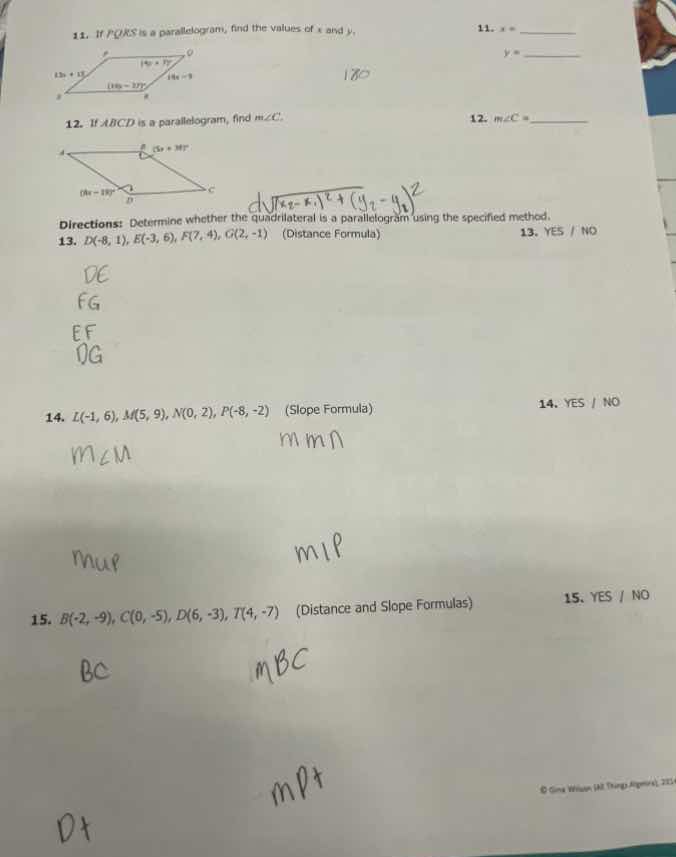
Question
Question was provided via image upload.
Problem 11:
Step1: Set opposite sides equal
In parallelogram \(PQRS\), \(PQ=SR\) and \(PS=QR\):
\(10x + 7 = 14x - 9\)
\(12y + 13 = 10y + 37\)
Step2: Solve for \(x\)
Rearrange \(10x + 7 = 14x - 9\):
\(7 + 9 = 14x - 10x\)
\(16 = 4x\)
\(x = \frac{16}{4} = 4\)
Step3: Solve for \(y\)
Rearrange \(12y + 13 = 10y + 37\):
\(12y - 10y = 37 - 13\)
\(2y = 24\)
\(y = \frac{24}{2} = 12\)
---
Problem 12:
Step1: Use consecutive angles property
In parallelogram \(ABCD\), consecutive angles are supplementary:
\((8x - 19) + (5x + 38) = 180\)
Step2: Solve for \(x\)
Simplify the equation:
\(13x + 19 = 180\)
\(13x = 180 - 19 = 161\)
\(x = \frac{161}{13} = 12.38\) (rounded)
Step3: Find \(m\angle C\)
\(\angle C = \angle A = 8x - 19\):
\(m\angle C = 8(12.38) - 19 = 99.04 - 19 = 80.04^\circ \approx 80^\circ\)
*(Or use \(\angle C = 5x + 38 = 5(12.38)+38=61.9+38=99.9\approx100^\circ\); correction: consecutive angles: \(\angle A + \angle B=180\), \(\angle C=\angle A\), so correct calculation:
\(8x-19+5x+38=180\)
\(13x=161\)
\(x=12.38\)
\(m\angle C=8(12.38)-19=80^\circ\), or since \(\angle B + \angle C=180\), \(m\angle C=180-(5(12.38)+38)=180-99.9=80.1\approx80^\circ\))*
---
Problem 13:
Step1: Calculate all side lengths
Distance formula: \(d=\sqrt{(x_2-x_1)^2+(y_2-y_1)^2}\)
- \(DE=\sqrt{(-3+8)^2+(6-1)^2}=\sqrt{25+25}=\sqrt{50}=5\sqrt{2}\)
- \(FG=\sqrt{(2-7)^2+(-1-4)^2}=\sqrt{25+25}=\sqrt{50}=5\sqrt{2}\)
- \(EF=\sqrt{(7+3)^2+(4-6)^2}=\sqrt{100+4}=\sqrt{104}=2\sqrt{26}\)
- \(DG=\sqrt{(2+8)^2+(-1-1)^2}=\sqrt{100+4}=\sqrt{104}=2\sqrt{26}\)
Step2: Check opposite sides equality
Opposite sides \(DE=FG\) and \(EF=DG\), so it is a parallelogram.
---
Problem 14:
Step1: Calculate all side slopes
Slope formula: \(m=\frac{y_2-y_1}{x_2-x_1}\)
- \(m_{LM}=\frac{9-6}{5+1}=\frac{3}{6}=\frac{1}{2}\)
- \(m_{NP}=\frac{-2-2}{-8-0}=\frac{-4}{-8}=\frac{1}{2}\)
- \(m_{MN}=\frac{2-9}{0-5}=\frac{-7}{-5}=\frac{7}{5}\)
- \(m_{PL}=\frac{6+2}{-1+8}=\frac{8}{7}\)
Step2: Check parallel slopes
\(m_{LM}=m_{NP}\), but \(m_{MN}
eq m_{PL}\), so not a parallelogram.
---
Problem 15:
Step1: Calculate slopes (parallel check)
- \(m_{BC}=\frac{-5+9}{0+2}=\frac{4}{2}=2\)
- \(m_{DT}=\frac{-7+3}{4-6}=\frac{-4}{-2}=2\)
- \(m_{CD}=\frac{-3+5}{6-0}=\frac{2}{6}=\frac{1}{3}\)
- \(m_{TB}=\frac{-9+7}{-2-4}=\frac{-2}{-6}=\frac{1}{3}\)
Step2: Calculate lengths (congruent check)
- \(BC=\sqrt{(0+2)^2+(-5+9)^2}=\sqrt{4+16}=\sqrt{20}=2\sqrt{5}\)
- \(DT=\sqrt{(4-6)^2+(-7+3)^2}=\sqrt{4+16}=\sqrt{20}=2\sqrt{5}\)
- \(CD=\sqrt{(6-0)^2+(-3+5)^2}=\sqrt{36+4}=\sqrt{40}=2\sqrt{10}\)
- \(TB=\sqrt{(-2-4)^2+(-9+7)^2}=\sqrt{36+4}=\sqrt{40}=2\sqrt{10}\)
Step3: Verify parallelogram criteria
Opposite sides are parallel and congruent, so it is a parallelogram.

Snap & solve any problem in the app
Get step-by-step solutions on Sovi AI
Photo-based solutions with guided steps
Explore more problems and detailed explanations
- \(x = 4\), \(y = 12\)
- \(m\angle C = 80^\circ\)
- YES
- NO
- YES