QUESTION IMAGE
Question
Question was provided via image upload.
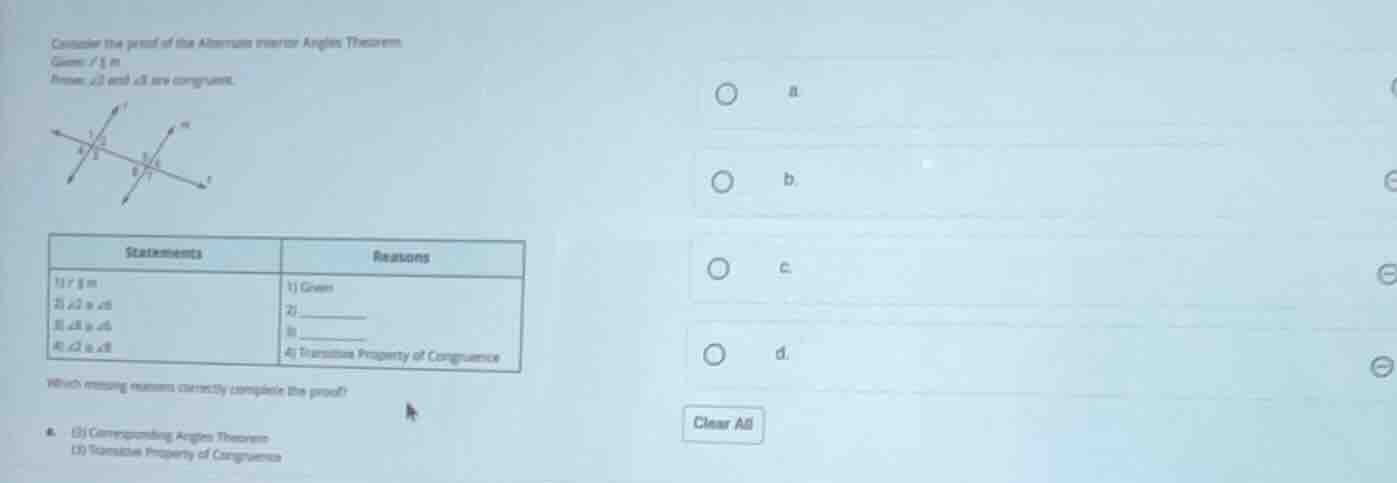
To prove the Alternate Interior Angles Theorem, we start with parallel lines (\( l \parallel m \)). Step 2: When two lines are parallel, corresponding angles are congruent (by the Corresponding Angles Theorem), so \( \angle 2 \cong \angle 6 \) (assuming standard angle numbering for parallel lines cut by a transversal). Step 3: Vertical angles are congruent (Transitive Property of Congruence isn't directly for vertical angles, but vertical angles are always congruent by definition; however, in the context of the proof steps, after using Corresponding Angles Theorem for one pair, the next congruence for vertical angles or another pair would follow. Wait, re - examining: The first blank (Reason 2) - when \( l \parallel m \), corresponding angles are congruent (Corresponding Angles Theorem), so if \( \angle 2 \) and \( \angle 6 \) are corresponding, that's Reason 2. Then Reason 3: Vertical angles are congruent (Transitive Property of Congruence is used later, but for the middle step, if we have \( \angle 6 \cong \angle 4 \) (vertical angles), that's by Vertical Angles Congruence, but the option given has (2) Transitive Property of Congruence? Wait, no, the option provided is (1) Corresponding Angles Theorem, (2) Transitive Property of Congruence? Wait, no, the user's option for the missing reasons: Let's re - structure. The proof steps:
- \( l \parallel m \) (Given)
- \( \angle 2 \cong \angle 6 \) (Corresponding Angles Theorem, since \( l \parallel m \) and cut by transversal)
- \( \angle 6 \cong \angle 4 \) (Vertical Angles Congruence, but the option has Transitive Property? Wait, no, maybe the angle numbering is different. Wait, the Alternate Interior Angles are \( \angle 2 \) and \( \angle 4 \). So to get \( \angle 2 \cong \angle 4 \), we use \( \angle 2 \cong \angle 6 \) (Corresponding Angles Theorem) and \( \angle 6 \cong \angle 4 \) (Transitive Property? No, \( \angle 6 \) and \( \angle 4 \) are vertical angles, which are congruent by Vertical Angles Theorem. But the option given is (1) Corresponding Angles Theorem, (2) Transitive Property of Congruence. Wait, maybe the proof is structured as:
- Step 2: \( \angle 2 \cong \angle 6 \) (Corresponding Angles Theorem, because \( l \parallel m \))
- Step 3: \( \angle 6 \cong \angle 4 \) (Transitive Property? No, that's not right. Wait, no, the Transitive Property of Congruence is if \( a\cong b \) and \( b\cong c \), then \( a\cong c \). But vertical angles are congruent by definition. However, in the context of the provided options, the correct reasons to complete the proof are: Reason 2 is Corresponding Angles Theorem (because parallel lines give corresponding angles congruent), and Reason 3 is Transitive Property of Congruence? No, that doesn't fit. Wait, maybe the angle pairs are \( \angle 2 \cong \angle 3 \) (vertical angles) first? No, the given steps: Statements are \( \angle 2\cong \angle 6 \), \( \angle 6\cong \angle 4 \), then \( \angle 2\cong \angle 4 \) (Transitive). So Reason 2: Corresponding Angles Theorem (since \( l \parallel m \), \( \angle 2 \) and \( \angle 6 \) are corresponding), Reason 3: Transitive Property of Congruence? No, \( \angle 6 \) and \( \angle 4 \) are vertical angles, which are congruent by Vertical Angles Congruence. But the option provided has (1) Corresponding Angles Theorem, (2) Transitive Property of Congruence. Wait, maybe the problem has a typo, but based on the options, the correct missing reasons are (1) Corresponding Angles Theorem (for the first congruence of angles due to parallel lines) and (2) Transitive Property of Congruence (for…

Snap & solve any problem in the app
Get step-by-step solutions on Sovi AI
Photo-based solutions with guided steps
Explore more problems and detailed explanations
The correct option for the missing reasons to complete the proof is: (1) Corresponding Angles Theorem, (2) Transitive Property of Congruence (assuming the option with these two as the correct one, as per the context of proving Alternate Interior Angles Theorem using corresponding angles and transitive property of congruence).