QUESTION IMAGE
Question
Question was provided via image upload.
Step1: Identify the coordinates of the points
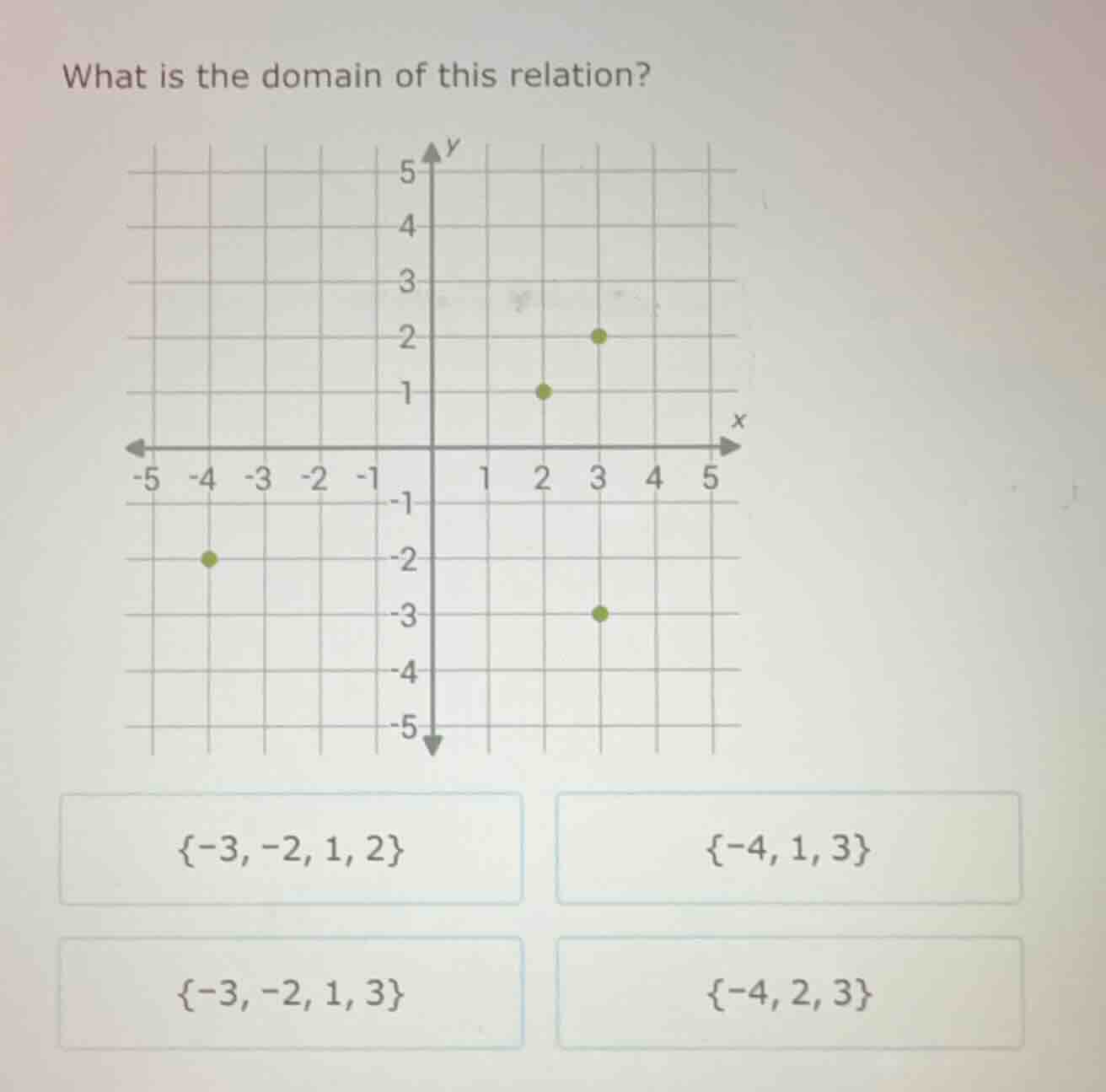
First, we find the coordinates of each green dot on the graph. The points are: \((-4, -2)\), \((2, 1)\), \((3, 2)\), \((3, -3)\). Wait, no, let's re - examine the graph. Wait, looking at the grid:
- The left - most point: x - coordinate is - 4, y - coordinate is - 2.
- Then, the point at x = 2, y = 1.
- Then, the point at x = 3, y = 2.
- Then, the point at x = 3, y = - 3. Wait, maybe I misread. Let's list the x - coordinates of each point.
Looking at the graph:
- One point is at \(x=-4\) (since it's above - 4 on the x - axis).
- One point is at \(x = 2\) (above x = 2).
- One point is at \(x=3\) (above x = 3). Wait, no, maybe I made a mistake. Wait, let's check again. The points:
First point: x=-4, y=-2.
Second point: x = 2, y = 1.
Third point: x = 3, y = 2.
Fourth point: x = 3, y=-3. Wait, but the x - coordinates of the points are the x - values of each ordered pair \((x,y)\) in the relation. The domain is the set of all x - values.
Wait, maybe I misidentified the points. Let's look at the graph again. The green dots:
- At x=-4, y=-2 (so x=-4)
- At x = 2, y = 1 (so x = 2? No, wait the x - axis: from left to right, the x - coordinates. Wait, the grid lines: the x - axis has marks at - 5,-4,-3,-2,-1,0,1,2,3,4,5.
Looking at the graph:
- One dot is at x=-4 (since it's on the vertical line x=-4)
- One dot is at x = 2 (vertical line x = 2)
- One dot is at x = 3 (vertical line x = 3)
Wait, no, maybe the options are different. Wait the options are:
- \(\{-3, - 2,1,2\}\)
- \(\{-4,1,3\}\) – no, 1 is not an x - coordinate here. Wait, maybe I misread the points. Wait, maybe the points are:
Wait, the y - axis is vertical. Let's list the ordered pairs:
- First point: (-4, - 2) → x=-4
- Second point: (2, 1) → x = 2? No, wait the x - coordinate for the second point: looking at the x - axis, the point is above x = 2? Wait, no, the x - axis is horizontal. The vertical lines are x=-5,-4,-3,-2,-1,0,1,2,3,4,5. So the x - coordinate of a point is the number on the x - axis directly below (or above) the point.
So:
- Point 1: x=-4 (since it's on the vertical line x=-4)
- Point 2: x = 2 (vertical line x = 2)
- Point 3: x = 3 (vertical line x = 3)
Wait, but the options have \(\{-4,2,3\}\) as one of them? Wait the last option is \(\{-4,2,3\}\)? Wait no, the last option is \(\{-4,2,3\}\)? Wait the options are:
First row: \(\{-3, - 2,1,2\}\) and \(\{-4,1,3\}\)
Second row: \(\{-3, - 2,1,3\}\) and \(\{-4,2,3\}\)
Ah, I see. So the points:
- One point at x=-4 (x - coordinate - 4)
- One point at x = 2? No, wait maybe the points are:
Wait, the y - value 2 is at x = 3? Wait, the green dot at (3,2) (x = 3, y = 2)
The green dot at (2,1) (x = 2, y = 1)
The green dot at (-4,-2) (x=-4, y=-2)
The green dot at (3,-3) (x = 3, y=-3)
So the x - coordinates are - 4, 2, 3? No, wait 2 and 3? Wait no, the x - coordinates are - 4, 2, 3? Wait no, the point at (2,1) has x = 2, the point at (3,2) has x = 3, the point at (-4,-2) has x=-4, and the point at (3,-3) has x = 3. Wait, but the domain is the set of all x - values, so we take unique x - values. So x=-4, x = 2, x = 3? But that's not matching the options. Wait, maybe I misread the x - coordinates. Let's check the options again. The last option is \(\{-4,2,3\}\)? Wait no, the last option is \(\{-4,2,3\}\)? Wait the options are:
First option: \(\{-3, - 2,1,2\}\)
Second: \(\{-4,1,3\}\)
Third: \(\{-3, - 2,1,3\}\)
Fourth: \(\{-4,2,3\}\)
Ah, maybe the points are:
- At x=-4 (correct)
- At x = 2 (y = 1? No, maybe the point at x = 2 has y = 1, x = 3 has y = 2, and x = 3 has y=-3, and x=-4 h…

Snap & solve any problem in the app
Get step-by-step solutions on Sovi AI
Photo-based solutions with guided steps
Explore more problems and detailed explanations
\(\{-4,2,3\}\) (the fourth option, i.e., \(\{-4,2,3\}\))