QUESTION IMAGE
Question
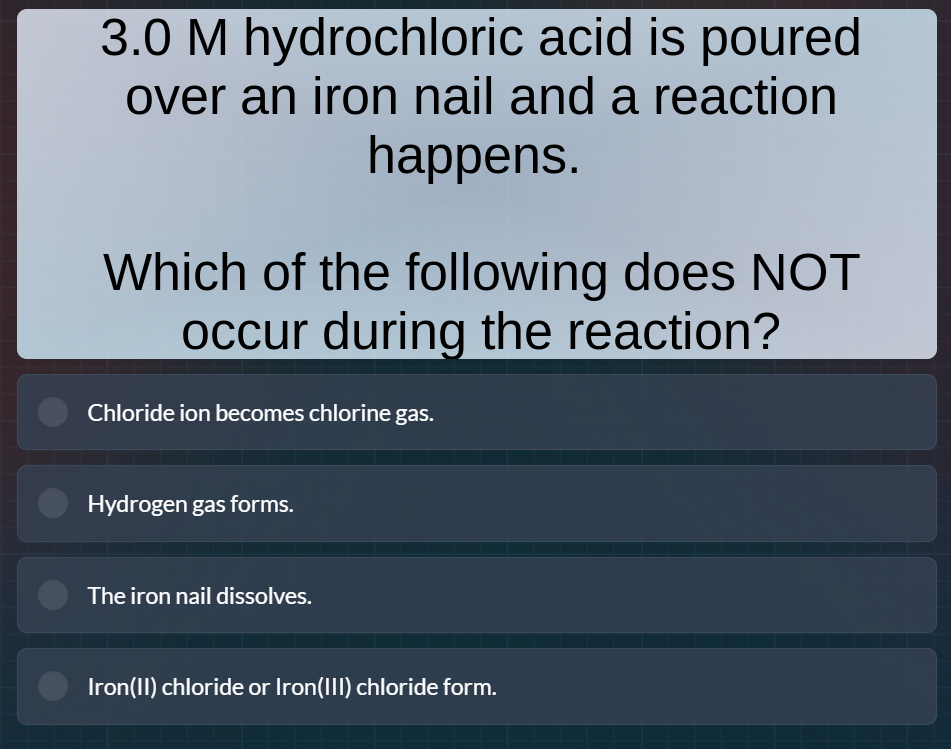
3.0 m hydrochloric acid is poured over an iron nail and a reaction happens. which of the following does not occur during the reaction? chloride ion becomes chlorine gas. hydrogen gas forms. the iron nail dissolves. iron(ii) chloride or iron(iii) chloride form.
The reaction between iron (Fe) and hydrochloric acid (HCl) is a single - displacement reaction. The chemical equation for the reaction is either $\ce{Fe + 2HCl -> FeCl_{2} + H_{2}\uparrow}$ (forming iron(II) chloride) or $\ce{2Fe + 6HCl -> 2FeCl_{3} + 3H_{2}\uparrow}$ (forming iron(III) chloride in the presence of excess acid or certain conditions). In this reaction:
- Hydrogen gas ($\ce{H_{2}}$) is produced as seen in the equations.
- The iron nail (Fe) reacts and dissolves as it is consumed in the reaction to form iron chlorides.
- Iron(II) chloride or iron(III) chloride are the products of the reaction.
- Chloride ions ($\ce{Cl^{-}}$) in HCl do not get oxidized to chlorine gas ($\ce{Cl_{2}}$) because iron is a stronger reducing agent than chloride ions, and the reaction involves the oxidation of Fe and reduction of $\ce{H^{+}}$ (from HCl) to $\ce{H_{2}}$, not the oxidation of $\ce{Cl^{-}}$.

Snap & solve any problem in the app
Get step-by-step solutions on Sovi AI
Photo-based solutions with guided steps
Explore more problems and detailed explanations
A. Chloride ion becomes chlorine gas.