QUESTION IMAGE
Question
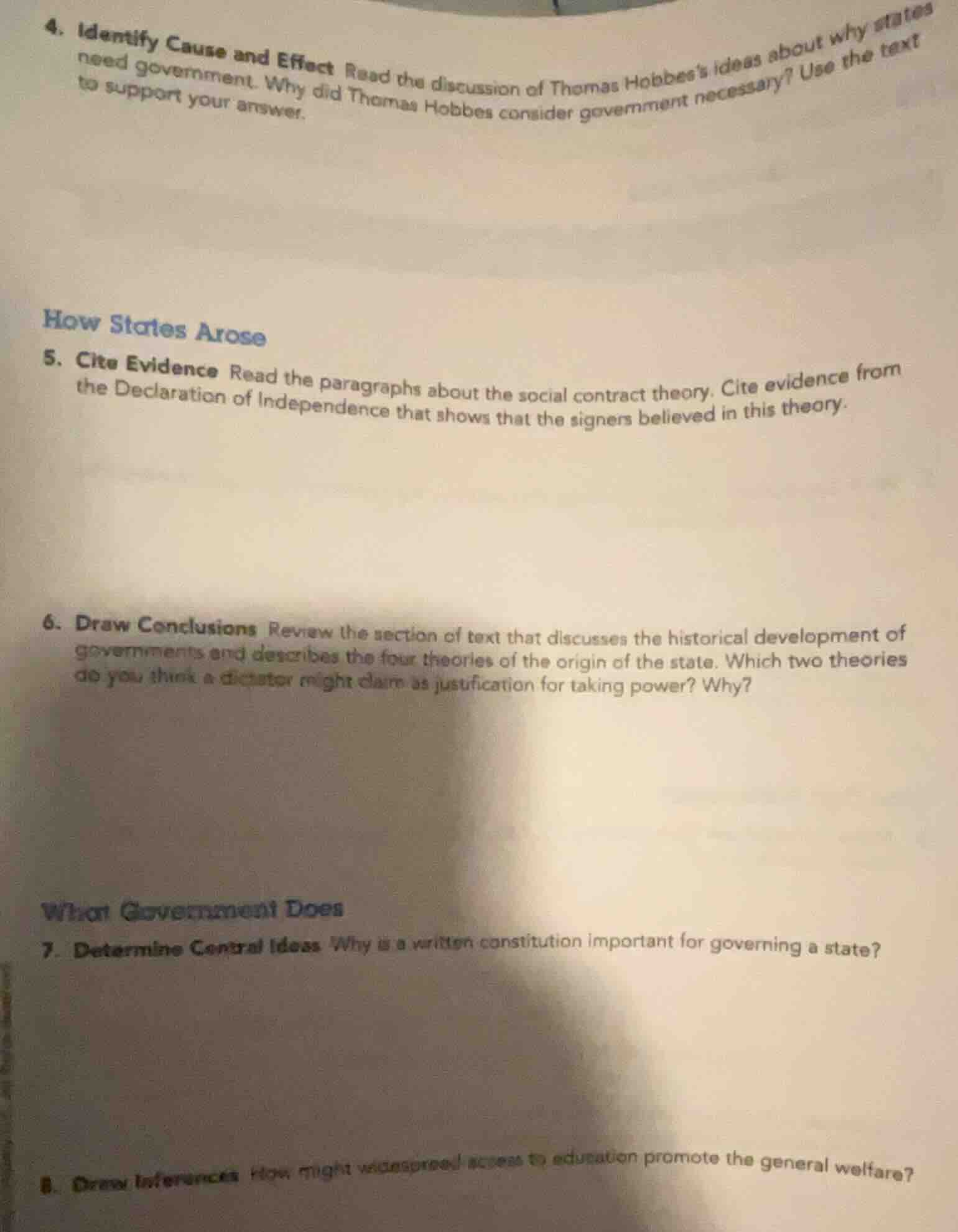
- identify cause and effect read the discussion of thomas hobbes’s ideas about why states need government. why did thomas hobbes consider government necessary? use the text to support your answer.
how states arose
- cite evidence read the paragraphs about the social contract theory. cite evidence from the declaration of independence that shows that the signers believed in this theory.
- draw conclusions review the section of text that discusses the historical development of governments and describes the four theories of the origin of the state. which two theories do you think a dictator might claim as justification for taking power? why?
what government does
- determine central ideas why is a written constitution important for governing a state?
- draw inferences how might widespread access to education promote the general welfare?
For Question 4:
Thomas Hobbes argued that in the "state of nature" (pre-government society), life was "solitary, poor, nasty, brutish, and short" because humans acted in their own self-interest, leading to constant conflict. He believed government (a single absolute authority, a leviathan) was necessary to enforce order, protect people from each other, and ensure stability by controlling humanity's inherent selfish and violent tendencies.
For Question 5:
The Declaration of Independence includes the line: "Governments are instituted among Men, deriving their just powers from the consent of the governed". This directly reflects social contract theory, which holds that governments are formed by an agreement (contract) between people, who give up some freedoms in exchange for protection and order, and rulers only have legitimate power if the people agree to their rule.
For Question 6:
- Force Theory: A dictator could claim they seized power through force to end chaos or unify a divided group, framing their violent takeover as necessary to establish order, which aligns with the force theory's core idea that states originate from conquest/coercion.
- Divine Right Theory: A dictator could claim they have a divine or sacred right to rule (e.g., being chosen by a god or higher power), which historically was used to justify absolute rule by framing their authority as unchallengeable and ordained, not from the people.
For Question 7:
A written constitution is important because:
- It sets clear, formal rules for how the government operates, defining the powers and limits of each branch to prevent abuse of authority.
- It protects the rights and freedoms of citizens by enshrining them in a permanent, accessible document that the government must follow.
- It provides a stable, consistent framework for governance, reducing uncertainty and creating a shared legal foundation for the state.
For Question 8:
Widespread access to education promotes general welfare by:
- Equipping people with skills to secure stable, higher-paying jobs, reducing poverty and improving economic security for individuals and communities.
- Fostering informed citizens who can participate in democratic processes, hold leaders accountable, and make decisions that benefit society.
- Improving public health outcomes, as educated people are more likely to understand and adopt healthy behaviors, reducing healthcare burdens on communities.
- Reducing inequality by creating equal opportunities for advancement regardless of background.

Snap & solve any problem in the app
Get step-by-step solutions on Sovi AI
Photo-based solutions with guided steps
Explore more problems and detailed explanations
- Question 4: Thomas Hobbes believed government was necessary to escape the violent, chaotic "state of nature" where self-interested humans constantly conflicted; an absolute government (leviathan) would enforce order and protect people from harm.
- Question 5: The line "Governments are instituted among Men, deriving their just powers from the consent of the governed" from the Declaration of Independence reflects social contract theory, as it states rulers' power comes from the people's agreement, a core tenet of the theory.
- Question 6:
- Force Theory: A dictator could claim they used force to end chaos, framing their takeover as necessary to establish order, matching the theory's origin of states via coercion.
- Divine Right Theory: A dictator could claim divine ordination, framing their rule as sacred and unchallengeable, a historical justification for absolute power.
- Question 7: A written constitution sets clear government rules, protects citizen rights, and provides a stable, consistent legal framework to prevent abuse of power and ensure fair governance.
- Question 8: It boosts economic security via job skills, creates informed democratic citizens, improves public health, and reduces inequality, all of which lift overall community well-being.