QUESTION IMAGE
Question
i can identify functions as linear or non - linear.
- classify each of the following equations as linear or non - linear
a. $y = 15x$ b. $y=\frac{15}{x}$ c. $y = 15x^{2}$ d. $y=\frac{1}{15}x + 15$
i can determine rate of change and initial values from ordered pairs.
write the equation in slope - intercept form: given the slope and a point or given two points.
- $m=-2,(7,4)$
- $m = \frac{2}{5},(6,1)$
- $m=-6,(-2,16)$
- $(-4,6)$ and $(5,7)$
- $(2,21)$ and $(6,45)$
- $(5,-18)$ and $(10,-28)$
i can determine rate of change and initial values from tables and graphs.
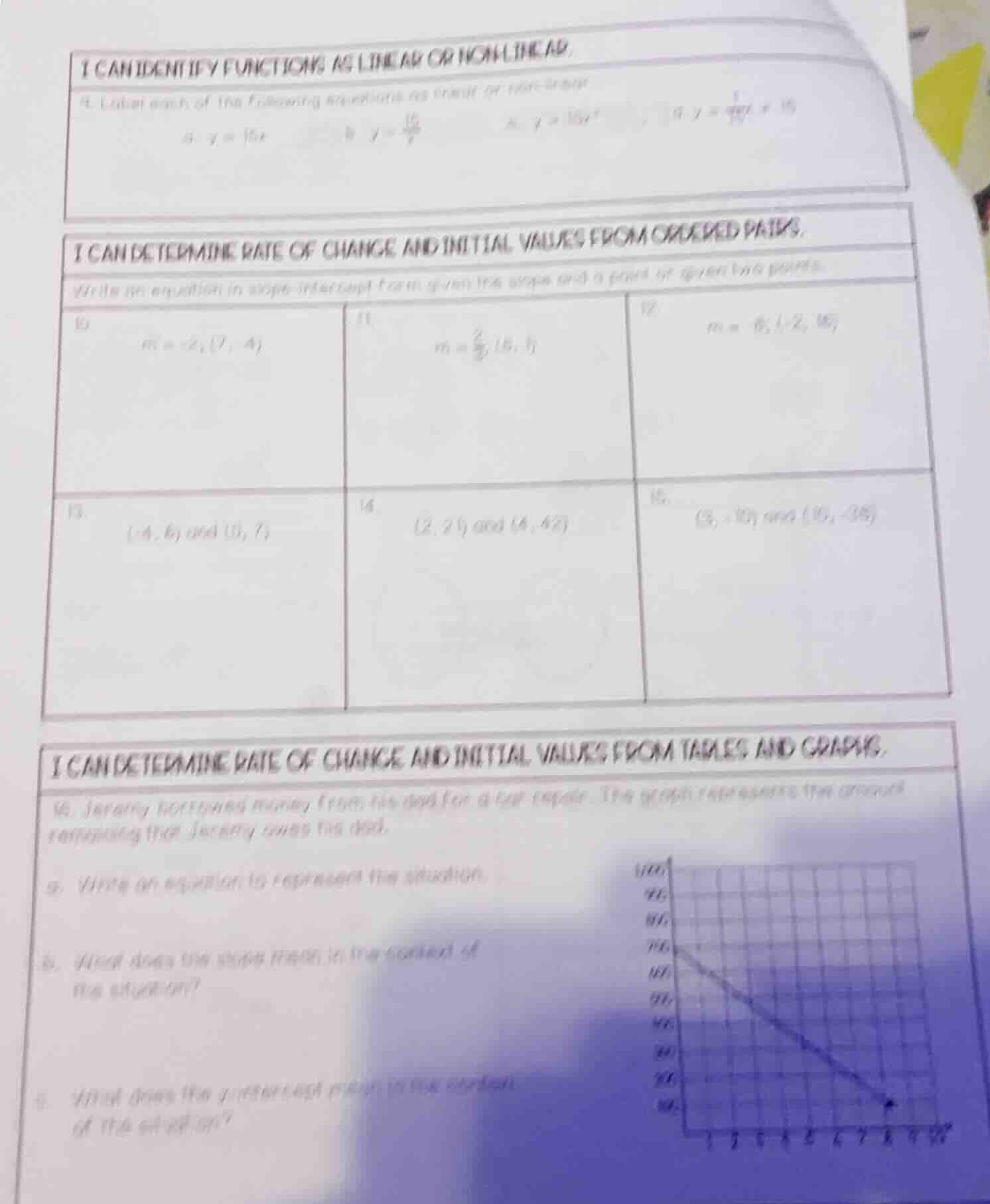
- jeremy borrowed money from his dad for a car repair. the graph represents the amount remaining that jeremy owes his dad.
a. write an equation to represent the situation.
b. how much does jeremy pay his dad each week?
c. what does the y - intercept represent in this situation?
First Section: Identify Linear/Non-Linear Functions
Step1: Recall linear function form
A linear function has the form $y=mx+b$ (degree 1 for $x$). Non-linear has $x$ with degree ≠1 or $x$ in denominator.
Step2: Classify each equation
a. $y=15x$: $x$ degree 1 → Linear
b. $y=\frac{10}{x}$: $x$ in denominator → Non-linear
c. $y=15x^2$: $x$ degree 2 → Non-linear
d. $y=\frac{1}{22}x + 16$: $x$ degree 1 → Linear
For problems 10-12 (slope + point):
Step1: Use point-slope formula
Point-slope: $y-y_1=m(x-x_1)$
Step2: Rearrange to $y=mx+b$
Simplify to solve for $y$.
Problem 10: $m=-2, (7,-4)$
Step1: Substitute into point-slope
$y-(-4)=-2(x-7)$
Step2: Simplify to slope-intercept
$y+4=-2x+14$ → $y=-2x+10$
Problem 11: $m=\frac{2}{3}, (6,1)$
Step1: Substitute into point-slope
$y-1=\frac{2}{3}(x-6)$
Step2: Simplify to slope-intercept
$y-1=\frac{2}{3}x-4$ → $y=\frac{2}{3}x-3$
Problem 12: $m=-8, (-2,16)$
Step1: Substitute into point-slope
$y-16=-8(x-(-2))$
Step2: Simplify to slope-intercept
$y-16=-8x-16$ → $y=-8x$
---
For problems 13-15 (two points):
Step1: Calculate slope $m$
$m=\frac{y_2-y_1}{x_2-x_1}$
Step2: Use point-slope then simplify
Substitute $m$ and one point to find $y=mx+b$.
Problem13: $(-4,6)$ and $(1,7)$
Step1: Calculate slope
$m=\frac{7-6}{1-(-4)}=\frac{1}{5}$
Step2: Substitute point $(1,7)$
$y-7=\frac{1}{5}(x-1)$ → $y=\frac{1}{5}x+\frac{34}{5}$
Problem14: $(2,21)$ and $(4,42)$
Step1: Calculate slope
$m=\frac{42-21}{4-2}=\frac{21}{2}$
Step2: Substitute point $(2,21)$
$y-21=\frac{21}{2}(x-2)$ → $y=\frac{21}{2}x$
Problem15: $(3,-10)$ and $(10,-38)$
Step1: Calculate slope
$m=\frac{-38-(-10)}{10-3}=\frac{-28}{7}=-4$
Step2: Substitute point $(3,-10)$
$y-(-10)=-4(x-3)$ → $y+10=-4x+12$ → $y=-4x+2$
Part a: Write the equation
Step1: Identify intercepts
y-intercept $(0,700)$, point $(8,100)$
Step2: Calculate slope
$m=\frac{100-700}{8-0}=\frac{-600}{8}=-75$
Step3: Write slope-intercept form
$y=-75x+700$
Part b: Interpret slope
Slope = rate of change of owed money over time.
Part c: Interpret y-intercept
y-intercept = initial amount owed at $x=0$ (start).

Snap & solve any problem in the app
Get step-by-step solutions on Sovi AI
Photo-based solutions with guided steps
Explore more problems and detailed explanations
a. Linear
b. Non-linear
c. Non-linear
d. Linear
---