QUESTION IMAGE
Question
identify the graph of $y = \ln x + 1$.
Step1: Recall the parent function
The parent function is \( y = \ln x \), which has a vertical asymptote at \( x = 0 \), passes through \( (1, 0) \), and is increasing for \( x>0 \).
Step2: Analyze the transformation
The function \( y=\ln x + 1 \) is a vertical shift of \( y = \ln x \) by 1 unit up. So we need to check the key points and the asymptote.
Step3: Check the vertical asymptote
For \( y=\ln x+1 \), the vertical asymptote is still \( x = 0 \) (since vertical shifts don't change the vertical asymptote of logarithmic functions).
Step4: Check the point when \( x = 1 \)
When \( x = 1 \), \( y=\ln(1)+1=0 + 1=1 \). So the graph should pass through \( (1, 1) \). Also, as \( x
ightarrow0^+ \), \( \ln x
ightarrow-\infty \), so \( y=\ln x + 1
ightarrow-\infty \), and as \( x
ightarrow\infty \), \( \ln x
ightarrow\infty \), so \( y
ightarrow\infty \).
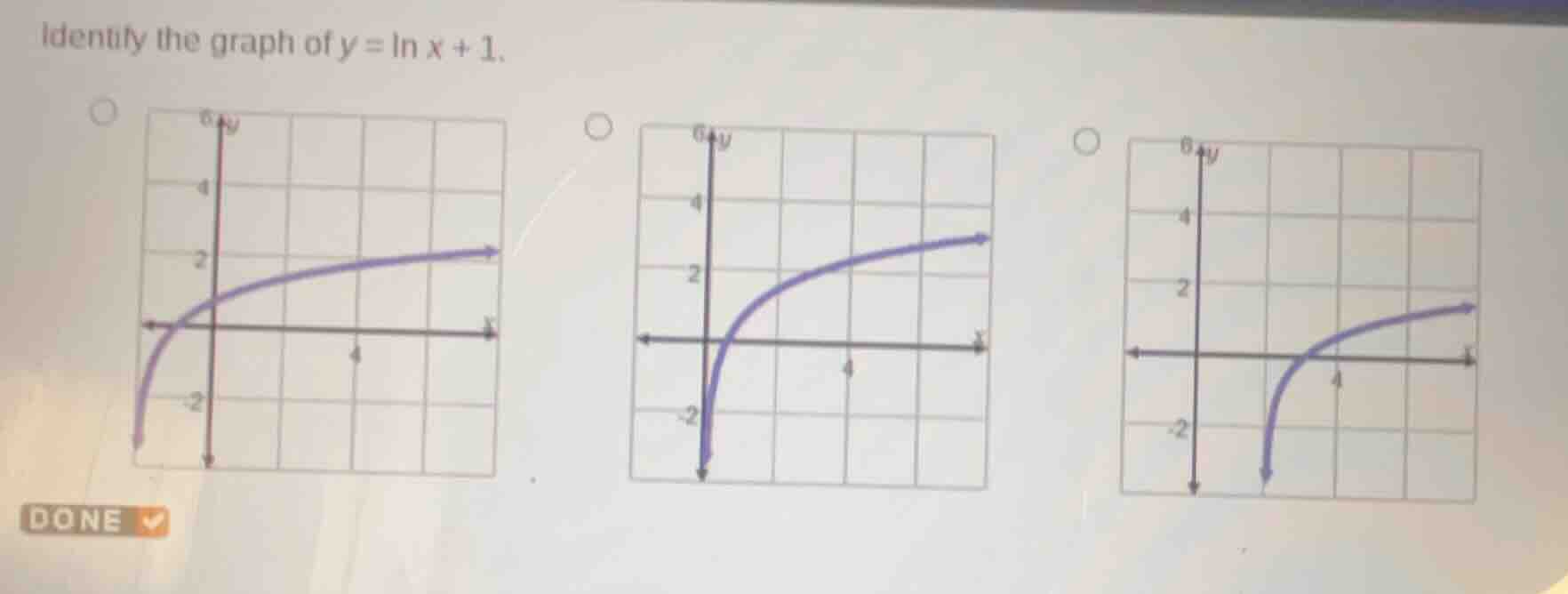
Now let's analyze the options:
- First graph: The curve is on the left of \( y \)-axis ( \( x<0 \) ) which is not possible for \( y = \ln x+1 \) (domain \( x>0 \)), so eliminate.
- Second graph: Vertical asymptote at \( x = 0 \), passes near \( (1, 1) \) (since when \( x = 1 \), \( y = 1 \)), and is increasing for \( x>0 \), which matches.
- Third graph: Vertical asymptote is at \( x = 4 \) (or some \( x>1 \)), which is wrong as the asymptote should be \( x = 0 \), so eliminate.

Snap & solve any problem in the app
Get step-by-step solutions on Sovi AI
Photo-based solutions with guided steps
Explore more problems and detailed explanations
The second graph (the middle one among the three options)