QUESTION IMAGE
Question
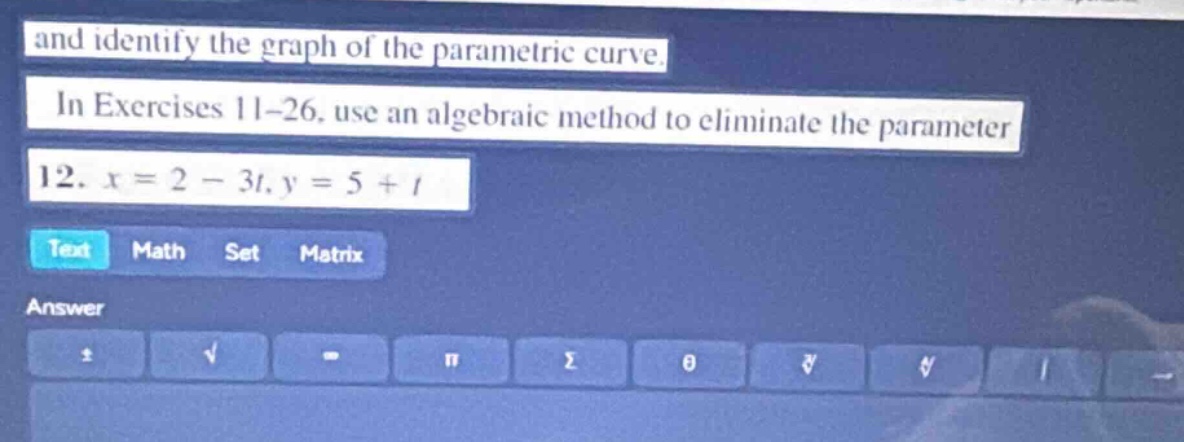
and identify the graph of the parametric curve. in exercises 11–26, use an algebraic method to eliminate the parameter 12. ( x = 2 - 3t, y = 5 + t )
Step1: Solve for \( t \) from the \( y \)-equation
From \( y = 5 + t \), we can isolate \( t \) by subtracting 5 from both sides. So, \( t = y - 5 \).
Step2: Substitute \( t \) into the \( x \)-equation
We have \( x = 2 - 3t \). Substitute \( t = y - 5 \) into this equation:
\( x = 2 - 3(y - 5) \)
Step3: Simplify the equation
First, distribute the -3: \( x = 2 - 3y + 15 \)
Then, combine like terms: \( x = 17 - 3y \)
We can rearrange this into slope - intercept form (\( y = mx + b \)) or standard form. Let's rearrange it to solve for \( y \):
Add \( 3y \) to both sides: \( 3y+x = 17 \)
Subtract \( x \) from both sides: \( 3y=-x + 17 \)
Divide both sides by 3: \( y=-\frac{1}{3}x+\frac{17}{3} \)

Snap & solve any problem in the app
Get step-by-step solutions on Sovi AI
Photo-based solutions with guided steps
Explore more problems and detailed explanations
The rectangular equation after eliminating the parameter is \( y = -\frac{1}{3}x+\frac{17}{3} \) (or equivalent forms like \( x + 3y=17 \)), and the graph of the parametric curve is a straight line with a slope of \( -\frac{1}{3} \) and a \( y \)-intercept of \( \frac{17}{3} \).