QUESTION IMAGE
Question
identify intervals on which a function increases, decreases, or is constant
e graphs to locate relative maxima or minima
st for symmetry
identify even or odd functions and recognize their symmetries
understand use piecewise functions
: section 2.2
are videos : section 2.2
erence: pages 237 - 256
v problems in section 2.2 in mylab math
for the week
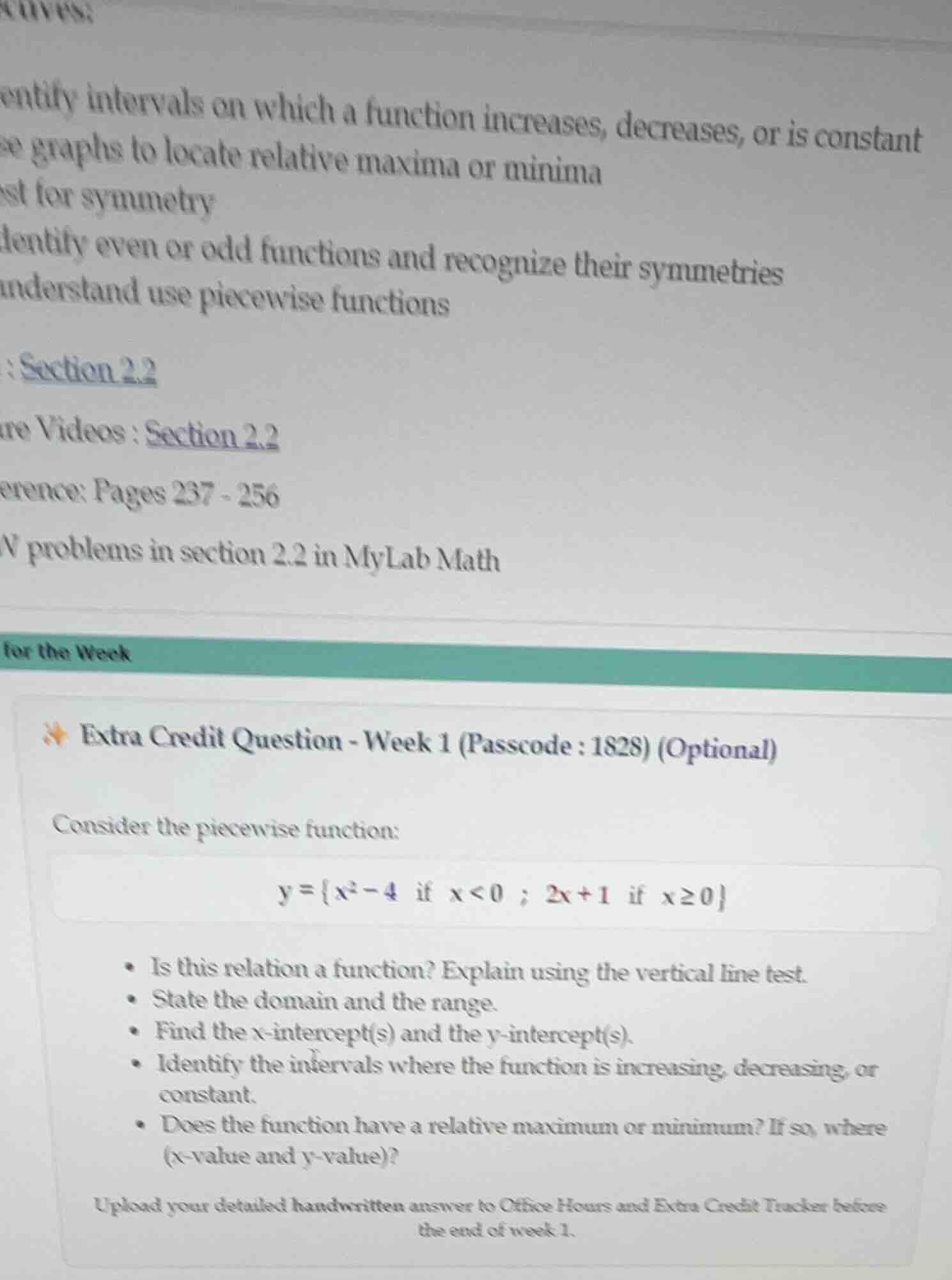
extra credit question - week 1 (passcode : 1828) (optional)
consider the piecewise function:
\\( y = \\{ x^2 - 4 \text{ if } x < 0 ; 2x + 1 \text{ if } x \geq 0 \\} \\)
- is this relation a function? explain using the vertical line test.
- state the domain and the range.
- find the x-intercept(s) and the y-intercept(s).
- identify the intervals where the function is increasing, decreasing, or constant.
- does the function have a relative maximum or minimum? if so, where (x-value and y-value)?
upload your detailed handwritten answer to office hours and extra credit tracker before the end of week 1.
Step1: Verify function via vertical line test
A relation is a function if every vertical line intersects its graph at most once. For $x<0$, $y=x^2-4$ is a right-opening parabola half; for $x\geq0$, $y=2x+1$ is a line. No vertical line intersects both parts, so each $x$ maps to exactly one $y$.
Step2: Find domain of the function
The function is defined for all $x<0$ and $x\geq0$, so all real numbers.
Domain: $(-\infty, \infty)$
Step3: Find range of the function
For $x<0$: $x^2>0$, so $y=x^2-4 > -4$. For $x\geq0$: $2x+1\geq 2(0)+1=1$. Combine both sets:
Range: $(-4, \infty)$
Step4: Calculate x-intercepts
Set $y=0$ for each piece:
- For $x<0$: $x^2-4=0 \implies x^2=4 \implies x=-2$ (since $x<0$)
- For $x\geq0$: $2x+1=0 \implies x=-\frac{1}{2}$, which is not $\geq0$, so discard.
x-intercept: $(-2, 0)$
Step5: Calculate y-intercepts
Set $x=0$ (use $x\geq0$ piece):
$y=2(0)+1=1$
y-intercept: $(0, 1)$
Step6: Identify increasing/decreasing intervals
- For $x<0$: $y=x^2-4$, derivative $y'=2x<0$ (since $x<0$), so decreasing.
- For $x\geq0$: $y=2x+1$, derivative $y'=2>0$, so increasing.
Decreasing: $(-\infty, 0)$; Increasing: $(0, \infty)$
Step7: Locate relative extrema
At $x=0$, the function switches from decreasing to increasing. The $y$-value at $x=0$ is 1, and values left of 0 approach -4 from above, values right increase from 1. This is a relative minimum. No relative maximum, as $y$ increases to $\infty$ on $(0,\infty)$ and approaches $\infty$ as $x\to-\infty$.
Relative minimum at $(0, 1)$

Snap & solve any problem in the app
Get step-by-step solutions on Sovi AI
Photo-based solutions with guided steps
Explore more problems and detailed explanations
- Yes, this relation is a function. Any vertical line will intersect the graph at most once: for $x<0$ it intersects the parabola segment, for $x\geq0$ it intersects the line segment, and no vertical line crosses both parts.
- Domain: $(-\infty, \infty)$; Range: $(-4, \infty)$
- x-intercept: $(-2, 0)$; y-intercept: $(0, 1)$
- Decreasing on $(-\infty, 0)$, increasing on $(0, \infty)$; no constant intervals.
- The function has a relative minimum at $(0, 1)$; there is no relative maximum.