QUESTION IMAGE
Question
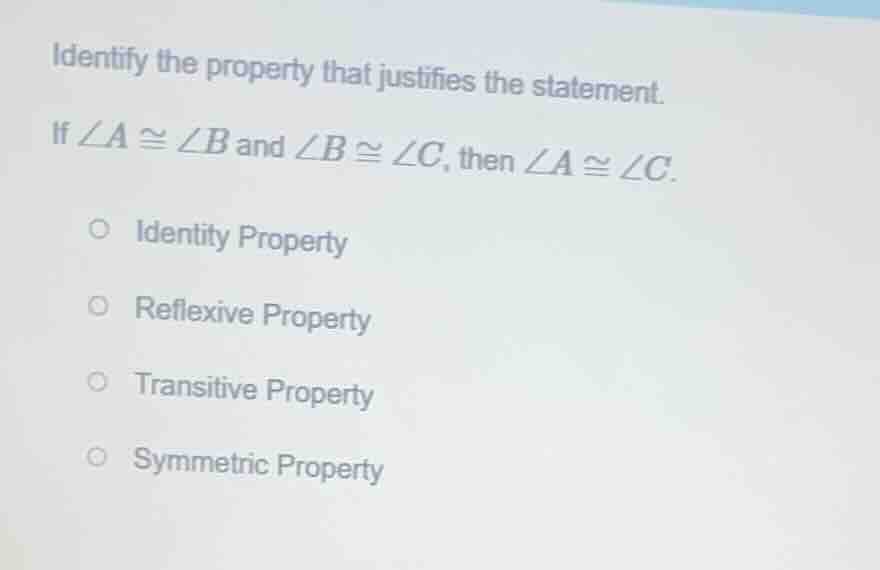
identify the property that justifies the statement. if $\angle a \cong \angle b$ and $\angle b \cong \angle c$, then $\angle a \cong \angle c$. \bigcirc identity property \bigcirc reflexive property \bigcirc transitive property \bigcirc symmetric property
The Transitive Property of congruence (or equality) states that if \( a \cong b \) and \( b \cong c \), then \( a \cong c \). In this case, \( \angle A \cong \angle B \) and \( \angle B \cong \angle C \), so by the Transitive Property, \( \angle A \cong \angle C \). The Identity Property is about operations (e.g., adding 0), the Reflexive Property is \( a \cong a \), and the Symmetric Property is if \( a \cong b \) then \( b \cong a \), none of which apply here.

Snap & solve any problem in the app
Get step-by-step solutions on Sovi AI
Photo-based solutions with guided steps
Explore more problems and detailed explanations
Transitive Property