QUESTION IMAGE
Question
identify the smallest angle of $\triangle fgh$.
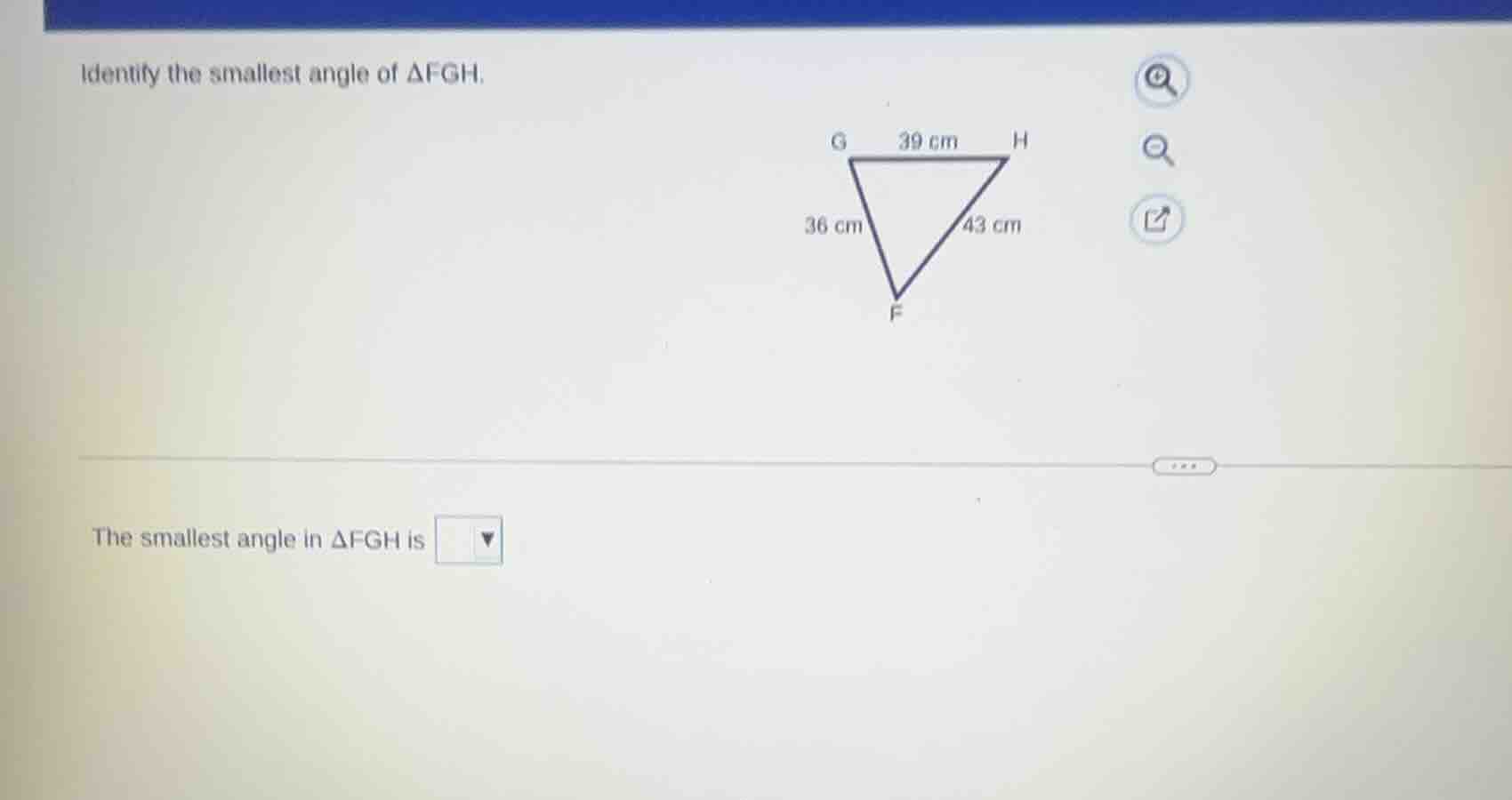
the triangle $\triangle fgh$ has sides: $gh = 39$ cm, $gf = 36$ cm, $hf = 43$ cm.
the smallest angle in $\triangle fgh$ is dropdown
Step1: Recall the triangle angle - side relationship
In a triangle, the smallest angle is opposite the shortest side. This is based on the fact that in a triangle, if one side is shorter than another side, the angle opposite the shorter side is smaller (by the Law of Sines or the basic triangle angle - side proportionality).
Step2: Identify the lengths of the sides of \(\triangle FGH\)
The sides of \(\triangle FGH\) are: \(FG = 36\space cm\), \(GH=39\space cm\), and \(FH = 43\space cm\).
Step3: Determine the shortest side and its opposite angle
The shortest side among \(36\space cm\), \(39\space cm\), and \(43\space cm\) is \(FG = 36\space cm\). The angle opposite to side \(FG\) is \(\angle H\) (because in \(\triangle FGH\), side \(FG\) is between vertices \(F\) and \(G\), so the angle opposite to it is \(\angle H\) at vertex \(H\)). Wait, no, let's label the triangle correctly. Let's denote the triangle with vertices \(F\), \(G\), \(H\). Side \(FG\) is from \(F\) to \(G\) (length \(36\space cm\)), side \(GH\) is from \(G\) to \(H\) (length \(39\space cm\)), and side \(FH\) is from \(F\) to \(H\) (length \(43\space cm\)). So, the angle opposite to side \(FG\) (length \(36\space cm\)) is \(\angle H\) (angle at \(H\)), the angle opposite to side \(GH\) (length \(39\space cm\)) is \(\angle F\) (angle at \(F\)), and the angle opposite to side \(FH\) (length \(43\space cm\)) is \(\angle G\) (angle at \(G\)). Wait, no, let's use the standard notation: in \(\triangle FGH\), the side opposite angle \(F\) is \(GH\), the side opposite angle \(G\) is \(FH\), and the side opposite angle \(H\) is \(FG\).
So, side lengths:
- \(GH = 39\space cm\) (opposite \(\angle F\))
- \(FH=43\space cm\) (opposite \(\angle G\))
- \(FG = 36\space cm\) (opposite \(\angle H\))
Now, compare the side lengths: \(36\lt39\lt43\). So the shortest side is \(FG = 36\space cm\), and the angle opposite to it is \(\angle H\)? Wait, no, wait: side opposite \(\angle F\) is \(GH = 39\), side opposite \(\angle G\) is \(FH = 43\), side opposite \(\angle H\) is \(FG = 36\). So since \(FG\) (length \(36\)) is the shortest side, the angle opposite to it, which is \(\angle H\)? Wait, no, I think I mixed up. Let's list the angles and their opposite sides:
- Angle \(F\): opposite side \(GH = 39\space cm\)
- Angle \(G\): opposite side \(FH = 43\space cm\)
- Angle \(H\): opposite side \(FG = 36\space cm\)
Since the shortest side is \(FG = 36\space cm\) (opposite angle \(H\))? Wait, no, wait, if we have triangle \(FGH\), with vertices \(F\), \(G\), \(H\), then:
- The side between \(F\) and \(G\) is \(FG\) (length \(36\))
- The side between \(G\) and \(H\) is \(GH\) (length \(39\))
- The side between \(H\) and \(F\) is \(FH\) (length \(43\))
So, angle at \(F\) is between sides \(FG\) and \(FH\), so the side opposite angle \(F\) is \(GH\).
Angle at \(G\) is between sides \(FG\) and \(GH\), so the side opposite angle \(G\) is \(FH\).
Angle at \(H\) is between sides \(GH\) and \(FH\), so the side opposite angle \(H\) is \(FG\).
So, side opposite angle \(F\): \(GH = 39\)
Side opposite angle \(G\): \(FH = 43\)
Side opposite angle \(H\): \(FG = 36\)
Now, since the length of the side opposite an angle is proportional to the measure of the angle (larger side opposite larger angle, smaller side opposite smaller angle), the shortest side is \(FG = 36\) (opposite angle \(H\))? Wait, no, \(36\) is the length of \(FG\), which is opposite angle \(H\). So if \(FG\) is the shortest side, then angle \(H\) is the smallest angle? Wait, no, wait, let's take an example. Suppose we have a…

Snap & solve any problem in the app
Get step-by-step solutions on Sovi AI
Photo-based solutions with guided steps
Explore more problems and detailed explanations
The smallest angle in \(\triangle FGH\) is \(\angle H\) (angle at \(H\))