QUESTION IMAGE
Question
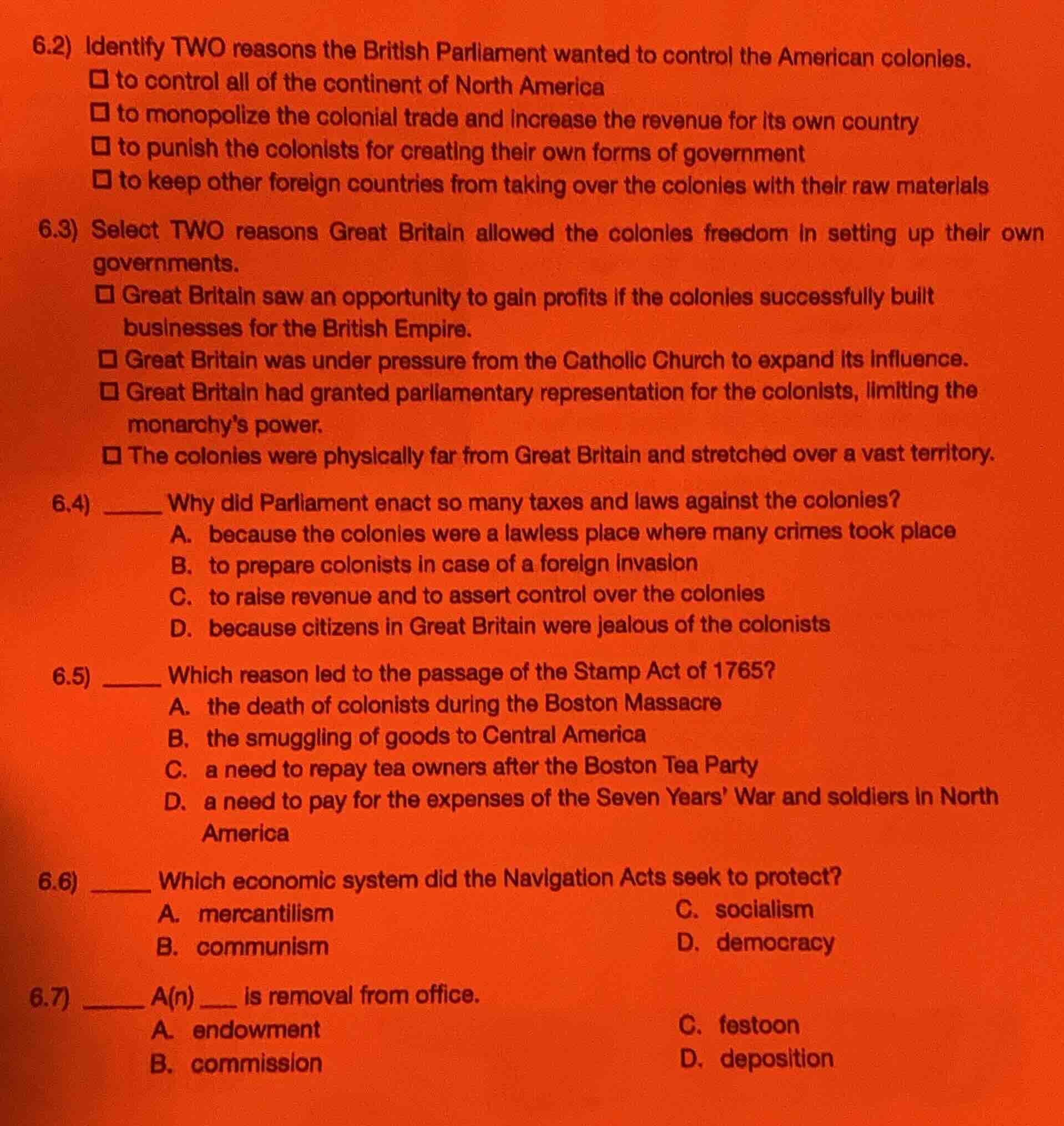
6.2) identify two reasons the british parliament wanted to control the american colonies.
□ to control all of the continent of north america
□ to monopolize the colonial trade and increase the revenue for its own country
□ to punish the colonists for creating their own forms of government
□ to keep other foreign countries from taking over the colonies with their raw materials
6.3) select two reasons great britain allowed the colonies freedom in setting up their own governments.
□ great britain saw an opportunity to gain profits if the colonies successfully built businesses for the british empire.
□ great britain was under pressure from the catholic church to expand its influence.
□ great britain had granted parliamentary representation for the colonists, limiting the monarchys power.
□ the colonies were physically far from great britain and stretched over a vast territory.
6.4) ______ why did parliament enact so many taxes and laws against the colonies?
a. because the colonies were a lawless place where many crimes took place
b. to prepare colonists in case of a foreign invasion
c. to raise revenue and to assert control over the colonies
d. because citizens in great britain were jealous of the colonists
6.5) ______ which reason led to the passage of the stamp act of 1765?
a. the death of colonists during the boston massacre
b. the smuggling of goods to central america
c. a need to repay tea owners after the boston tea party
d. a need to pay for the expenses of the seven years war and soldiers in north america
6.6) ______ which economic system did the navigation acts seek to protect?
a. mercantilism c. socialism
b. communism d. democracy
6.7) ____ a(n) _ is removal from office.
a. endowment c. festoon
b. commission d. deposition
6.2
- To monopolize colonial trade and increase revenue: British mercantilist policy aimed at using colonies for economic gain, controlling trade to ensure profits went to Britain.
- To keep other foreign countries from taking over: The colonies had valuable raw materials, and Britain wanted to prevent rival nations (like France, Spain) from seizing them.
- "Control all of North America" is too broad (Britain's focus was more on trade/profit and preventing rivals, not full continental control at this stage), and "punish colonists for their government" is inaccurate as the colonists' self - government was more of a later grievance, not a reason for initial control.
- Profit from colonial businesses: If colonies built successful businesses, Britain could benefit through trade and resources, so allowing self - government facilitated economic growth for the empire.
- Distance and vast territory: The colonies were far from Britain and spread out, making direct governance difficult, so allowing local self - government was practical.
- "Pressure from Catholic Church" is incorrect (Britain was Protestant - dominated and not pressured by the Catholic Church in this way), and "granted parliamentary representation" is false as colonists had no parliamentary representation.
- Option A: Colonies were not lawless in a way that justified many taxes/laws.
- Option B: Taxes/laws were not for foreign invasion preparation.
- Option C: Parliament wanted to raise money (e.g., to pay war debts) and assert control over the colonies (to ensure colonial compliance with British economic policies).
- Option D: Jealousy of colonists is not a valid historical reason for taxes/laws.

Snap & solve any problem in the app
Get step-by-step solutions on Sovi AI
Photo-based solutions with guided steps
Explore more problems and detailed explanations
- to monopolize the colonial trade and increase the revenue for its own country
- to keep other foreign countries from taking over the colonies with their raw materials