QUESTION IMAGE
Question
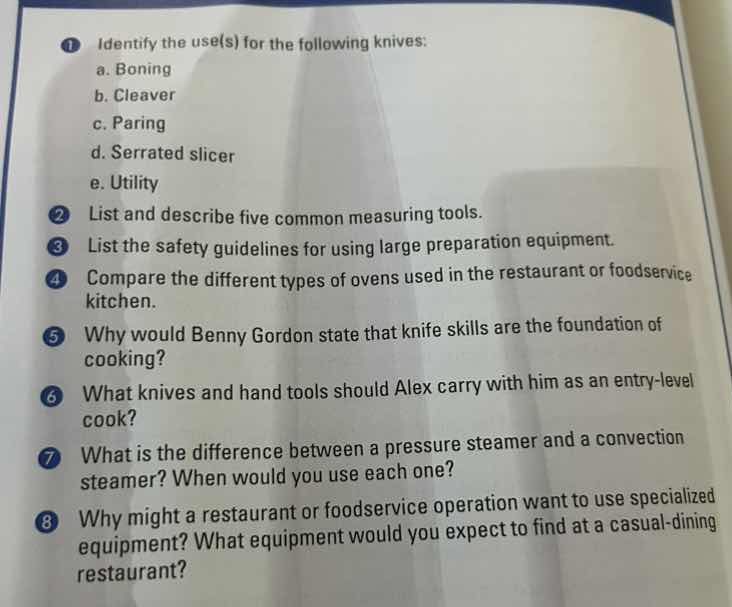
1 identify the use(s) for the following knives:
a. boning
b. cleaver
c. paring
d. serrated slicer
e. utility
2 list and describe five common measuring tools.
3 list the safety guidelines for using large preparation equipment.
4 compare the different types of ovens used in the restaurant or foodservice kitchen.
5 why would benny gordon state that knife skills are the foundation of cooking?
6 what knives and hand tools should alex carry with him as an entry - level cook?
7 what is the difference between a pressure steamer and a convection steamer? when would you use each one?
8 why might a restaurant or foodservice operation want to use specialized equipment? what equipment would you expect to find at a casual - dining restaurant?
- Knife Uses:
- Boning: Remove bones from meat/fish/poultry.
- Cleaver: Chop bones, split large ingredients, crush foods.
- Paring: Peel, trim, do small precision cuts.
- Serrated slicer: Slice soft, crusty, or delicate foods (bread, tomatoes).
- Utility: General-purpose small-to-medium cutting tasks.
- Measuring Tools:
- Measuring cups (dry): Measure dry ingredients (flour, sugar) by volume.
- Measuring cups (liquid): Measure liquid ingredients (water, oil) with spouts for pouring.
- Measuring spoons: Measure small volumes (spices, extracts) in tsp/tbsp.
- Kitchen scale: Measure ingredients by weight for precise baking/cooking.
- Liquid measuring jug: Large-volume liquid measurement with marked gradations.
- Large Equipment Safety Guidelines:
- Read and follow manufacturer instructions.
- Wear appropriate PPE (non-slip shoes, hairnets).
- Ensure equipment is turned off/unplugged before cleaning/maintenance.
- Keep work areas around equipment clear of clutter.
- Do not operate equipment if you are untrained or it is damaged.
- Oven Types Comparison:
- Conventional Ovens: Use top/bottom heating elements; hot/cold spots exist. Best for roasting, baking where slight temperature variation is acceptable.
- Convection Ovens: Have fans to circulate hot air; cooks faster and more evenly. Ideal for baking multiple trays, roasting, and crisping foods.
- Deck Ovens: Have stone decks; use radiant heat. Perfect for artisanal bread, pizza to get crispy crusts.
- Steam Ovens: Inject steam; retain moisture. Used for baking pastries (croissants), reheating foods without drying them out.
- Combination Ovens: Combine convection, steam, and dry heat. Versatile for roasting, baking, steaming, and braising.
- Knife Skills as Foundation:
Knife skills are foundational because they are required for nearly every prep task: consistent cutting ensures even cooking, reduces waste, improves kitchen safety, increases efficiency, and is the first step in creating well-executed dishes.
- Entry-Level Cook Tools:
Knives: Chef's knife, paring knife, serrated bread knife. Hand tools: Peeler, tongs, spatula, whisk, measuring cups/spoons, cutting board.
- Steamer Difference & Uses:
- Pressure Steamer: Uses high-pressure steam; cooks food very quickly by raising the boiling point of water. Best for tough cuts of meat, large batches of grains, or when speed is critical.
- Convection Steamer: Circulates low-pressure steam evenly; cooks food gently. Ideal for delicate foods (vegetables, fish) where texture and moisture retention are key.
- Specialized Equipment & Casual Dining Gear:
- Reasons for Specialized Equipment: Increases efficiency, ensures consistency in food quality, reduces labor time, allows for unique menu items, and improves food safety.
- Casual-Dining Equipment: Grills, fryers, conventional/convection ovens, refrigerators/freezers, prep tables, dishwashers, microwaves, and basic prep tools.

Snap & solve any problem in the app
Get step-by-step solutions on Sovi AI
Photo-based solutions with guided steps
Explore more problems and detailed explanations
- a. Boning: Remove bones from meat/fish/poultry
b. Cleaver: Chop bones, crush, split large ingredients
c. Paring: Peel, trim, small precision cuts
d. Serrated slicer: Slice bread, tomatoes, delicate foods
e. Utility: General-purpose small-to-medium cutting
- 1. Dry measuring cups: Measure dry ingredients by volume
- Liquid measuring cups: Measure liquids with pour spouts
- Measuring spoons: Small volume (spices, extracts) measurement
- Kitchen scale: Precise weight measurement for ingredients
- Measuring jug: Large-volume liquid measurement
- 1. Follow manufacturer instructions
- Wear proper PPE (non-slip shoes, hairnets)
- Turn off/unplug before cleaning/maintenance
- Keep surrounding work areas clear
- Do not operate if untrained or equipment is damaged
- - Conventional: Top/bottom elements, hot spots; for roasting/baking
- Convection: Fan-circulated air, even/fast cooking; for multi-tray baking, roasting
- Deck: Stone decks, radiant heat; for artisanal bread/pizza
- Steam: Inject steam, retains moisture; for pastries, reheating
- Combination: Convection + steam; versatile for all cooking methods
- Knife skills are required for nearly all prep tasks, ensuring even cooking, efficiency, safety, and consistent dish quality.
- Knives: Chef's knife, paring knife, serrated bread knife
Hand tools: Peeler, tongs, spatula, whisk, measuring cups/spoons, cutting board
- - Pressure steamer: Uses high-pressure steam, cooks fast; for tough meats, large grain batches
- Convection steamer: Circulates low-pressure steam, gentle cooking; for delicate veggies/fish
- - Reasons for specialized equipment: Boosts efficiency, ensures consistency, reduces labor, enables unique menu items
- Casual-dining equipment: Grills, fryers, conventional/convection ovens, prep tables, refrigerators, dishwashers