QUESTION IMAGE
Question
identifying domain and range of exponential functions
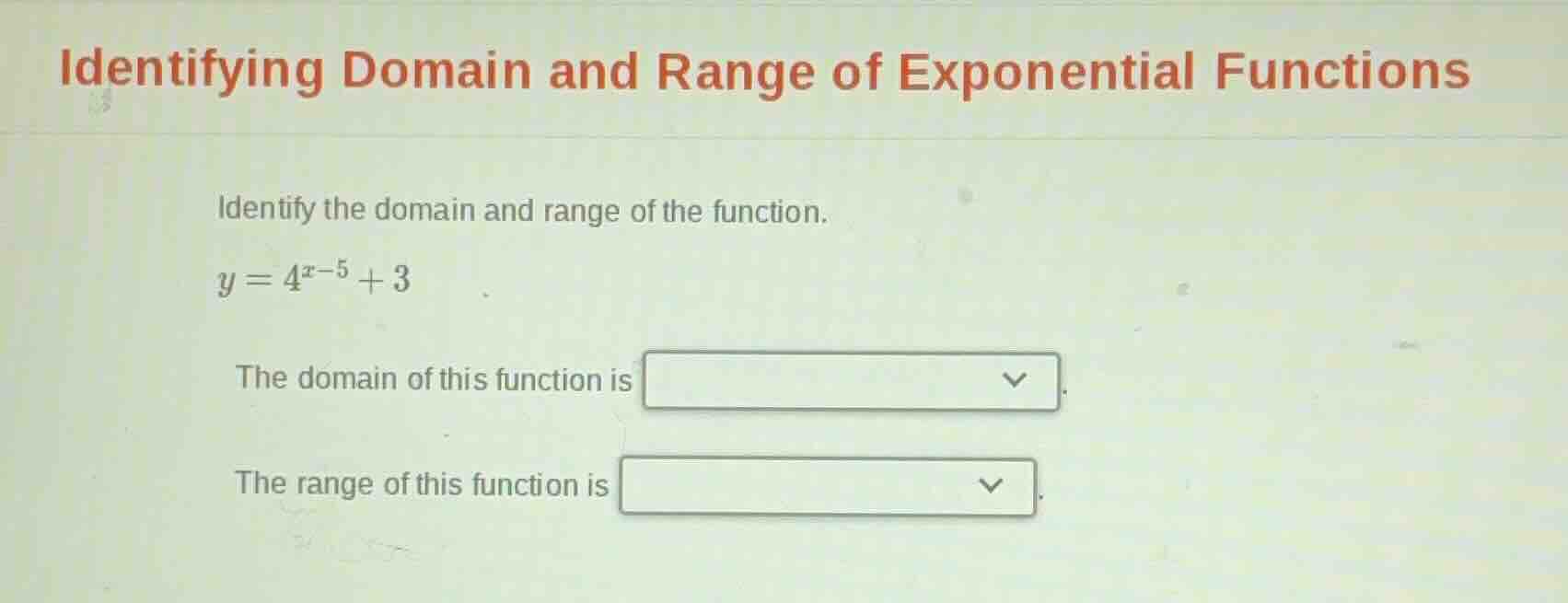
identify the domain and range of the function.
$y = 4^{x - 5} + 3$
the domain of this function is
the range of this function is
Step1: Analyze the domain of exponential function
For an exponential function of the form \(y = a^{x - h}+k\) (where \(a>0,a
eq1\)), the exponent \(x - h\) can take any real number value because there are no restrictions on the input \(x\) for exponential functions (we can raise a positive base to any real power). In the function \(y = 4^{x - 5}+3\), the base \(a = 4>0,a
eq1\), and the exponent is \(x - 5\). So \(x\) can be any real number.
Step2: Analyze the range of exponential function
First, recall the range of the basic exponential function \(y = a^{x}\) (where \(a>0,a
eq1\)) is \((0,\infty)\). For the function \(y = 4^{x-5}\), since the transformation \(x
ightarrow x - 5\) is a horizontal shift, it does not affect the range. So the range of \(y = 4^{x - 5}\) is \((0,\infty)\). Then we have the function \(y=4^{x - 5}+3\), which is a vertical shift of \(y = 4^{x - 5}\) by 3 units up. When we add 3 to a function whose range is \((0,\infty)\), the new range is \((0 + 3,\infty)\) i.e., \((3,\infty)\).

Snap & solve any problem in the app
Get step-by-step solutions on Sovi AI
Photo-based solutions with guided steps
Explore more problems and detailed explanations
The domain of this function is all real numbers (or \(\mathbb{R}\) or \((-\infty,\infty)\)).
The range of this function is \((3,\infty)\).