QUESTION IMAGE
Question
identifying equivalent expressions continued
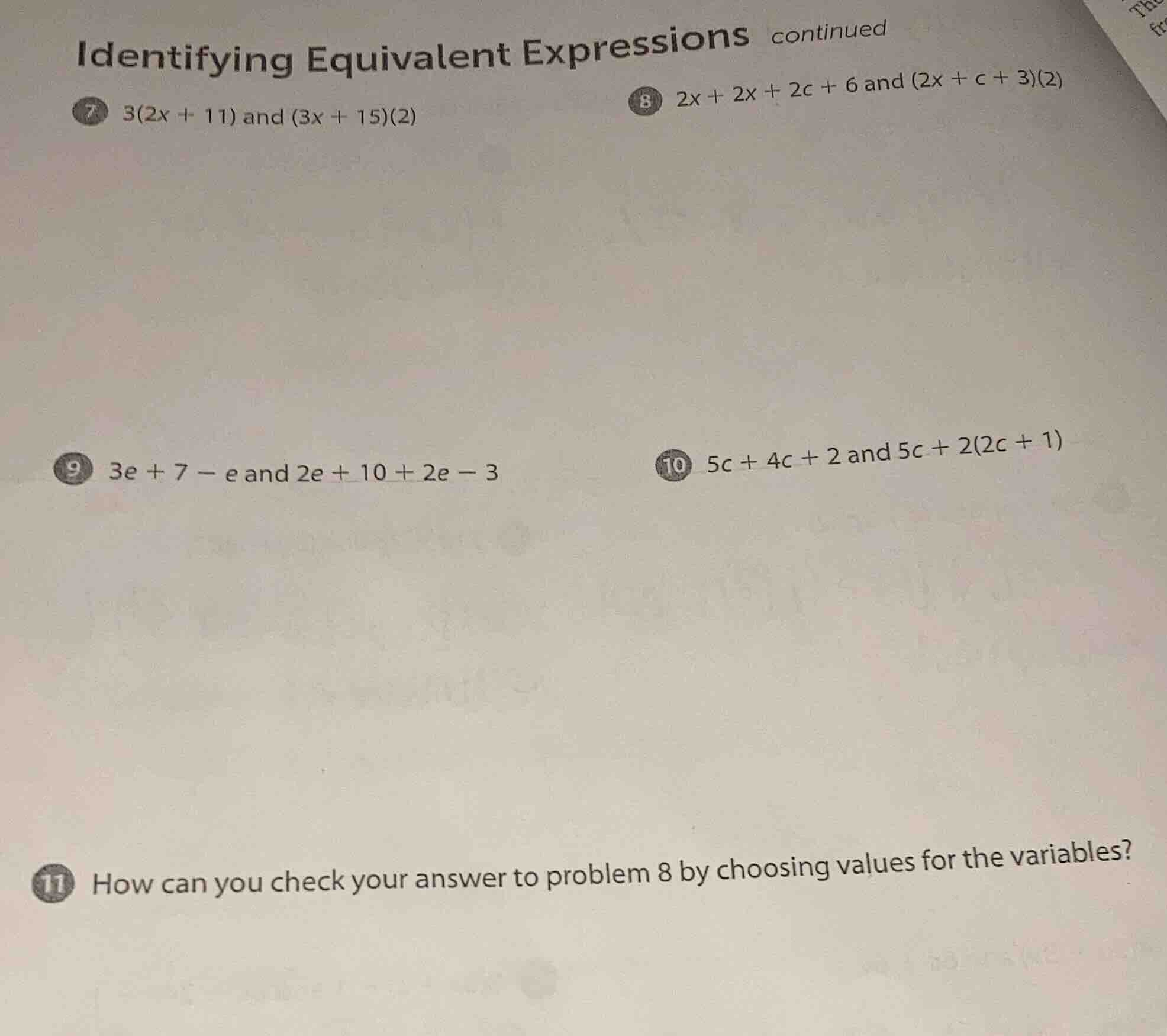
7 ( 3(2x + 11) ) and ( (3x + 15)(2) )
8 ( 2x + 2x + 2c + 6 ) and ( (2x + c + 3)(2) )
9 ( 3e + 7 - e ) and ( 2e + 10 + 2e - 3 )
10 ( 5c + 4c + 2 ) and ( 5c + 2(2c + 1) )
11 how can you check your answer to problem 8 by choosing values for the variables?
Step1: Expand/simplify Q7 expressions
First expression: $3(2x + 11) = 6x + 33$
Second expression: $(3x + 15)(2) = 6x + 30$
Step2: Compare Q7 results
$6x + 33
eq 6x + 30$, so not equivalent.
Step3: Expand/simplify Q8 expressions
First expression: $2x + 2x + 2c + 6 = 4x + 2c + 6$
Second expression: $(2x + c + 3)(2) = 4x + 2c + 6$
Step4: Compare Q8 results
$4x + 2c + 6 = 4x + 2c + 6$, so equivalent.
Step5: Expand/simplify Q9 expressions
First expression: $3e + 7 - e = 2e + 7$
Second expression: $2e + 10 + 2e - 3 = 4e + 7$
Step6: Compare Q9 results
$2e + 7
eq 4e + 7$, so not equivalent.
Step7: Expand/simplify Q10 expressions
First expression: $5c + 4c + 2 = 9c + 2$
Second expression: $5c + 2(2c + 1) = 5c + 4c + 2 = 9c + 2$
Step8: Compare Q10 results
$9c + 2 = 9c + 2$, so equivalent.
Step9: Explain Q11 verification method
Pick arbitrary values for $x$ and $c$, substitute into both expressions from Q8, then check if the numerical results are equal.

Snap & solve any problem in the app
Get step-by-step solutions on Sovi AI
Photo-based solutions with guided steps
Explore more problems and detailed explanations
- The expressions are not equivalent.
- The expressions are equivalent.
- The expressions are not equivalent.
- The expressions are equivalent.
- Choose specific numbers for $x$ and $c$ (e.g., $x=1$, $c=2$), plug them into both $2x + 2x + 2c + 6$ and $(2x + c + 3)(2)$, calculate the value of each expression. If the two values are equal, this supports that the expressions are equivalent (testing multiple values increases confidence).