QUESTION IMAGE
Question
identifying the graph of a translated cubic function
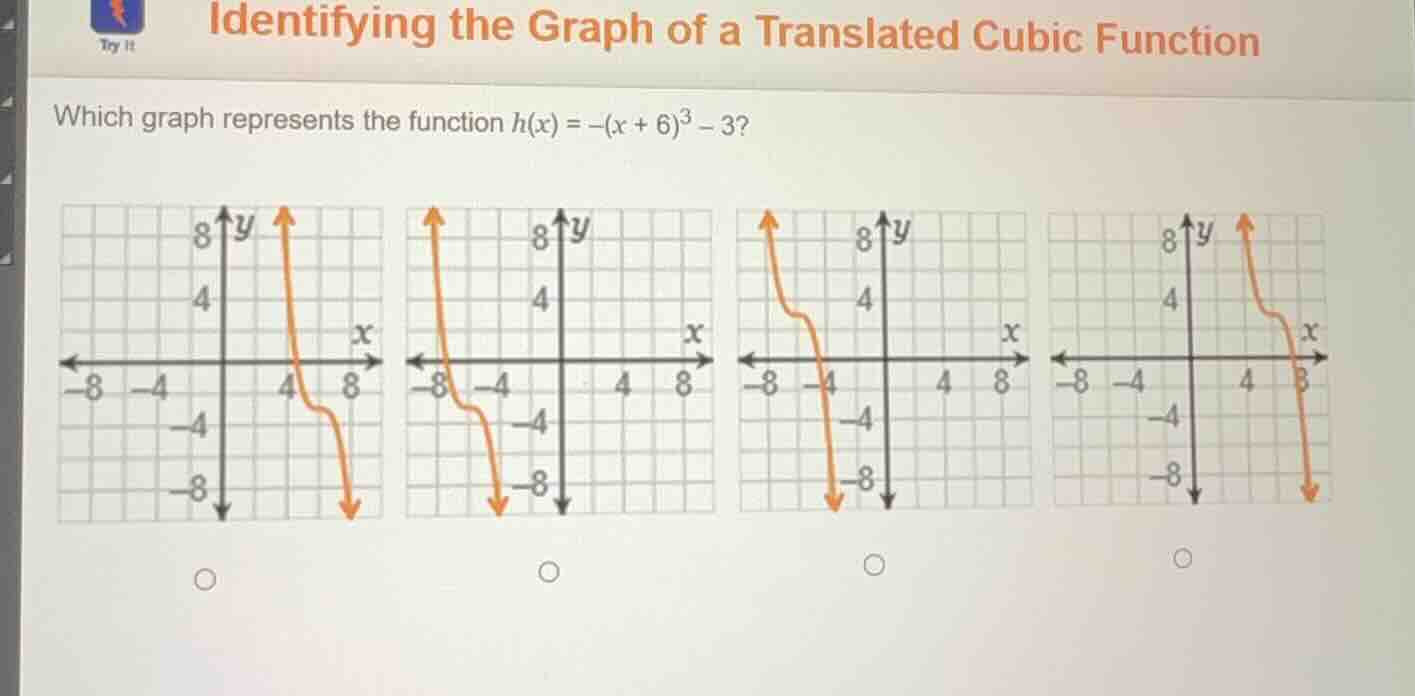
which graph represents the function $h(x) = -(x + 6)^3 - 3$?
four graphs with coordinate planes and cubic function curves, each with a radio button below
Step1: Analyze the parent function
The parent cubic function is \( y = x^3 \), which has a point of inflection at the origin \((0,0)\), and as \( x \to +\infty \), \( y \to +\infty \); as \( x \to -\infty \), \( y \to -\infty \).
Step2: Analyze transformations
For the function \( h(x) = -(x + 6)^3 - 3 \):
- The negative sign reflects the graph of \( y = (x + 6)^3 \) over the \( x \)-axis. So now, as \( x \to +\infty \), \( y \to -\infty \); as \( x \to -\infty \), \( y \to +\infty \).
- The \( (x + 6) \) inside the cube means a horizontal shift. The formula for horizontal shift is: if we have \( y = f(x + h) \), it's a shift of \( h \) units to the left (when \( h>0 \)). Here \( h = 6 \), so the graph of \( y = -x^3 \) is shifted 6 units to the left.
- The \( - 3 \) at the end is a vertical shift. The formula for vertical shift is: if we have \( y = f(x) + k \), it's a shift of \( |k| \) units down (when \( k<0 \)). Here \( k=-3 \), so the graph is shifted 3 units down.
Step3: Find the inflection point
The inflection point of the parent function \( y = x^3 \) is at \((0,0)\). After the transformations:
- Horizontal shift 6 units left: \( x \)-coordinate becomes \( 0 - 6=-6 \)
- Vertical shift 3 units down: \( y \)-coordinate becomes \( 0 - 3=-3 \)
So the inflection point of \( h(x) \) is at \((-6, -3)\).
Step4: Analyze the end - behaviors and the inflection point
We know the end - behaviors: as \( x\to+\infty \), \( h(x)\to-\infty \); as \( x\to-\infty \), \( h(x)\to+\infty \). And the inflection point is at \((-6, -3)\).
Now, let's analyze the given graphs:
- The first graph: The inflection point seems to be around positive \( x \)-values, which does not match \((-6, -3)\).
- The second graph: Let's check the inflection point. It should be at \( x=-6 \), \( y = - 3 \). Looking at the second graph, the point of inflection (the "bend" in the cubic graph) is around \( x=-6 \) (since it's shifted 6 units left from the origin) and \( y=-3 \) (shifted 3 units down). Also, the end - behaviors: as \( x\to+\infty \), the graph goes down (since the leading coefficient is negative) and as \( x\to-\infty \), the graph goes up, which matches our transformed function.
- The third graph: The inflection point is around \( x=-4 \) or so, not \( x = - 6 \), so it does not match.
- The fourth graph: The inflection point is around positive \( x \)-values, which does not match \((-6, -3)\).

Snap & solve any problem in the app
Get step-by-step solutions on Sovi AI
Photo-based solutions with guided steps
Explore more problems and detailed explanations
The second graph (the one with the inflection point around \( x=-6,y = - 3 \) and the correct end - behaviors)