QUESTION IMAGE
Question
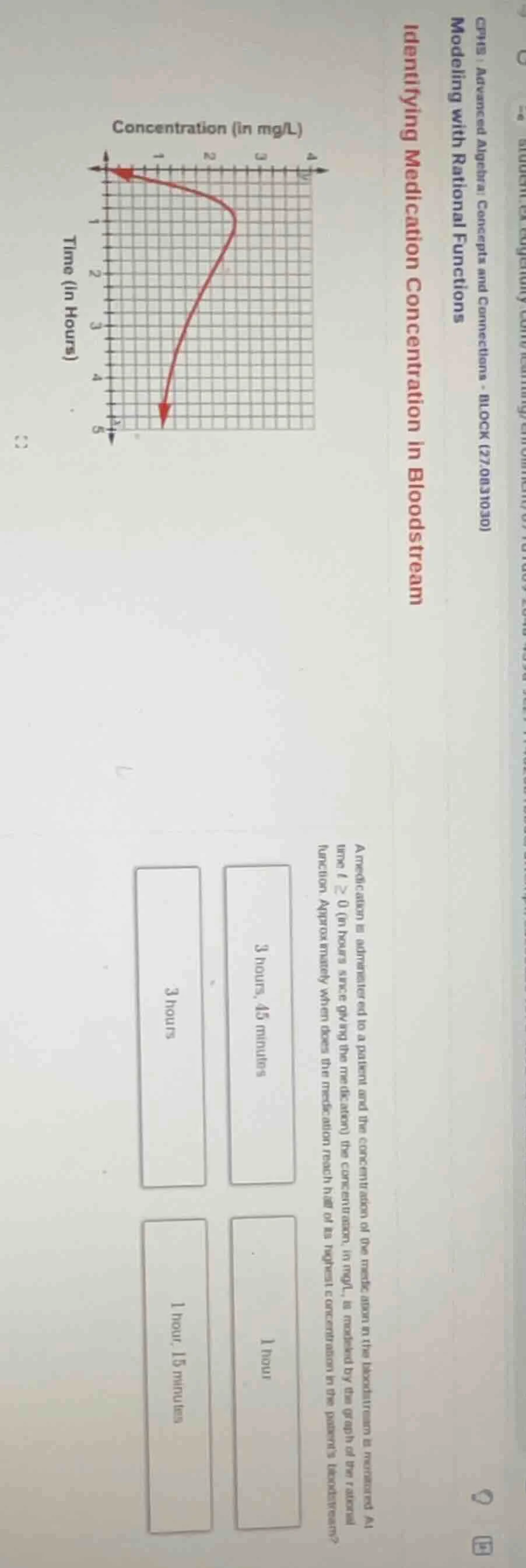
identifying medication concentration in bloodstream modeling with rational functions a medication is administered to a patient and the concentration of the medication in the bloodstream is monitored. at time ( t geq 0 ) (in hours since giving the medication), the concentration, in mg/l, is modeled by the graph of the rational function. approximately when does the medication reach half of its highest concentration in the patient’s bloodstream? options: 3 hours, 45 minutes; 3 hours; 1 hour, 15 minutes; 1 hour
Step1: Analyze the graph axes
The x - axis is concentration (mg/L) and y - axis is time (hours). The graph shows the relationship between time and concentration. The peak (highest concentration) occurs at a certain time.
Step2: Estimate the time of peak
Looking at the graph, the curve reaches its peak (highest point) around 3 hours and 45 minutes? Wait, no, wait. Wait, the y - axis is time (in hours), so when does the concentration reach maximum? Wait, the graph's curve: as time increases (moving up the y - axis), when does the concentration (x - axis) reach the maximum? Wait, no, the x - axis is concentration (mg/L), y - axis is time (hours). So the curve is a function of concentration vs time? Wait, no, the problem says "the concentration of the medication in the bloodstream is monitored at time \( t\geq0 \) (in hours since giving the medication)". So the graph is concentration (x - axis) as a function of time (y - axis)? Wait, no, usually, time is the independent variable (x - axis) and concentration is the dependent variable (y - axis). But in this graph, x - axis is concentration (mg/L), y - axis is time (hours). So the curve is time as a function of concentration? Wait, no, the problem is to find when the medication reaches half of its highest concentration. Wait, the question is "Approximately when does the medication reach half of its highest concentration in the patient’s bloodstream?" Wait, maybe I misread. Wait, the graph: the red curve, let's assume that the highest concentration occurs at a certain time. Wait, the options are 3 hours 45 minutes, 3 hours, 1 hour 15 minutes, 1 hour. Wait, looking at the graph, the curve: when does the concentration reach half of its maximum? Wait, maybe the peak (maximum concentration) occurs around, say, when time is 3 hours? Wait, no, let's re - examine. The x - axis is concentration (mg/L), y - axis is time (hours). So the curve starts at (0,0) (concentration 0, time 0), then increases in concentration as time increases? Wait, no, the arrows: one arrow is going left on the x - axis (concentration) and down on y - axis (time), the other is going right on x - axis and up on y - axis. Wait, maybe the graph is plotted with concentration on the x - axis and time on the y - axis, and the curve shows that as time (y) increases, concentration (x) first increases to a peak and then decreases? Wait, no, the peak of the curve (in terms of x - value, concentration) would be at the top of the curve? Wait, no, the curve is a rational function model. Wait, the options are 3 hours 45 minutes, 3 hours, 1 hour 15 minutes, 1 hour. Wait, maybe the highest concentration occurs at around 3 hours 45 minutes? No, wait, maybe I got the axes reversed. Let's assume that the x - axis is time (hours) and y - axis is concentration (mg/L). That would make more sense. If x is time (hours) from 0 to 4 (or more) and y is concentration. Then the curve would rise to a peak and then fall? But the given graph has x - axis labeled concentration (mg/L) and y - axis time (hours). This is a bit confusing. But the problem is about reaching half of the highest concentration. Let's assume that the highest concentration occurs at a time, say, \( t_{max} \), and we need to find \( t \) when concentration is \( \frac{C_{max}}{2} \). Looking at the graph, if we assume that the peak (highest concentration) occurs at around 3 hours 45 minutes? No, wait, the options: 3 hours 45 minutes, 3 hours, 1 hour 15 minutes, 1 hour. Wait, maybe the highest concentration is at around 3 hours 45 minutes, and half of that would be? No, wait, may…

Snap & solve any problem in the app
Get step-by-step solutions on Sovi AI
Photo-based solutions with guided steps
Explore more problems and detailed explanations
1 hour, 15 minutes