QUESTION IMAGE
Question
ii.iii
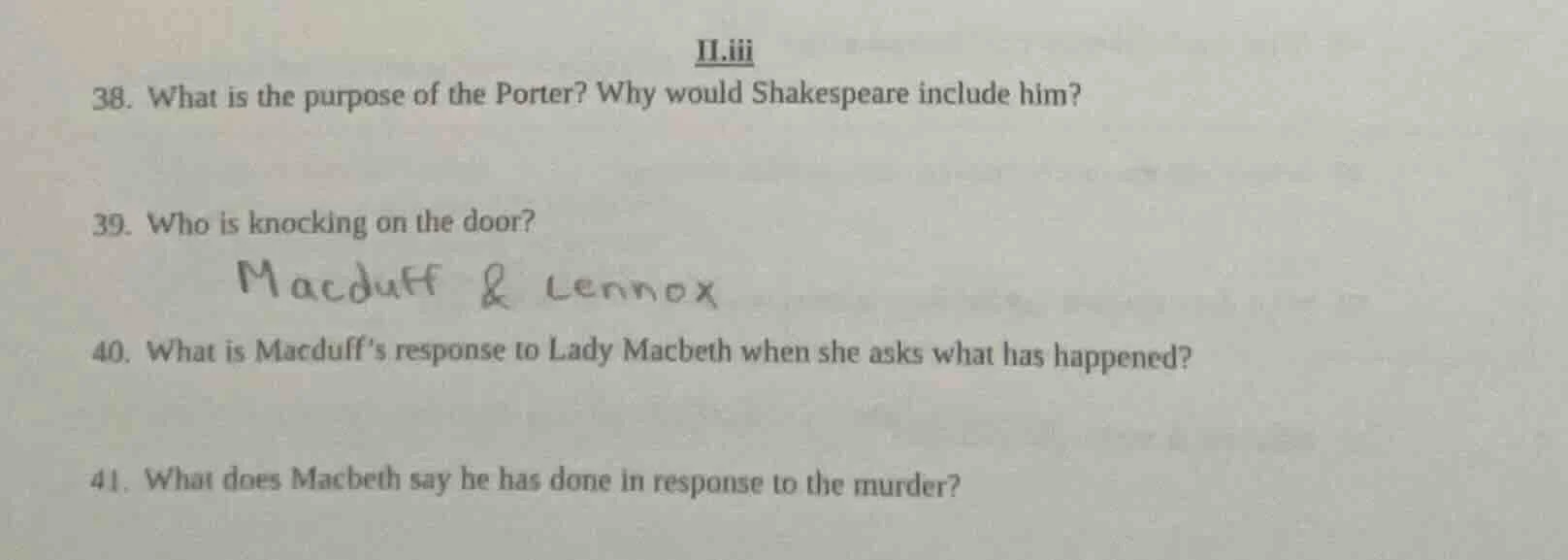
- what is the purpose of the porter? why would shakespeare include him?
- who is knocking on the door?
macduff & lennox
- what is macduff’s response to lady macbeth when she asks what has happened?
- what does macbeth say he has done in response to the murder?
Question 38:
The Porter in Macbeth serves multiple purposes. He provides comic relief after the tense murder scene, easing the audience's tension. His drunken ramblings also act as a form of social commentary, mocking the hell - like nature of Macbeth's castle (symbolic of the moral corruption within) and the vices of drink. Thematically, he contrasts the serious, violent events with absurdity, highlighting the chaos Macbeth's actions have brought. Shakespeare includes him to balance the play's tone, offer social critique, and enhance thematic depth.
In Act II, iii of Macbeth, the people knocking on the door are Macduff and Lennox. This is a key plot point as they arrive to meet with Duncan (unaware of his murder at this point), and their arrival sets in motion the discovery of the crime and the subsequent events in the play.
When Lady Macbeth asks what has happened, Macduff responds by revealing the murder of King Duncan. He tells her (and the others present) that Duncan, the king, has been killed, which is a pivotal moment in the play as it initiates the investigation and the unraveling of Macbeth's deeds.

Snap & solve any problem in the app
Get step-by-step solutions on Sovi AI
Photo-based solutions with guided steps
Explore more problems and detailed explanations
The Porter provides comic relief, offers social commentary (mocking vice and the hell - like castle), and balances the play’s tone. Shakespeare includes him to ease tension after the murder, critique society, and enhance thematic depth (e.g., contrasting absurdity with the serious crime).