QUESTION IMAGE
Question
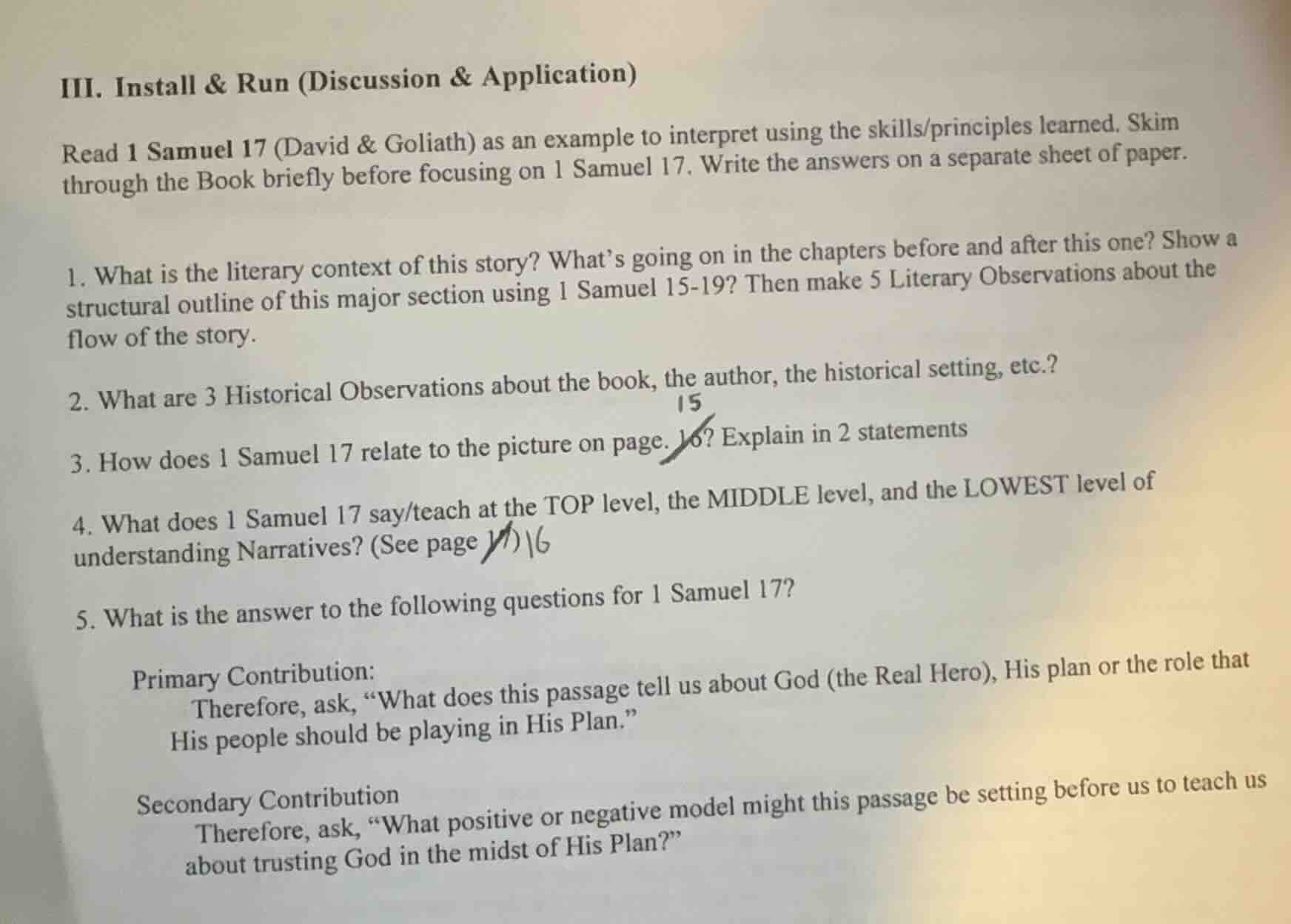
iii. install & run (discussion & application)
read 1 samuel 17 (david & goliath) as an example to interpret using the skills/principles learned. skim through the book briefly before focusing on 1 samuel 17. write the answers on a separate sheet of paper.
- what is the literary context of this story? what’s going on in the chapters before and after this one? show a structural outline of this major section using 1 samuel 15 - 19? then make 5 literary observations about the flow of the story.
- what are 3 historical observations about the book, the author, the historical setting, etc.?
- how does 1 samuel 17 relate to the picture on page 16? explain in 2 statements
- what does 1 samuel 17 say/teach at the top level, the middle level, and the lowest level of understanding narratives? (see page 16)
- what is the answer to the following questions for 1 samuel 17?
primary contribution:
therefore, ask, “what does this passage tell us about god (the real hero), his plan or the role that his people should be playing in his plan.”
secondary contribution
therefore, ask, “what positive or negative model might this passage be setting before us to teach us about trusting god in the midst of his plan?”
- For question 1: The literary context of 1 Samuel 17 is the transition of Israel's leadership from Saul to David. Chapters 15-16: Saul is rejected by God for disobedience, Samuel anoints David as the future king. Chapters 18-19: David gains favor with Israel but is hunted by the jealous Saul.
Literary Observations:
- Builds tension between Saul's failure and David's rise.
- Uses contrast (Goliath's size vs. David's small stature) to emphasize theme.
- Centers the climax on David's faith, not physical strength.
- Uses dialogue to reveal Saul's insecurity and David's resolve.
- Frames the story as part of God's larger plan for Israel's leadership.
- For question 2:
- Historical Setting: 1 Samuel is set in the 11th century BCE, during Israel's transition from a tribal confederacy to a monarchy, amid conflict with Philistine neighbors.
- Authorship & Text: The book is a Deuteronomistic history, likely compiled by editors in the 7th-6th centuries BCE, drawing on earlier oral and written sources.
- Cultural Context: The story reflects ancient Near Eastern warrior traditions, while subverting them by having a young shepherd defeat a giant through divine favor, not royal or military power.
- For question 3: (Note: Since the page 15 image is unavailable, a general connection is provided)
- The image likely depicts David and Goliath in combat, directly illustrating the central, climactic event of 1 Samuel 17.
- The visual representation emphasizes the stark physical contrast between the two figures, which mirrors the thematic contrast of human might vs. divine support in the text.
- For question 4:
- Top Level (Theological): God elevates the humble and faithful, and rejects those who act in pride and disobedience.
- Middle Level (Narrative/Character): True leadership is rooted in trust in God, not status, physical strength, or royal title.
- Lowest Level (Literal/Event): A young shepherd named David defeats the Philistine giant Goliath using a sling and stone, after no Israelite warrior dares to fight Goliath.
- For question 5:
- Primary Contribution: The passage reveals God as the real hero, who uses the unlikely (a young shepherd) to fulfill his plan to establish a faithful leader for Israel, showing that his power is not limited by human standards of strength or status.
- Secondary Contribution: It provides a positive model of trusting God completely in the face of overwhelming odds, and a negative model of Saul's cowardice and failure to rely on God, teaching that faith in God is the key to overcoming challenges.

Snap & solve any problem in the app
Get step-by-step solutions on Sovi AI
Photo-based solutions with guided steps
Explore more problems and detailed explanations
- Literary Context: Transition from Saul to David (1 Sam 15-19: Saul rejected, David anointed, Saul hunts David).
Literary Observations:
- Tension builds between Saul's fall and David's rise
- Contrasts Goliath's size with David's stature
- Climax centers on David's faith, not strength
- Dialogue reveals Saul's insecurity, David's resolve
- Frames story as God's leadership plan
- Historical Observations:
- Set in 11th BCE, Israel's shift to monarchy vs. Philistines
- Part of 7th-6th BCE Deuteronomistic history compilation
- Subverts ancient Near Eastern warrior traditions via divine favor
- (General connection):
- The image depicts the core combat scene of 1 Samuel 17.
- It visualizes the physical contrast central to the text's theme.
- Leveled Teachings:
- Top: God exalts the humble, rejects the proud.
- Middle: True leadership needs faith, not status.
- Lowest: David defeats Goliath with a sling and stone.
- Contributions:
- Primary: God is the hero, using the unlikely to fulfill his leadership plan for Israel.
- Secondary: Models faithful trust in God (positive) and Saul's cowardly lack of faith (negative) amid hardship.