QUESTION IMAGE
Question
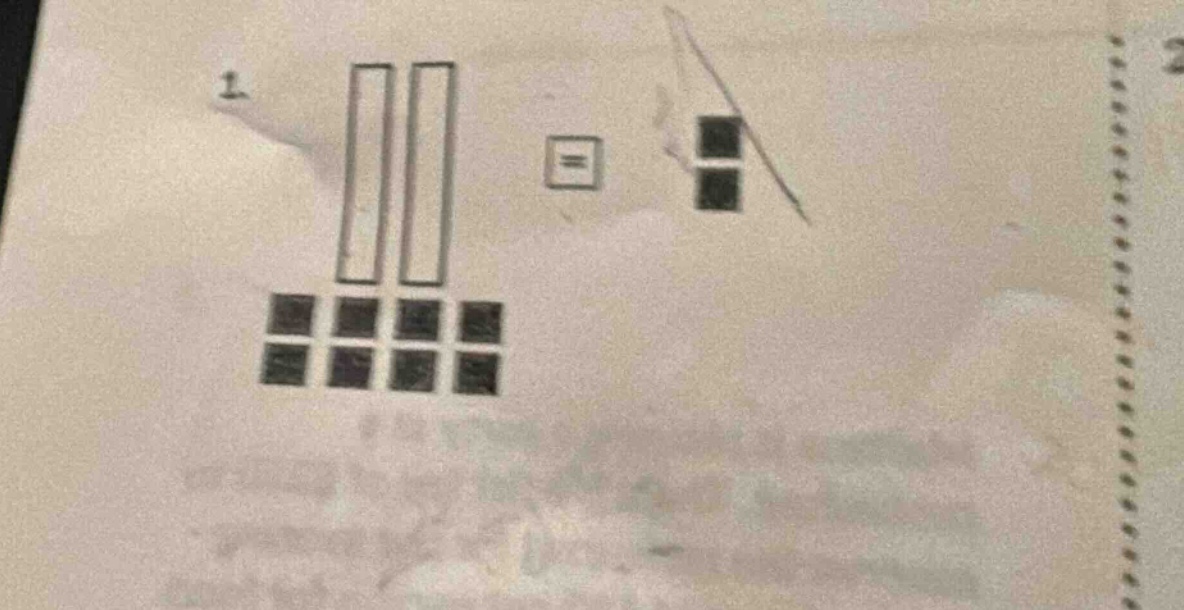
- image content: two vertical rectangles, an equal sign, two black squares, and eight black squares arranged in two rows of four below the rectangles
Step1: Analyze the left side
The left side has 2 tall rectangles (let's assume each tall rectangle represents 10 units, maybe as tens place) and 8 small squares (each small square as 1 unit, ones place). So the number is \(2\times10 + 8\times1=20 + 8 = 28\).
Step2: Analyze the right side
The right side has some black squares and a crossed - out part? Wait, maybe it's a subtraction or a representation. Wait, maybe the left is equal to the right. Wait, maybe the left is 2 tens (20) and 8 ones (8), total 28. The right has 2 black squares? No, maybe the problem is to find what the right side should be or maybe it's a representation of a number. Wait, maybe the left is 28, and the right has 2 black squares (maybe as tens? No, maybe the left is 28, and the right is a way to represent 28. Wait, maybe the left has 2 tall rectangles (each is 10, so 20) and 8 small squares (8), so total 28. The right has 2 black squares (maybe each is 10? No, maybe the right is a different representation. Wait, maybe the problem is to find the value. Wait, the left side: 2 tall rectangles (let's say each is 10) and 8 small squares (each is 1). So \(2\times10+8\times1 = 28\).

Snap & solve any problem in the app
Get step-by-step solutions on Sovi AI
Photo-based solutions with guided steps
Explore more problems and detailed explanations
28 (assuming the left side represents the number 28 and we are to find its value from the visual representation)