QUESTION IMAGE
Question
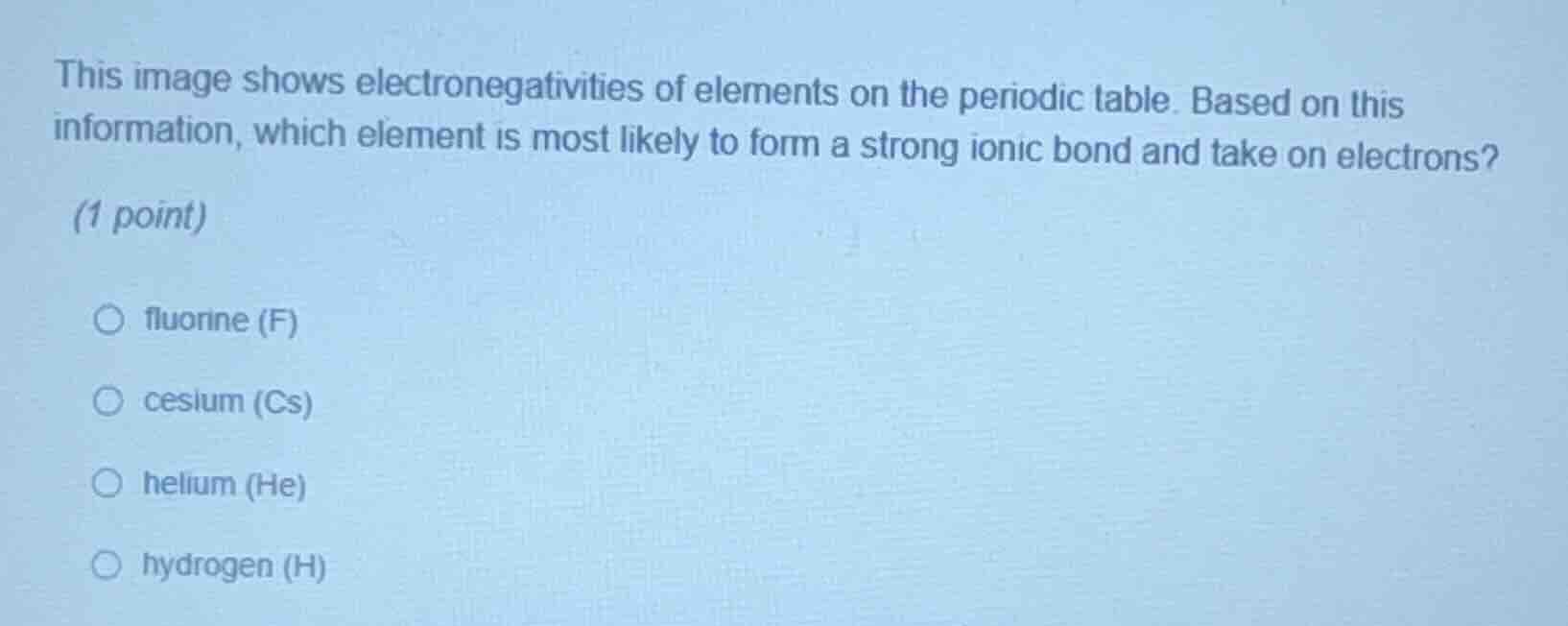
this image shows electronegativities of elements on the periodic table. based on this information, which element is most likely to form a strong ionic bond and take on electrons? (1 point) \bigcirc fluorine (f) \bigcirc cesium (cs) \bigcirc helium (he) \bigcirc hydrogen (h)
Brief Explanations
To determine which element forms a strong ionic bond and takes electrons, we analyze electronegativity and bonding behavior:
- Fluorine (F): It has the highest electronegativity (attracts electrons strongly), is a non - metal, and readily gains electrons to form anions. In ionic bonds, it takes electrons from metals.
- Cesium (Cs): It is a metal with low electronegativity, so it loses electrons (forms cations) rather than taking them.
- Helium (He): It is a noble gas with a full valence shell, so it is chemically inert and does not form ionic bonds.
- Hydrogen (H): Its electronegativity is moderate, and it is less likely to form strong ionic bonds as a electron - acceptor compared to fluorine.

Snap & solve any problem in the app
Get step-by-step solutions on Sovi AI
Photo-based solutions with guided steps
Explore more problems and detailed explanations
A. fluorine (F)