QUESTION IMAGE
Question
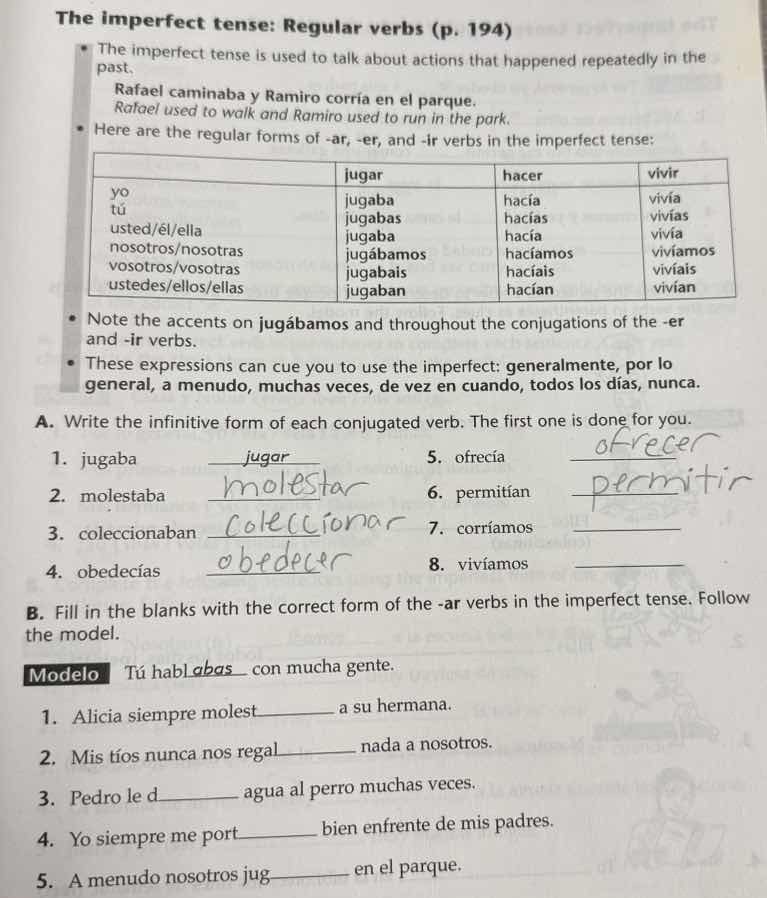
the imperfect tense: regular verbs (p. 194)
- the imperfect tense is used to talk about actions that happened repeatedly in the past.
rafael caminaba y ramiro corría en el parque.
rafael used to walk and ramiro used to run in the park.
- here are the regular forms of -ar, -er, and -ir verbs in the imperfect tense:
| jugar | hacer | vivir | |
|---|---|---|---|
| tú | jugabas | hacías | vivías |
| usted/él/ella | jugaba | hacía | vivía |
| nosotros/nosotras | jugábamos | hacíamos | vivíamos |
| vosotros/vosotras | jugabais | hacíais | vivíais |
| ustedes/ellos/ellas | jugaban | hacían | vivían |
- note the accents on jugábamos and throughout the conjugations of the -er and -ir verbs.
- these expressions can cue you to use the imperfect: generalmente, por lo general, a menudo, muchas veces, de vez en cuando, todos los días, nunca.
a. write the infinitive form of each conjugated verb. the first one is done for you.
- jugaba _jugar_
- molestaba ______
- coleccionaban ______
- obedecías ______
- ofrecía ______
- permitían ______
- corríamos ______
- vivíamos ______
b. fill in the blanks with the correct form of the -ar verbs in the imperfect tense. follow the model.
modelo tú hablabas con mucha gente.
- alicia siempre molest______ a su hermana.
- mis tíos nunca nos regal______ nada a nosotros.
- pedro le d______ agua al perro muchas veces.
- yo siempre me port______ bien enfrente de mis padres.
- a menudo nosotros jug______ en el parque.
Part A: Infinitive Forms of Conjugated Verbs
To find the infinitive form, we identify the base verb from the conjugated form (removing the imperfect tense endings).
- jugaba → The infinitive is jugar (given as a model, follows -ar verb conjugation pattern).
- molestaba → For -ar verbs in imperfect, the stem is "molest" and infinitive is molestar (remove "aba" ending).
- coleccionaban → Remove "aban" (ending for ellos/ellas/ustedes in -ar imperfect) → infinitive coleccionar.
- obedecías → Wait, "obedecías" is an -er verb? Wait, no—wait, the original might have a typo? Wait, "obedecías" (if it's from "obedecer", but in the problem, the user wrote "obedecias" (maybe missing accent). Wait, but following the pattern: for -er or -ir verbs, but in the problem, let's check. Wait, the first part A has:
Wait, the user's A section:
- jugaba → jugar (correct)
- molestaba → molestar (since "molestaba" is -ar imperfect: yo jugaba, tú jugabas, él jugaba; "molestaba" would be yo molestaba, so infinitive molestar)
- coleccionaban → coleccionar (ellos coleccionaban, infinitive coleccionar)
- obedecías → Wait, "obedecías" (with accent on "í") is the tú form of "obedecer" ( -er verb). Wait, but the problem's A.4: the user wrote "obedecías" (maybe as "obedecias" without accent). But following the pattern, infinitive of "obedecías" (tú form of imperfect) is obedecer (since -er verb: yo obedecía, tú obedecías, etc.)
- ofrecía → "ofrecía" is the yo form of "ofrecer" ( -er verb, imperfect: yo ofrecía, tú ofrecías, etc.), so infinitive ofrecer
- permitían → "permitían" is the ellos form of "permitir" ( -ir verb, imperfect: ellos permitían), so infinitive permitir
- corríamos → "corríamos" is the nosotros form of "correr" ( -er verb, imperfect: nosotros corríamos), so infinitive correr
- vivíamos → "vivíamos" is the nosotros form of "vivir" ( -ir verb, imperfect: nosotros vivíamos), so infinitive vivir
Part B: Filling in -ar Verbs in Imperfect Tense
The model is "Tú hablabas con mucha gente" (tú + -ar verb "hablar" → imperfect form "hablabas"). For -ar verbs, the imperfect endings are:
- yo: aba (e.g., jugaba)
- tú: abas (e.g., jugabas)
- él/ella/usted: aba (e.g., jugaba)
- nosotros: ábamos (e.g., jugábamos)
- vosotros: abais (not used here)
- ellos/ellas/ustedes: aban (e.g., jugaban)
- Alicia siempre molest____ a su hermana
Alicia is él/ella (third person singular), so -ar verb "molestar" → imperfect form: ella molestaba (ending "aba" for él/ella). So fill in aba → "molestaba".
- Mis tíos nunca nos regal____ nada a nosotros
Mis tíos is ellos (third person plural), so -ar verb "regalar" → imperfect form: ellos regalaban (ending "aban" for ellos). So fill in aban → "regalaban".
- Pedro le d____ agua al perro muchas veces
Pedro is él (third person singular), -ar verb "dar" → imperfect form: él daba (ending "aba" for yo/él/ella). So fill in aba → "daba".
- Yo siempre me port____ bien enfrente de mis padres
Yo + -ar verb "portarse" (reflexive verb, but the main verb is "portar"? Wait, "portarse" is reflexive: yo me portaba. So -ar verb "portar" (reflexive: portarse) → yo form: portaba (ending "aba" for yo). So fill in aba → "portaba".
- A menudo nosotros jug____ en el parque
Nosotros + -ar verb "jugar" → imperfect form: nosotros jugábamos (ending "ábamos" for nosotros). So fill in ábamos → "jugábamos".
Final Answers (Filled)
Part A (Infinitive Forms):
- jugar
- molestar
- coleccionar
- o…

Snap & solve any problem in the app
Get step-by-step solutions on Sovi AI
Photo-based solutions with guided steps
Explore more problems and detailed explanations
Part A: Infinitive Forms of Conjugated Verbs
To find the infinitive form, we identify the base verb from the conjugated form (removing the imperfect tense endings).
- jugaba → The infinitive is jugar (given as a model, follows -ar verb conjugation pattern).
- molestaba → For -ar verbs in imperfect, the stem is "molest" and infinitive is molestar (remove "aba" ending).
- coleccionaban → Remove "aban" (ending for ellos/ellas/ustedes in -ar imperfect) → infinitive coleccionar.
- obedecías → Wait, "obedecías" is an -er verb? Wait, no—wait, the original might have a typo? Wait, "obedecías" (if it's from "obedecer", but in the problem, the user wrote "obedecias" (maybe missing accent). Wait, but following the pattern: for -er or -ir verbs, but in the problem, let's check. Wait, the first part A has:
Wait, the user's A section:
- jugaba → jugar (correct)
- molestaba → molestar (since "molestaba" is -ar imperfect: yo jugaba, tú jugabas, él jugaba; "molestaba" would be yo molestaba, so infinitive molestar)
- coleccionaban → coleccionar (ellos coleccionaban, infinitive coleccionar)
- obedecías → Wait, "obedecías" (with accent on "í") is the tú form of "obedecer" ( -er verb). Wait, but the problem's A.4: the user wrote "obedecías" (maybe as "obedecias" without accent). But following the pattern, infinitive of "obedecías" (tú form of imperfect) is obedecer (since -er verb: yo obedecía, tú obedecías, etc.)
- ofrecía → "ofrecía" is the yo form of "ofrecer" ( -er verb, imperfect: yo ofrecía, tú ofrecías, etc.), so infinitive ofrecer
- permitían → "permitían" is the ellos form of "permitir" ( -ir verb, imperfect: ellos permitían), so infinitive permitir
- corríamos → "corríamos" is the nosotros form of "correr" ( -er verb, imperfect: nosotros corríamos), so infinitive correr
- vivíamos → "vivíamos" is the nosotros form of "vivir" ( -ir verb, imperfect: nosotros vivíamos), so infinitive vivir
Part B: Filling in -ar Verbs in Imperfect Tense
The model is "Tú hablabas con mucha gente" (tú + -ar verb "hablar" → imperfect form "hablabas"). For -ar verbs, the imperfect endings are:
- yo: aba (e.g., jugaba)
- tú: abas (e.g., jugabas)
- él/ella/usted: aba (e.g., jugaba)
- nosotros: ábamos (e.g., jugábamos)
- vosotros: abais (not used here)
- ellos/ellas/ustedes: aban (e.g., jugaban)
- Alicia siempre molest____ a su hermana
Alicia is él/ella (third person singular), so -ar verb "molestar" → imperfect form: ella molestaba (ending "aba" for él/ella). So fill in aba → "molestaba".
- Mis tíos nunca nos regal____ nada a nosotros
Mis tíos is ellos (third person plural), so -ar verb "regalar" → imperfect form: ellos regalaban (ending "aban" for ellos). So fill in aban → "regalaban".
- Pedro le d____ agua al perro muchas veces
Pedro is él (third person singular), -ar verb "dar" → imperfect form: él daba (ending "aba" for yo/él/ella). So fill in aba → "daba".
- Yo siempre me port____ bien enfrente de mis padres
Yo + -ar verb "portarse" (reflexive verb, but the main verb is "portar"? Wait, "portarse" is reflexive: yo me portaba. So -ar verb "portar" (reflexive: portarse) → yo form: portaba (ending "aba" for yo). So fill in aba → "portaba".
- A menudo nosotros jug____ en el parque
Nosotros + -ar verb "jugar" → imperfect form: nosotros jugábamos (ending "ábamos" for nosotros). So fill in ábamos → "jugábamos".
Final Answers (Filled)
Part A (Infinitive Forms):
- jugar
- molestar
- coleccionar
- obedecer
- ofrecer
- permitir
- correr
- vivir
Part B (Imperfect -ar Verbs):
- Alicia siempre molestaba a su hermana.
- Mis tíos nunca nos regalaban nada a nosotros.
- Pedro le daba agua al perro muchas veces.
- Yo siempre me portaba bien enfrente de mis padres.
- A menudo nosotros jugábamos en el parque.
(Note: For Part A, ensure accents are correct: e.g., "obedecer", "ofrecer", "permitir", "correr", "vivir" have correct spellings. For Part B, the endings follow -ar imperfect conjugation: yo aba, tú abas, él/ella aba, nosotros ábamos, ellos aban.)