QUESTION IMAGE
Question
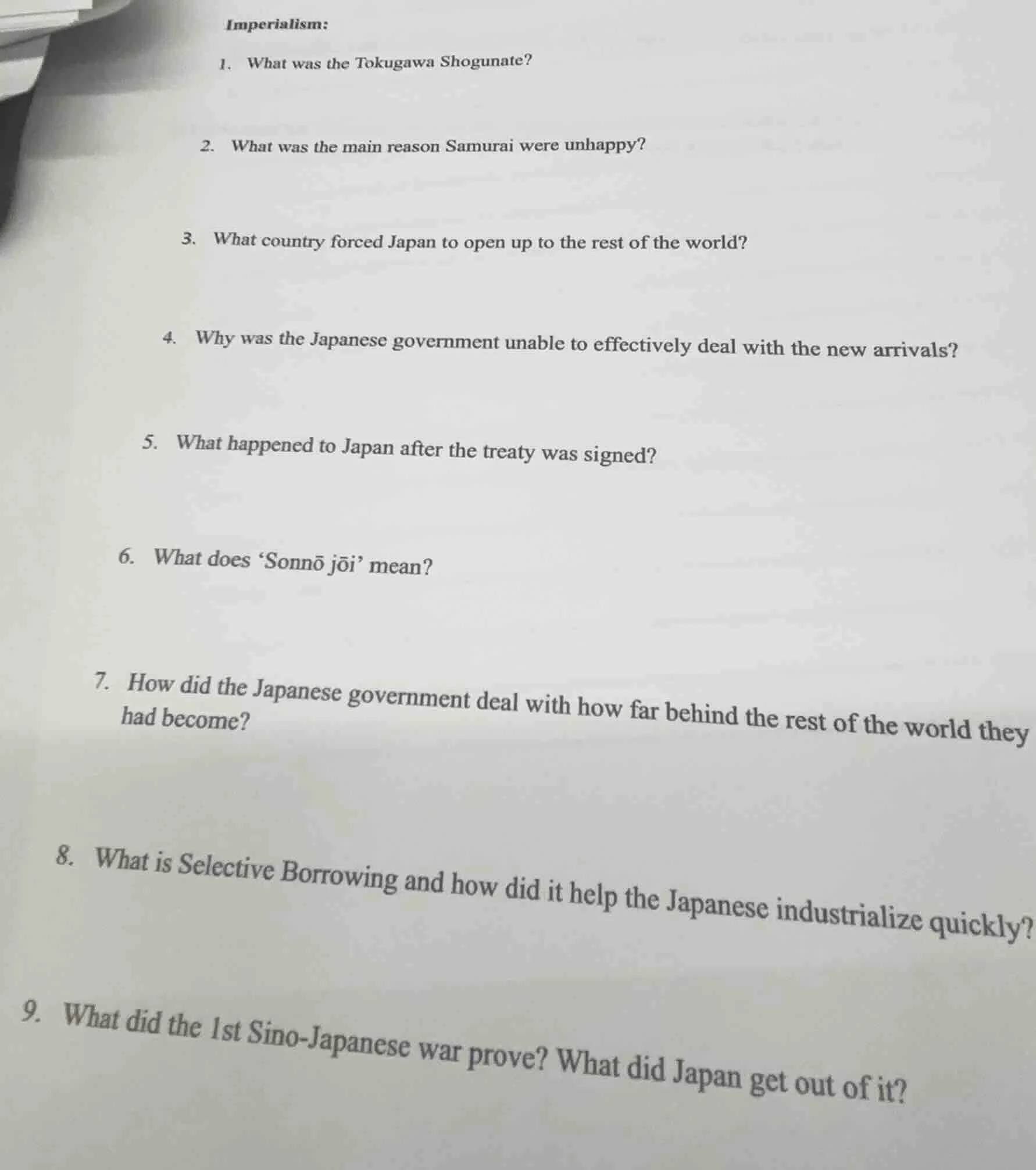
imperialism:
- what was the tokugawa shogunate?
- what was the main reason samurai were unhappy?
- what country forced japan to open up to the rest of the world?
- why was the japanese government unable to effectively deal with the new arrivals?
- what happened to japan after the treaty was signed?
- what does sonnō jōi mean?
- how did the japanese government deal with how far behind the rest of the world they had become?
- what is selective borrowing and how did it help the japanese industrialize quickly?
- what did the 1st sino-japanese war prove? what did japan get out of it?
Brief Explanations
- Defined the Tokugawa Shogunate as Japan's ruling military government.
- Identified loss of privileges/income as samurai's core grievance.
- Named the U.S. as the forcing nation for Japan's opening.
- Cited military/technological inferiority for government failure.
- Outlined post-treaty social, economic, and political upheaval.
- Translated and explained the "Sonnō jōi" slogan.
- Described the Meiji Restoration's modernization efforts.
- Defined selective borrowing and its industrialization role.
- Summarized the First Sino-Japanese War's outcomes and gains.

Snap & solve any problem in the app
Get step-by-step solutions on Sovi AI
Photo-based solutions with guided steps
Explore more problems and detailed explanations
- The Tokugawa Shogunate was a feudal military government that ruled Japan from 1603 to 1868, led by a shogun (military dictator) of the Tokugawa clan, enforcing strict isolationist policies for most of its rule.
- The main reason samurai were unhappy was the erosion of their traditional privileges, including loss of stipends (paid in depreciating rice) and loss of social status as the Tokugawa Shogunate weakened and Japan faced external pressure.
- The United States, led by Commodore Matthew Perry in 1853-1854, forced Japan to open up to the rest of the world with the Treaty of Kanagawa.
- The Japanese government (Tokugawa Shogunate) was unable to effectively deal with new arrivals because it was militarily and technologically far behind Western powers, and its isolationist policies had left it unprepared for external pressure.
- After the treaty was signed, Japan faced severe social and economic unrest: foreign trade disrupted traditional industries, samurai privileges declined, and widespread dissatisfaction with the shogunate led to political upheaval that culminated in the Meiji Restoration of 1868.
- 'Sonnō jōi' is a Japanese slogan meaning "Revere the Emperor, Expel the Barbarians." It was a nationalist rallying cry in the mid-1800s, used by groups opposing the Tokugawa Shogunate and foreign influence.
- The Japanese government launched the Meiji Restoration (1868), abolishing feudalism, modernizing the military, adopting Western technology and political systems, and implementing widespread industrial and social reforms to catch up with global powers.
- Selective Borrowing is the practice of adopting foreign ideas, technologies, and institutions while rejecting elements that conflict with local culture or goals. It helped Japan industrialize quickly by allowing it to import proven Western industrial and technological advances (like factory systems and military technology) without abandoning core social structures, enabling rapid, targeted modernization.
- The 1st Sino-Japanese War (1894-1895) proved that Japan had successfully modernized into a major military power, surpassing Qing Dynasty China. Japan gained control of Taiwan, the Pescadores Islands, and the Liaodong Peninsula (later returned for a large indemnity), as well as a huge war indemnity from China, which further funded its industrial and military growth.