QUESTION IMAGE
Question
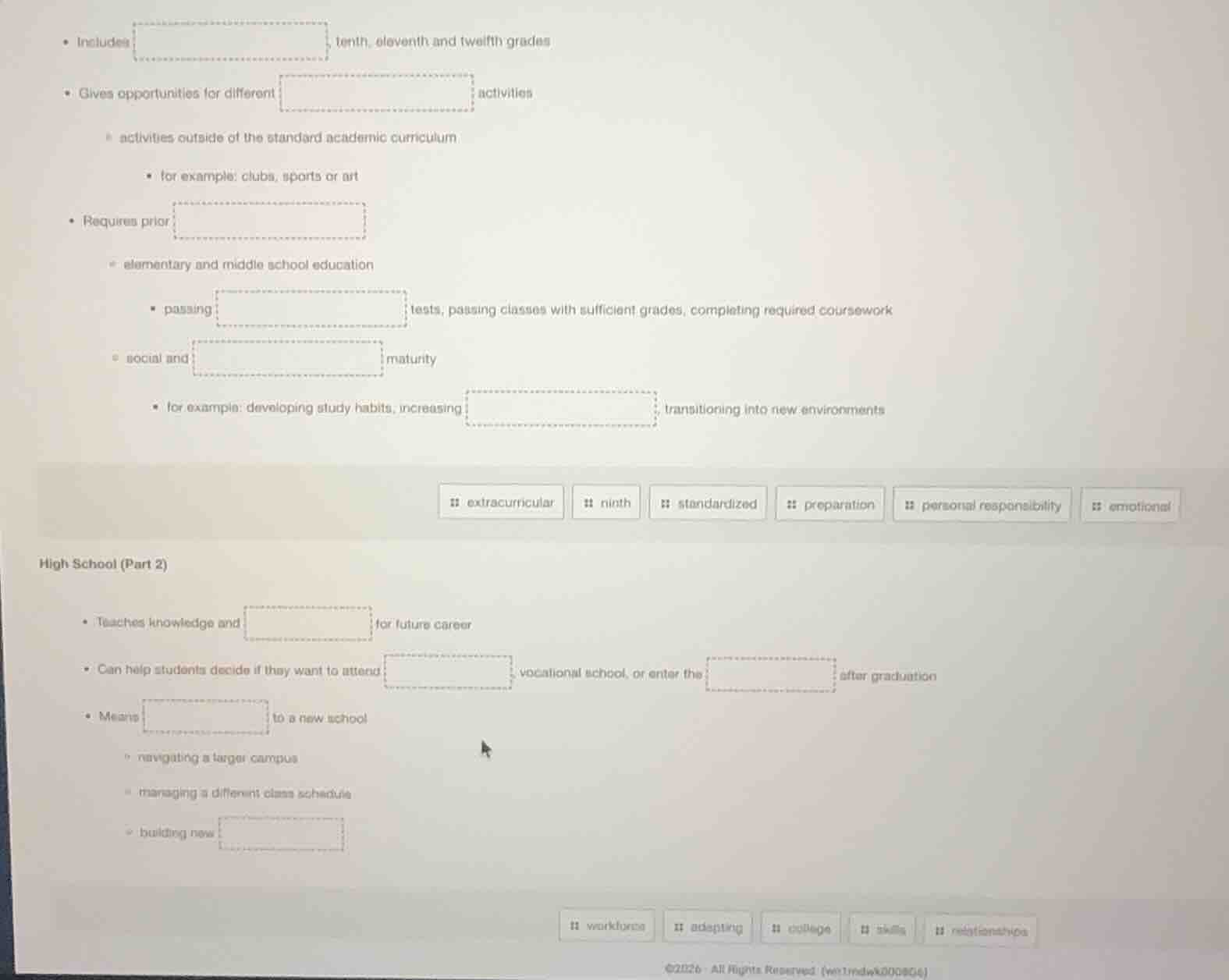
- includes tenth, eleventh and twelfth grades
- gives opportunities for different activities
- activities outside of the standard academic curriculum
- for example: clubs, sports or art
- requires prior
- elementary and middle school education
- passing tests, passing classes with sufficient grades, completing required coursework
- social and maturity
- for example: developing study habits, increasing transitioning into new environments
extracurricular ninth standardized preparation personal responsibility emotional
high school (part 2)
- teaches knowledge and for future career
- can help students decide if they want to attend , vocational school, or enter the after graduation
- means to a new school
- navigating a larger campus
- managing a different class schedule
- building new
workforce adapting college skills relationships
Brief Explanations
Match each term to the blank based on context and definitions of high school education requirements and features.
- First blank: High school includes 9th-12th grade, so "ninth" fits.
- Second blank: Activities outside standard curriculum are "extracurricular".
- Third blank: High school requires prior "preparation" (elementary/middle school).
- Fourth blank: Common required tests are "standardized".
- Fifth blank: Maturity has social and "emotional" components.
- Sixth blank: Example of maturity is "personal responsibility".
- Seventh blank: High school teaches career-focused "skills".
- Eighth blank: Post-high school options include "college" and vocational school.
- Ninth blank: Another post-high school path is the "workforce".
- Tenth blank: Moving to a new school means "adapting".
- Eleventh blank: School transition involves building new "relationships".

Snap & solve any problem in the app
Get step-by-step solutions on Sovi AI
Photo-based solutions with guided steps
Explore more problems and detailed explanations
High School (Part 1)
- Includes ninth tenth, eleventh and twelfth grades
- Gives opportunities for different extracurricular activities
- Requires prior preparation
- passing standardized tests; passing classes with sufficient grades, completing required coursework
- social and emotional maturity
- for example: developing study habits, increasing personal responsibility; transitioning into new environments
High School (Part 2)
- Teaches knowledge and skills for future career
- Can help students decide if they want to attend college, vocational school, or enter the workforce after graduation
- Means adapting to a new school
- building new relationships