QUESTION IMAGE
Question
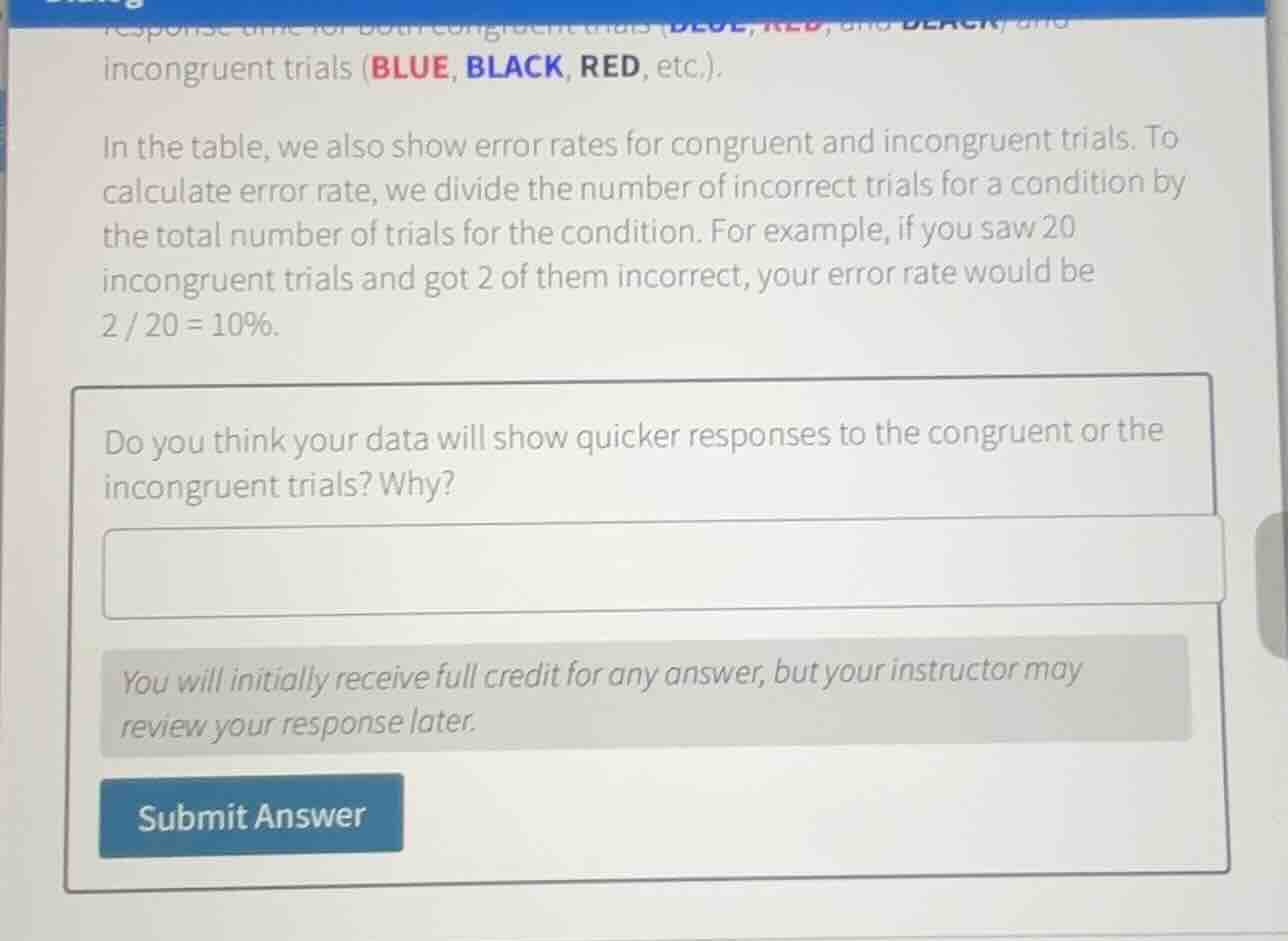
incongruent trials (blue, black, red, etc.). in the table, we also show error rates for congruent and incongruent trials. to calculate error rate, we divide the number of incorrect trials for a condition by the total number of trials for the condition. for example, if you saw 20 incongruent trials and got 2 of them incorrect, your error rate would be 2 / 20 = 10%. do you think your data will show quicker responses to the congruent or the incongruent trials? why? you will initially receive full credit for any answer, but your instructor may review your response later. submit answer
This refers to the Stroop effect, a well-documented psychological phenomenon. In congruent trials (e.g., the word "BLUE" printed in blue ink), the information from the word's meaning and the ink color aligns, so the brain processes the task quickly without conflict. In incongruent trials (e.g., the word "RED" printed in blue ink), the brain experiences cognitive conflict as it must suppress the automatic response of reading the word to focus on naming the ink color, which slows down reaction time.

Snap & solve any problem in the app
Get step-by-step solutions on Sovi AI
Photo-based solutions with guided steps
Explore more problems and detailed explanations
Data will show quicker responses to congruent trials. This is due to the Stroop effect: congruent trials have matching word meaning and ink color, so the brain experiences no cognitive conflict and processes the task faster, while incongruent trials create conflicting signals that require extra mental effort to resolve, slowing response time.