QUESTION IMAGE
Question
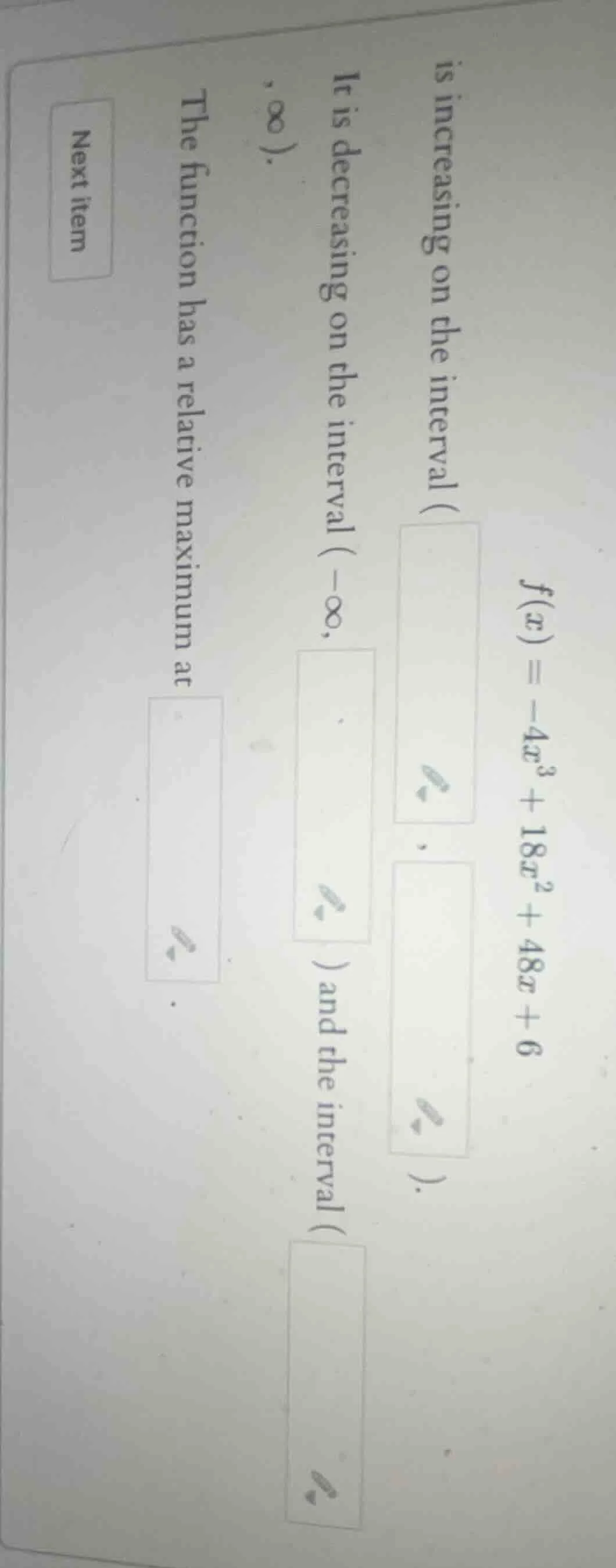
$f(x) = -4x^3 + 18x^2 + 48x + 6$
is increasing on the interval ( $square$ , $square$ ).
it is decreasing on the interval $(-\infty, \square)$ and the interval ( $square$ , $\infty$ ).
the function has a relative maximum at $square$.
Step1: Find first derivative
$f'(x) = \frac{d}{dx}(-4x^3 + 18x^2 + 48x + 6) = -12x^2 + 36x + 48$
Step2: Factor derivative
Factor out -12:
$f'(x) = -12(x^2 - 3x - 4) = -12(x-4)(x+1)$
Step3: Find critical points
Set $f'(x)=0$:
$-12(x-4)(x+1)=0$
Solutions: $x=-1, x=4$
Step4: Test intervals for increase/decrease
- For $x < -1$: $f'(x) < 0$ (function decreasing)
- For $-1 < x < 4$: $f'(x) > 0$ (function increasing)
- For $x > 4$: $f'(x) < 0$ (function decreasing)
Step5: Identify relative maximum
The function switches from increasing to decreasing at $x=4$, so this is a relative maximum.

Snap & solve any problem in the app
Get step-by-step solutions on Sovi AI
Photo-based solutions with guided steps
Explore more problems and detailed explanations
Increasing interval: $(-1, 4)$
Decreasing intervals: $(-\infty, -1)$ and $(4, \infty)$
Relative maximum at $x=4$