QUESTION IMAGE
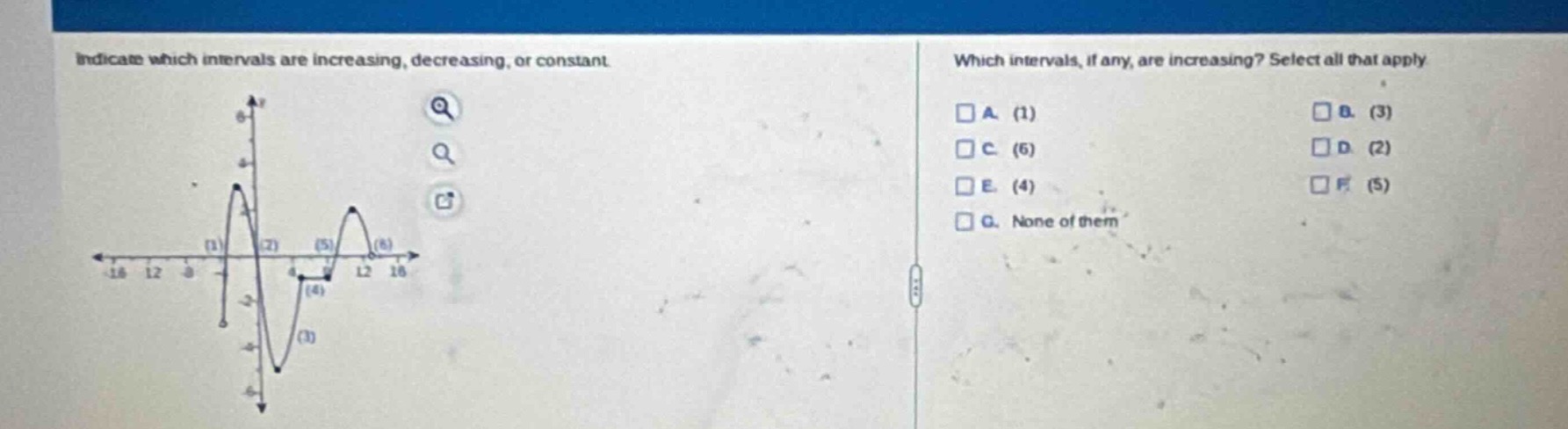
Question
indicate which intervals are increasing, decreasing, or constant.
which intervals, if any, are increasing? select all that apply
a. (1)
b. (3)
c. (6)
d. (2)
e. (4)
f. (5)
g. none of them
To determine which intervals are increasing, we analyze the graph's behavior:
- An increasing interval is where, as \( x \) increases, \( y \) also increases.
- Interval (3): From the minimum point (lowest \( y \)) to the point at \( x = 5 \), as \( x \) increases, \( y \) increases (the graph rises from the bottom to the horizontal segment at (4) and then to the peak before (6)? Wait, no, re - examining: Wait, interval (3) is from the bottom (where \( x \) is around, say, after the left part) up to the horizontal line? Wait, no, let's look at the intervals:
- Interval (1): The graph on (1) - as \( x \) increases (from left to right in (1)), the \( y \) - value is decreasing (since it goes from a higher point to a lower open circle).
- Interval (2): The graph crosses the x - axis, but as \( x \) increases, \( y \) is decreasing (going from positive to negative? Wait, no, the left part: the first peak, then it goes down, crosses the x - axis, then goes to a minimum. Then interval (3): from the minimum (lowest \( y \)) to the horizontal line (4) - as \( x \) increases, \( y \) increases (since it goes from a low \( y \) to the horizontal line's \( y \) - value). Wait, no, the horizontal line (4) is constant. Then interval (5): constant (horizontal line). Interval (6): from the open circle, the graph goes up? Wait, no, the right part: after (5), there is a peak, then it goes to an open circle at (6). Wait, maybe I misread. Wait, the key is: an increasing function has \( f(x_1)<f(x_2) \) when \( x_1 < x_2 \).
- Let's re - evaluate each interval:
- Interval (1): As \( x \) increases (moving right in (1)), \( y \) decreases (so decreasing).
- Interval (2): As \( x \) increases, \( y \) decreases (crossing x - axis, going down), so decreasing.
- Interval (3): As \( x \) increases (from the minimum point to the start of the horizontal line (4)), \( y \) increases (because it goes from a lower \( y \) - value to the \( y \) - value of the horizontal line). Wait, but the horizontal line (4) is constant. Wait, maybe the interval (3) is from the minimum (where \( y \) is lowest) to the point before (4). So in interval (3), as \( x \) increases, \( y \) increases.
- Interval (4): Constant (horizontal line, so \( y \) doesn't change, so constant, not increasing).
- Interval (5): Constant (horizontal line, so constant, not increasing).
- Interval (6): As \( x \) increases (moving right in (6)), does \( y \) increase? Wait, the open circle at (6) - before (6), there is a peak, then it goes to (6). Wait, maybe I made a mistake. Wait, the correct way: an increasing interval is where the graph is rising as we move from left to right.
- Wait, maybe the interval (3) is increasing. Wait, but let's check the options. The options are A. (1), B. (3), C. (6), D. (2), E. (4), F. (5), G. None.
- Wait, maybe I was wrong earlier. Let's think again: the graph has a minimum, then from the minimum (start of interval (3)) to the horizontal line (interval (4) starts), as \( x \) increases, \( y \) increases (because it goes from a low \( y \) to the \( y \) of the horizontal line). So interval (3) is increasing.

Snap & solve any problem in the app
Get step-by-step solutions on Sovi AI
Photo-based solutions with guided steps
Explore more problems and detailed explanations
B. (3)