QUESTION IMAGE
Question
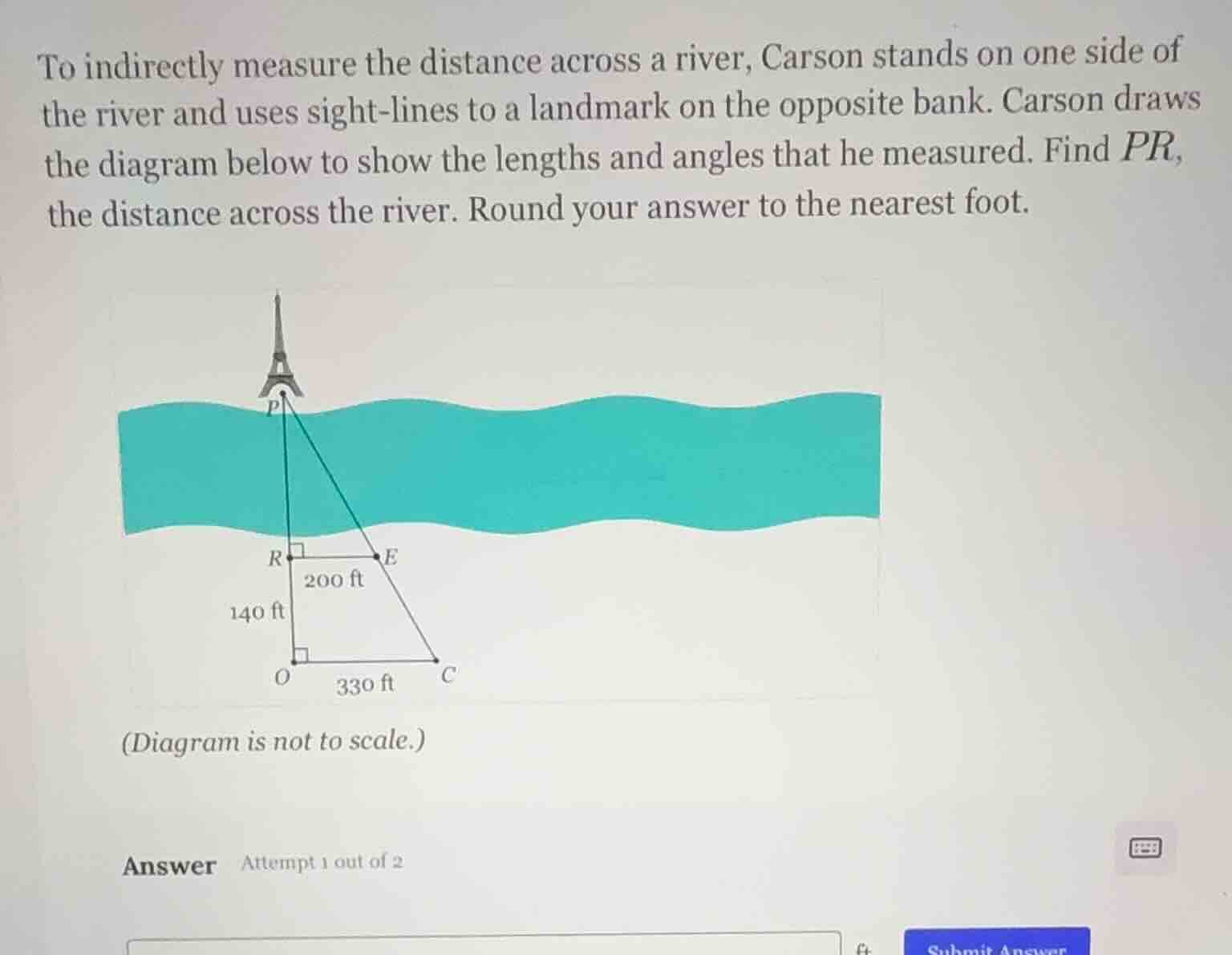
to indirectly measure the distance across a river, carson stands on one side of the river and uses sight - lines to a landmark on the opposite bank. carson draws the diagram below to show the lengths and angles that he measured. find ( pr ), the distance across the river. round your answer to the nearest foot. (diagram is not to scale.)
Step1: Identify similar triangles
Triangles \(PRE\) and \(PCO\) are similar (by AA similarity, as both have a right angle and share \(\angle P\)). So, the ratios of corresponding sides are equal: \(\frac{PR}{PO}=\frac{RE}{OC}\).
Step2: Define variables
Let \(PR = x\). Then \(PO=x + 140\) (since \(RO = 140\) ft), \(RE = 200\) ft, and \(OC = 330\) ft.
Step3: Set up proportion
Substitute into the proportion: \(\frac{x}{x + 140}=\frac{200}{330}\).
Step4: Cross - multiply and solve
Cross - multiply: \(330x=200(x + 140)\).
Expand: \(330x=200x+28000\).
Subtract \(200x\) from both sides: \(330x - 200x=28000\).
Simplify: \(130x = 28000\).
Solve for \(x\): \(x=\frac{28000}{130}\approx215.38\). Rounding to the nearest foot, \(x\approx215\). Wait, no, wait. Wait, maybe I made a mistake in the setup. Wait, actually, \(RO\) is 140, \(RE = 200\), \(OC = 330\). Wait, the right angles: \(\angle R\) and \(\angle O\) are right angles. So \(\triangle PRE\sim\triangle POC\) (order matters). So \(\frac{PR}{PO}=\frac{RE}{OC}\), where \(PO=PR + RO=PR + 140\), \(PR\) is what we need, \(RE = 200\), \(OC = 330\). So:
\(330\times PR=200\times(PR + 140)\)
\(330PR=200PR+28000\)
\(330PR - 200PR=28000\)
\(130PR=28000\)
\(PR=\frac{28000}{130}\approx215.38\). Wait, but that seems low. Wait, maybe the triangles are \(\triangle PRE\) and \(\triangle POC\) with \(RE\) parallel to \(OC\), so the ratio is \(\frac{PR}{RO}=\frac{RE}{OC - RE}\)? No, no, let's re - examine the diagram. Wait, \(R\) and \(O\) are on the same vertical line, \(E\) is on \(RC\) (horizontal), \(C\) is on the horizontal from \(O\). So \(RE = 200\), \(OC = 330\), \(RO = 140\). So the two right triangles: \(\triangle PRE\) (right at \(R\)) and \(\triangle POC\) (right at \(O\)). So \(\angle P\) is common, so they are similar. So corresponding sides: \(PR\) corresponds to \(PO\), \(RE\) corresponds to \(OC\). So \(PR/PO=RE/OC\), \(PO = PR + RO=PR + 140\). So:
\(PR/(PR + 140)=200/330\)
\(330PR=200PR + 28000\)
\(130PR=28000\)
\(PR = 28000/130\approx215\). Wait, but maybe I mixed up the sides. Wait, maybe \(RE\) is 200, \(OC\) is 330, and \(RO\) is 140. Alternatively, maybe the height from \(P\) to \(R\) is \(x\), and from \(P\) to \(O\) is \(x + 140\). The horizontal distances: \(RE = 200\), \(OC = 330\). So the slope of \(PE\) is \(200/x\), and the slope of \(PC\) is \(330/(x + 140)\). Since they are the same line, slopes are equal: \(200/x=330/(x + 140)\). Which is the same equation as before. So solving \(200(x + 140)=330x\), \(200x+28000 = 330x\), \(130x=28000\), \(x = 28000/130\approx215.38\), so approximately 215 feet. Wait, but let's check again. Wait, maybe the diagram is such that \(RO = 140\), \(RE = 200\), \(OC = 330\). So the horizontal segment from \(R\) to \(E\) is 200, from \(O\) to \(C\) is 330. The vertical segment from \(R\) to \(O\) is 140. So the two triangles: \(\triangle PRE\) (right at \(R\)) with legs \(PR\) (vertical) and \(RE\) (horizontal), and \(\triangle POC\) (right at \(O\)) with legs \(PO\) (vertical, \(PO=PR + 140\)) and \(OC\) (horizontal). So similarity ratio is \(RE/OC = 200/330\), and \(PR/PO=200/330\). So that's correct. So the calculation gives approximately 215 feet. Wait, but maybe I made a mistake in the problem interpretation. Wait, maybe the triangles are \(\triangle PRE\) and \(\triangle POC\) with \(PR\) and \(PO\) as vertical sides, \(RE\) and \(OC\) as horizontal sides. So yes, the proportion is correct. So the distance \(PR\) is approximately 215 feet. Wait, but let's do the division: 28000 divided by 130. 130215 = 130200+130*15 =…

Snap & solve any problem in the app
Get step-by-step solutions on Sovi AI
Photo-based solutions with guided steps
Explore more problems and detailed explanations
\(215\)