QUESTION IMAGE
Question
influence on u.s. government
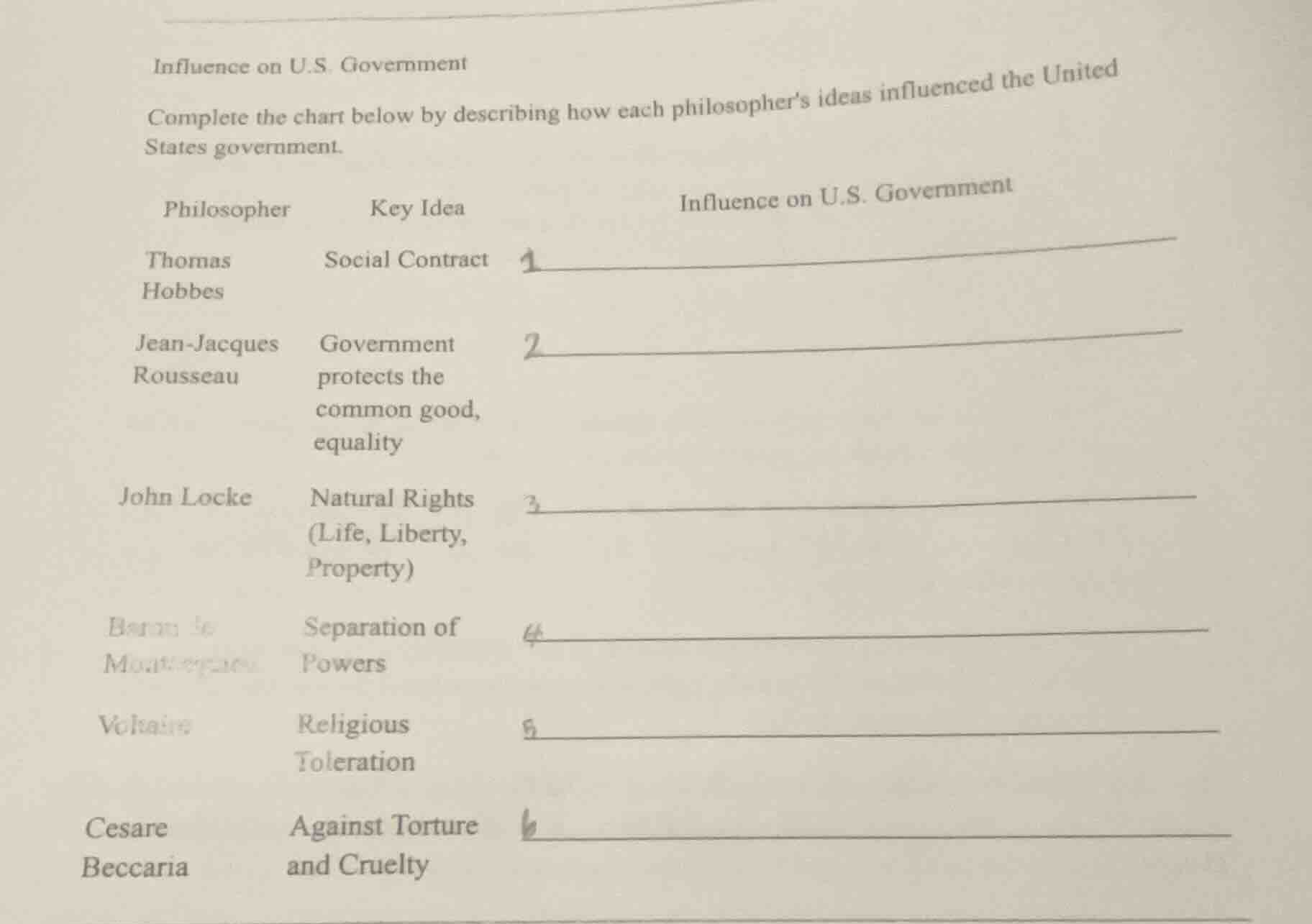
complete the chart below by describing how each philosophers ideas influenced the united states government.
philosopher | key idea | influence on u.s. government
thomas hobbes | social contract | 1
jean-jacques rousseau | government protects the common good, equality | 2
john locke | natural rights (life, liberty, property) | 3
baron de montesquieu | separation of powers | 4
voltaire | religious toleration | 5
cesare beccaria | against torture and cruelty | 6
Brief Explanations
- Thomas Hobbes: His social contract theory established the foundational idea that citizens consent to be governed in exchange for order and protection, which underpins the U.S. government's legitimate authority to maintain stability.
- Jean-Jacques Rousseau: His focus on the common good and equality informed the U.S. system's emphasis on majority rule (via elected representatives) and the principle that government exists to serve the collective will of the people.
- John Locke: His natural rights framework directly inspired the U.S. Declaration of Independence, which enshrines the rights to life, liberty, and the pursuit of happiness (a rephrasing of Locke's "property"), and the idea that people can overthrow unjust governments.
- Baron de Montesquieu: His separation of powers concept was adopted to create the U.S. government's three branches (legislative, executive, judicial) with checks and balances to prevent tyranny.
- Voltaire: His advocacy for religious tolerance influenced the First Amendment's Establishment Clause and Free Exercise Clause, which prohibit a state religion and protect religious freedom.
- Cesare Beccaria: His opposition to torture and cruel punishment shaped the Eighth Amendment, which bans cruel and unusual punishment in the U.S. legal system.

Snap & solve any problem in the app
Get step-by-step solutions on Sovi AI
Photo-based solutions with guided steps
Explore more problems and detailed explanations
- Established the core idea that citizens agree to be governed in exchange for the government maintaining order and security, forming the basis of the U.S. government's legitimate authority.
- Inspired the principle that U.S. government should prioritize the common good of all citizens, reflected in majority rule and democratic representation.
- Directly informed the U.S. Declaration of Independence's enshrinement of natural rights (life, liberty, pursuit of happiness) and the right to replace unjust governments.
- Led to the creation of the U.S. government's three separate branches (legislative, executive, judicial) with checks and balances to avoid concentrated power.
- Influenced the First Amendment's protections for religious freedom, including the ban on an official state religion and the right to practice one's faith freely.
- Shaped the Eighth Amendment, which prohibits the use of cruel and unusual punishment in the U.S. criminal justice system.