QUESTION IMAGE
Question
information about a shipment of mirrors to a local store is shown.
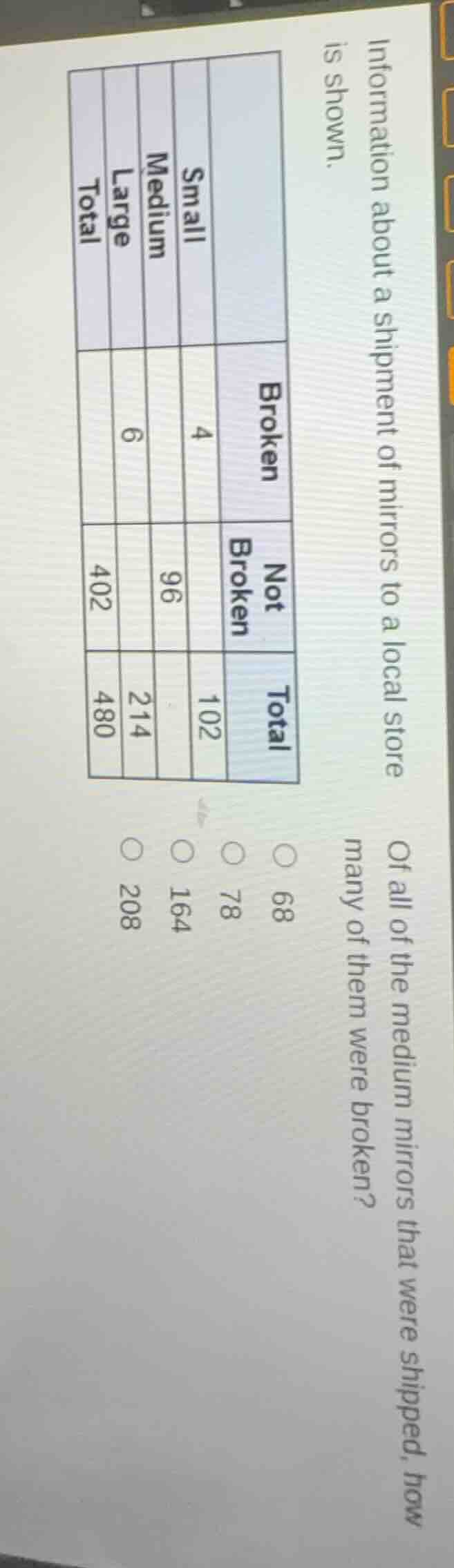
chart with rows: broken, not broken, total; columns: small, medium, large, total. data: small - broken: 4, not broken: (lets infer, but table has small total 102, so not broken for small is 102 - 4 = 98? wait, original table: small row: broken 4, total 102; medium row: not broken 96, total?; large row: broken 6, total 214; total row: broken?, not broken 402, total 480. then question: of all of the medium mirrors that were shipped, how many of them were broken? options: 68, 78, 164, 208
Step1: Find total medium mirrors
First, we know the total number of mirrors is 480. The total for small is 102 and for large is 214. So total medium mirrors = 480 - 102 - 214 = 164.
Step2: Find broken medium mirrors
We know the number of not - broken medium mirrors is 96. Let the number of broken medium mirrors be \(x\). Then, using the formula for total medium mirrors (total = broken + not broken), we have \(x+96 = 164\). Solving for \(x\), we get \(x=164 - 96=68\). Wait, no, wait. Wait, let's check again. Wait, the total of all mirrors: small total 102, large total 214, so medium total is 480 - 102 - 214 = 164. Then, the number of not - broken medium mirrors is 96. So broken medium mirrors = total medium - not broken medium = 164 - 96 = 68? Wait, but let's check the total broken. The total broken: small broken 4, large broken 6, so total broken is 4 + 6+ broken medium. And total not broken is 402, so total broken is 480 - 402 = 78. So 4 + 6+ broken medium = 78. So broken medium = 78 - 10 = 68. Yes, that's correct.

Snap & solve any problem in the app
Get step-by-step solutions on Sovi AI
Photo-based solutions with guided steps
Explore more problems and detailed explanations
68