QUESTION IMAGE
Question
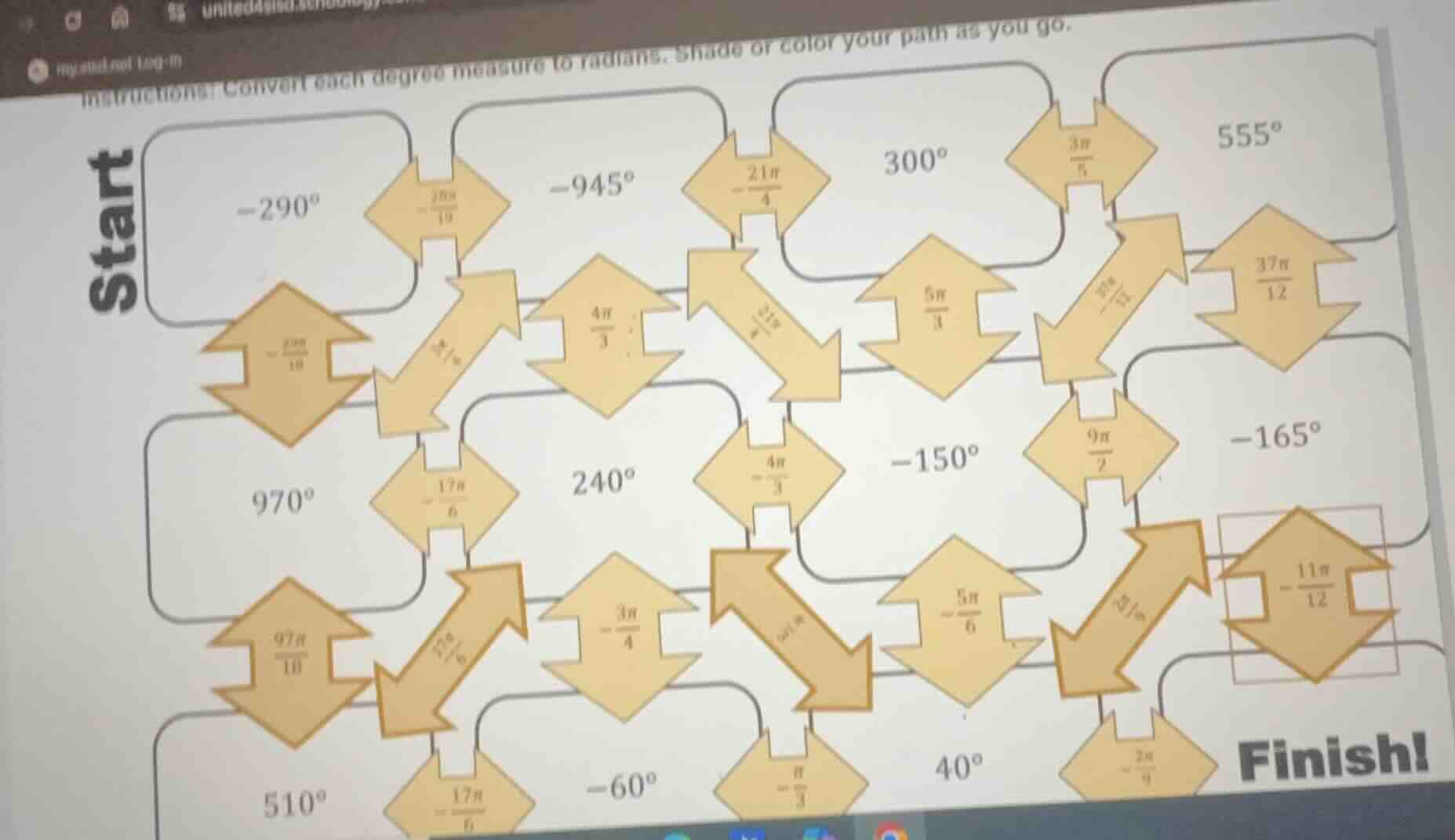
instructions: convert each degree measure to radians. shade or color your path as you go. start -290° -945° 300° 555° 970° 240° -150° -165° 510° -60° 40° finish!
To solve the problem of converting degree measures to radians, we use the conversion formula: \( \text{radians} = \text{degrees} \times \frac{\pi}{180} \). Let's take a few examples from the given problem:
Example 1: Convert \( -290^\circ \) to radians
Step 1: Apply the conversion formula
Multiply the degree measure by \( \frac{\pi}{180} \).
\( -290^\circ \times \frac{\pi}{180} = -\frac{290\pi}{180} \)
Step 2: Simplify the fraction
Divide numerator and denominator by 10: \( -\frac{29\pi}{18} \) (Wait, there seems to be a typo in the given arrow, maybe a different angle? Let's check another, like \( 300^\circ \))
Example 2: Convert \( 300^\circ \) to radians
Step 1: Apply the conversion formula
\( 300^\circ \times \frac{\pi}{180} = \frac{300\pi}{180} \)
Step 2: Simplify
Divide numerator and denominator by 60: \( \frac{5\pi}{3} \) (which matches the given diamond)
Example 3: Convert \( -150^\circ \) to radians
Step 1: Apply the formula
\( -150^\circ \times \frac{\pi}{180} = -\frac{150\pi}{180} \)
Step 2: Simplify
Divide numerator and denominator by 30: \( -\frac{5\pi}{6} \) (matches the given diamond)
Example 4: Convert \( -60^\circ \) to radians
Step 1: Apply the formula
\( -60^\circ \times \frac{\pi}{180} = -\frac{60\pi}{180} \)
Step 2: Simplify
\( -\frac{\pi}{3} \) (matches the given diamond)
Example 5: Convert \( 240^\circ \) to radians
Step 1: Apply the formula
\( 240^\circ \times \frac{\pi}{180} = \frac{240\pi}{180} \)
Step 2: Simplify
Divide numerator and denominator by 60: \( \frac{4\pi}{3} \) (matches the given diamond)
Example 6: Convert \( -165^\circ \) to radians
Step 1: Apply the formula
\( -165^\circ \times \frac{\pi}{180} = -\frac{165\pi}{180} \)
Step 2: Simplify
Divide numerator and denominator by 15: \( -\frac{11\pi}{12} \) (matches the final diamond)
So the general process is: take each degree measure, multiply by \( \frac{\pi}{180} \), and simplify the fraction to get the radian measure. This helps in navigating the path by converting each degree to radians and finding the matching arrow/diamond.
For example, starting from "Start" with \( -290^\circ \), converting gives \( -\frac{29\pi}{18} \), but if we follow the correct conversions (like \( 300^\circ \to \frac{5\pi}{3} \), then \( \frac{5\pi}{3} \) leads to the next, etc.), we can trace the path by converting each degree to radians using \( \text{radians} = \text{degrees} \times \frac{\pi}{180} \), simplifying, and moving along the matching symbols.
The key is to use the conversion factor \( \frac{\pi}{180} \) for each degree measure, simplify the resulting fraction, and match it to the given arrows/diamonds to find the path from "Start" to "Finish".

Snap & solve any problem in the app
Get step-by-step solutions on Sovi AI
Photo-based solutions with guided steps
Explore more problems and detailed explanations
To solve the problem of converting degree measures to radians, we use the conversion formula: \( \text{radians} = \text{degrees} \times \frac{\pi}{180} \). Let's take a few examples from the given problem:
Example 1: Convert \( -290^\circ \) to radians
Step 1: Apply the conversion formula
Multiply the degree measure by \( \frac{\pi}{180} \).
\( -290^\circ \times \frac{\pi}{180} = -\frac{290\pi}{180} \)
Step 2: Simplify the fraction
Divide numerator and denominator by 10: \( -\frac{29\pi}{18} \) (Wait, there seems to be a typo in the given arrow, maybe a different angle? Let's check another, like \( 300^\circ \))
Example 2: Convert \( 300^\circ \) to radians
Step 1: Apply the conversion formula
\( 300^\circ \times \frac{\pi}{180} = \frac{300\pi}{180} \)
Step 2: Simplify
Divide numerator and denominator by 60: \( \frac{5\pi}{3} \) (which matches the given diamond)
Example 3: Convert \( -150^\circ \) to radians
Step 1: Apply the formula
\( -150^\circ \times \frac{\pi}{180} = -\frac{150\pi}{180} \)
Step 2: Simplify
Divide numerator and denominator by 30: \( -\frac{5\pi}{6} \) (matches the given diamond)
Example 4: Convert \( -60^\circ \) to radians
Step 1: Apply the formula
\( -60^\circ \times \frac{\pi}{180} = -\frac{60\pi}{180} \)
Step 2: Simplify
\( -\frac{\pi}{3} \) (matches the given diamond)
Example 5: Convert \( 240^\circ \) to radians
Step 1: Apply the formula
\( 240^\circ \times \frac{\pi}{180} = \frac{240\pi}{180} \)
Step 2: Simplify
Divide numerator and denominator by 60: \( \frac{4\pi}{3} \) (matches the given diamond)
Example 6: Convert \( -165^\circ \) to radians
Step 1: Apply the formula
\( -165^\circ \times \frac{\pi}{180} = -\frac{165\pi}{180} \)
Step 2: Simplify
Divide numerator and denominator by 15: \( -\frac{11\pi}{12} \) (matches the final diamond)
So the general process is: take each degree measure, multiply by \( \frac{\pi}{180} \), and simplify the fraction to get the radian measure. This helps in navigating the path by converting each degree to radians and finding the matching arrow/diamond.
For example, starting from "Start" with \( -290^\circ \), converting gives \( -\frac{29\pi}{18} \), but if we follow the correct conversions (like \( 300^\circ \to \frac{5\pi}{3} \), then \( \frac{5\pi}{3} \) leads to the next, etc.), we can trace the path by converting each degree to radians using \( \text{radians} = \text{degrees} \times \frac{\pi}{180} \), simplifying, and moving along the matching symbols.
The key is to use the conversion factor \( \frac{\pi}{180} \) for each degree measure, simplify the resulting fraction, and match it to the given arrows/diamonds to find the path from "Start" to "Finish".