QUESTION IMAGE
Question
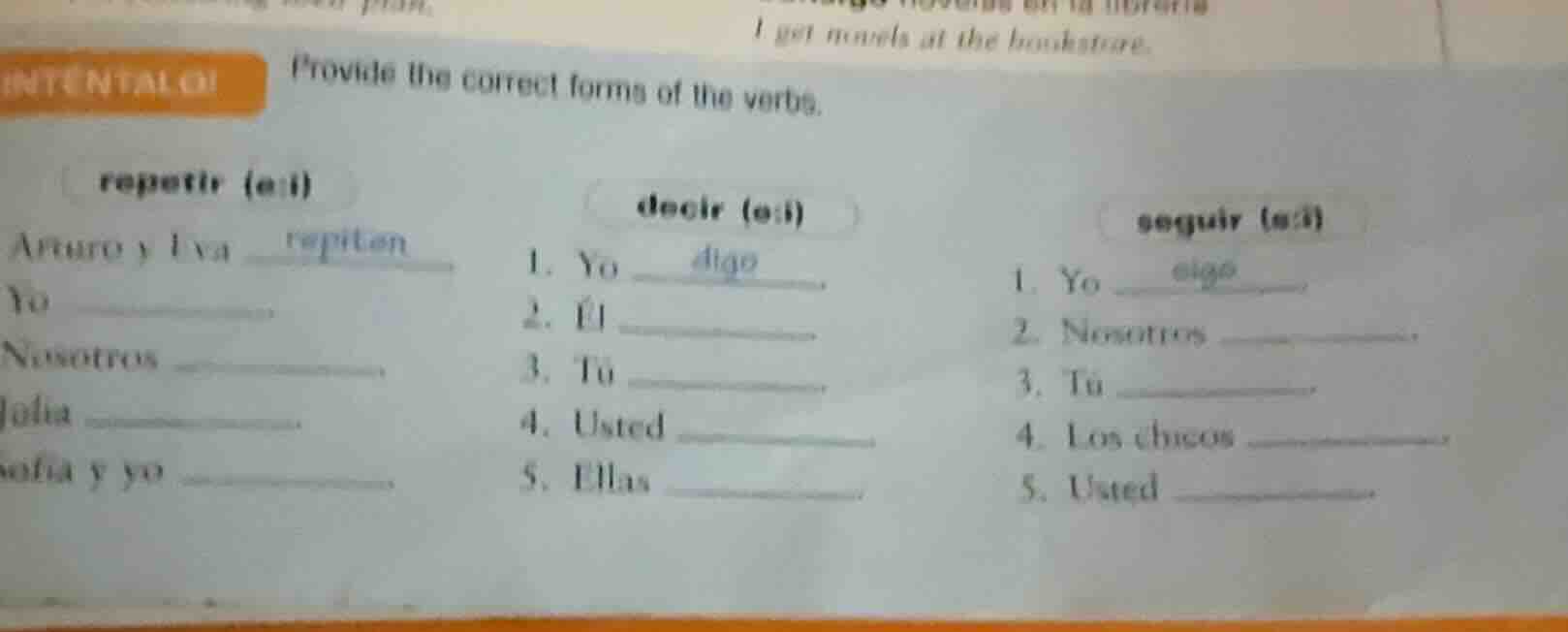
inténtalo! provide the correct forms of the verbs.
repetir (e:i)
arturo y eva repiten
yo ________.
nosotros ________.
julia ________.
sofía y yo ________.
decir (e:i)
- yo digo
- él ________.
- tú ________.
- usted ________.
- ellas ________.
seguir (e:i)
- yo sigo
- nosotros ________.
- tú ________.
- los chicos ________.
- usted ________.
Response
For "repetir" conjugation:
- Yo: The first - person singular (yo) form of "repetir" (with the stem - change \( e \to i \)) is "repito". The verb "repetir" is a stem - changing verb, and for the yo form, we have the stem change and the appropriate ending. The base form is "repetir", and for yo, we take the stem "repet - " (but with the stem change \( e \) to \( i \) in the stressed syllable), so it becomes "repit - " and then add the - o ending for yo in the present tense. So \( \text{Yo repito} \).
- Nosotros: For the first - person plural (nosotros) of "repetir", stem - changing verbs do not have a stem change in the nosotros form. The present - tense ending for nosotros is - imos. So we take the base stem "repet - " and add - imos, resulting in "repetimos". So \( \text{Nosotros repetimos} \).
- Julia: Julia is a third - person singular (ella) subject. For "repetir" (stem - change \( e \to i \)), the third - person singular ending in the present tense is - e. So we take the stem "repit - " (after the stem change) and add - e, getting "repite". So \( \text{Julia repite} \).
- Mafalda y yo: This is a first - person plural (nosotros) subject (since it includes "yo" and another person). As with the "nosotros" form of "repetir", there is no stem change, and we use the ending - imos. So "repetimos". So \( \text{Mafalda y yo repetimos} \).
For "decir" conjugation:
- Él: The third - person singular (él) form of "decir" (with the stem - change \( e \to i \)) is "dice". The verb "decir" has a stem change, and for the third - person singular, we take the stem "dic - " (after the stem change \( e \to i \)) and add the - e ending (for él in present tense). So \( \text{Él dice} \).
- Tú: The second - person singular (tú) form of "decir" is "dices". The stem - changed stem is "dic - " and we add the - es ending for tú in the present tense. So \( \text{Tú dices} \).
- Usted: Usted is a formal second - person singular, and its conjugation is the same as the third - person singular (él/ella). So the form of "decir" for usted is "dice". So \( \text{Usted dice} \).
- Ellas: Ellas is a third - person plural (ellas) subject. The present - tense ending for ellas (third - person plural) is - en. For "decir", the stem - changed stem is "dic - ", and we add - en, getting "dicen". So \( \text{Ellas dicen} \).
For "seguir" conjugation:
- Nosotros: For the first - person plural (nosotros) of "seguir" (stem - change \( e \to i \)), stem - changing verbs do not have a stem change in the nosotros form. The present - tense ending for nosotros is - imos. The base stem of "seguir" is "segu - ", and we add - imos, resulting in "seguimos". So \( \text{Nosotros seguimos} \).
- Tú: The second - person singular (tú) form of "seguir" (stem - change \( e \to i \)) is "sigues". The stem - changed stem is "sig - " and we add the - es ending for tú in the present tense. So \( \text{Tú sigues} \).
- Los chicos: Los chicos is a third - person plural (ellos) subject. The present - tense ending for ellos is - en. For "seguir", the stem - changed stem is "sig - ", and we add - en, getting "siguen". So \( \text{Los chicos siguen} \).
- Usted: Usted is a formal second - person singular, and its conjugation is the same as the third - person singular (él/ella). The third - person singular form of "seguir" is "sigue". So \( \text{Usted sigue} \).
Final Answers for each blank:
- repetir
- Yo: repito
- Nosotros: repetimos
- Julia: repite
- Mafalda y yo: repetimos
- decir
- Él: dice
- Tú: dic…

Snap & solve any problem in the app
Get step-by-step solutions on Sovi AI
Photo-based solutions with guided steps
Explore more problems and detailed explanations
For "repetir" conjugation:
- Yo: The first - person singular (yo) form of "repetir" (with the stem - change \( e \to i \)) is "repito". The verb "repetir" is a stem - changing verb, and for the yo form, we have the stem change and the appropriate ending. The base form is "repetir", and for yo, we take the stem "repet - " (but with the stem change \( e \) to \( i \) in the stressed syllable), so it becomes "repit - " and then add the - o ending for yo in the present tense. So \( \text{Yo repito} \).
- Nosotros: For the first - person plural (nosotros) of "repetir", stem - changing verbs do not have a stem change in the nosotros form. The present - tense ending for nosotros is - imos. So we take the base stem "repet - " and add - imos, resulting in "repetimos". So \( \text{Nosotros repetimos} \).
- Julia: Julia is a third - person singular (ella) subject. For "repetir" (stem - change \( e \to i \)), the third - person singular ending in the present tense is - e. So we take the stem "repit - " (after the stem change) and add - e, getting "repite". So \( \text{Julia repite} \).
- Mafalda y yo: This is a first - person plural (nosotros) subject (since it includes "yo" and another person). As with the "nosotros" form of "repetir", there is no stem change, and we use the ending - imos. So "repetimos". So \( \text{Mafalda y yo repetimos} \).
For "decir" conjugation:
- Él: The third - person singular (él) form of "decir" (with the stem - change \( e \to i \)) is "dice". The verb "decir" has a stem change, and for the third - person singular, we take the stem "dic - " (after the stem change \( e \to i \)) and add the - e ending (for él in present tense). So \( \text{Él dice} \).
- Tú: The second - person singular (tú) form of "decir" is "dices". The stem - changed stem is "dic - " and we add the - es ending for tú in the present tense. So \( \text{Tú dices} \).
- Usted: Usted is a formal second - person singular, and its conjugation is the same as the third - person singular (él/ella). So the form of "decir" for usted is "dice". So \( \text{Usted dice} \).
- Ellas: Ellas is a third - person plural (ellas) subject. The present - tense ending for ellas (third - person plural) is - en. For "decir", the stem - changed stem is "dic - ", and we add - en, getting "dicen". So \( \text{Ellas dicen} \).
For "seguir" conjugation:
- Nosotros: For the first - person plural (nosotros) of "seguir" (stem - change \( e \to i \)), stem - changing verbs do not have a stem change in the nosotros form. The present - tense ending for nosotros is - imos. The base stem of "seguir" is "segu - ", and we add - imos, resulting in "seguimos". So \( \text{Nosotros seguimos} \).
- Tú: The second - person singular (tú) form of "seguir" (stem - change \( e \to i \)) is "sigues". The stem - changed stem is "sig - " and we add the - es ending for tú in the present tense. So \( \text{Tú sigues} \).
- Los chicos: Los chicos is a third - person plural (ellos) subject. The present - tense ending for ellos is - en. For "seguir", the stem - changed stem is "sig - ", and we add - en, getting "siguen". So \( \text{Los chicos siguen} \).
- Usted: Usted is a formal second - person singular, and its conjugation is the same as the third - person singular (él/ella). The third - person singular form of "seguir" is "sigue". So \( \text{Usted sigue} \).
Final Answers for each blank:
- repetir
- Yo: repito
- Nosotros: repetimos
- Julia: repite
- Mafalda y yo: repetimos
- decir
- Él: dice
- Tú: dices
- Usted: dice
- Ellas: dicen
- seguir
- Nosotros: seguimos
- Tú: sigues
- Los chicos: siguen
- Usted: sigue