QUESTION IMAGE
Question
interpreting meaning
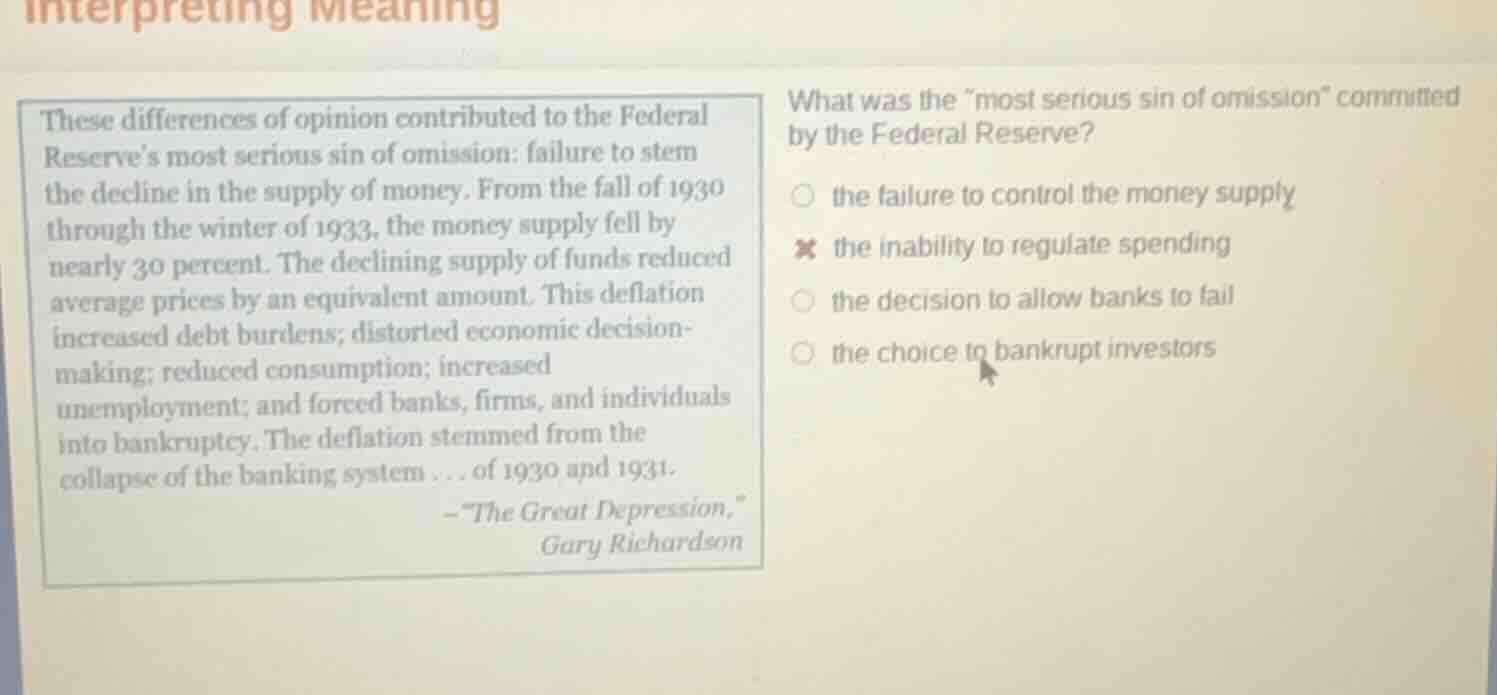
these differences of opinion contributed to the federal reserve’s most serious sin of omission: failure to stem the decline in the supply of money. from the fall of 1930 through the winter of 1933, the money supply fell by nearly 30 percent. the declining supply of funds reduced average prices by an equivalent amount. this deflation increased debt burdens; distorted economic decision - making; reduced consumption; increased unemployment; and forced banks, firms, and individuals into bankruptcy. the deflation stemmed from the collapse of the banking system... of 1930 and 1931.
—\the great depression,\ gary richardson
what was the \most serious sin of omission\ committed by the federal reserve?
○ the failure to control the money supply
× the inability to regulate spending
○ the decision to allow banks to fail
○ the choice to bankrupt investors
The text explicitly states the Federal Reserve's "most serious sin of omission" was failing to stem the decline in the money supply, which matches the first option. The marked option is incorrect as the passage does not mention regulating spending as the key failure.

Snap & solve any problem in the app
Get step-by-step solutions on Sovi AI
Photo-based solutions with guided steps
Explore more problems and detailed explanations
the failure to control the money supply