QUESTION IMAGE
Question
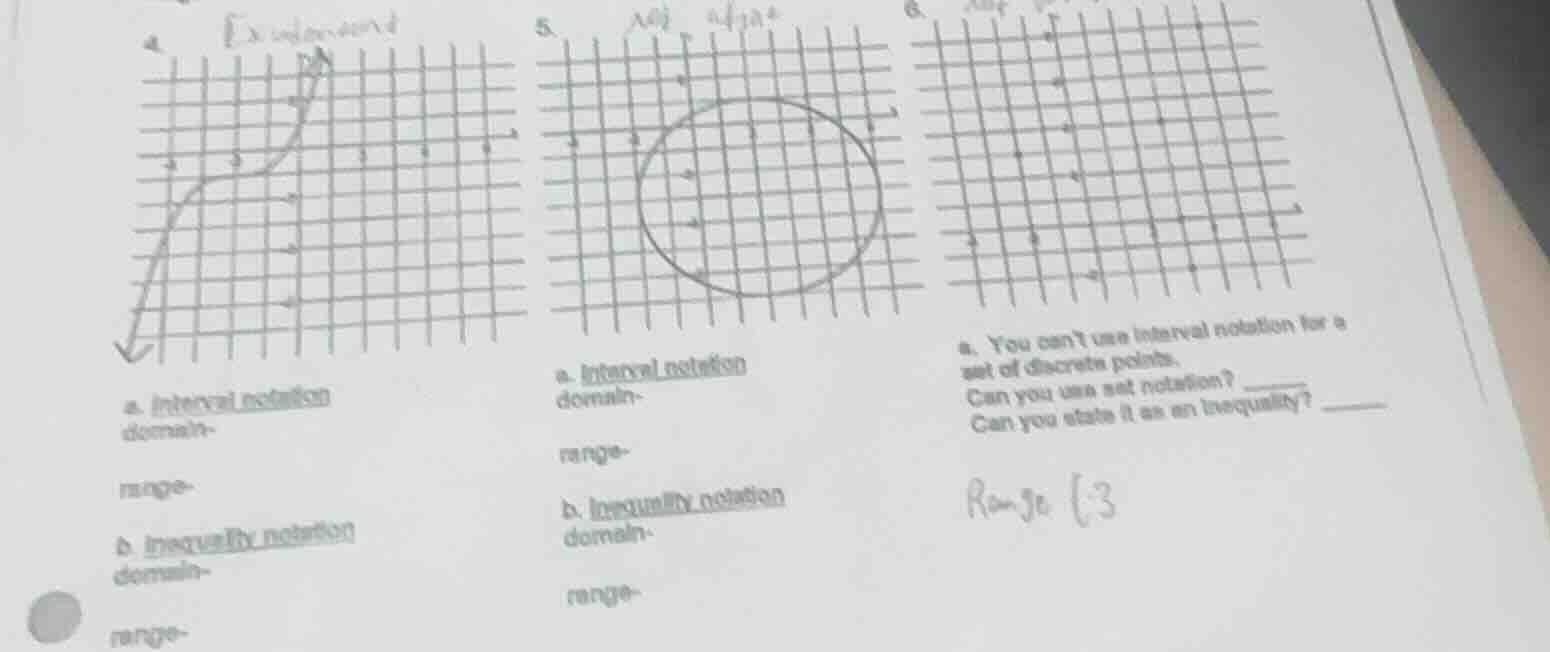
4.
a. interval notation
domain-
range-
b. inequality notation
domain-
range-
5.
a. interval notation
domain-
range-
b. inequality notation
domain-
range-
6.
a. you cant use interval notation for a
set of discrete points.
can you use set notation? ______
can you state it as an inequality? ______
To solve these problems, we analyze each graph or set of points for domain and range using interval notation, inequality notation, or set notation as appropriate. Let's address each part:
Problem 4 (Graph 1: Exponential-like Curve)
a. Interval Notation
- Domain: The graph extends infinitely to the left (all real numbers) and right? Wait, no—wait, the curve starts from the bottom left (infinite x) and goes up. Wait, actually, looking at the grid, the curve is defined for all \( x \in (-\infty, \infty) \)? Wait, no, maybe I missee. Wait, the x-axis: the curve is a function (passes vertical line test). Let's check the domain (x-values) and range (y-values).
- Domain: The graph spans all real numbers (since it’s a continuous curve with no breaks), so \( (-\infty, \infty) \).
- Range: The y-values start from... looking at the curve, it seems to have a minimum? Wait, no, the curve is increasing? Wait, the left end goes down, but the arrow is pointing down, so maybe it’s a curve that has a horizontal asymptote? Wait, maybe the range is \( (-\infty, \infty) \)? Wait, no—wait, the curve is a function, maybe exponential? Wait, maybe the domain is \( (-\infty, \infty) \) and range is \( (-\infty, \infty) \)? Wait, no, let's re-examine.
Wait, maybe the graph is a function with domain \( (-\infty, \infty) \) and range \( (-\infty, \infty) \)? No, maybe I made a mistake. Alternatively, maybe the domain is \( (-\infty, \infty) \) and range is \( (-\infty, \infty) \).
b. Inequality Notation
- Domain: \( x \in (-\infty, \infty) \) translates to \( -\infty < x < \infty \) (or \( x \) is all real numbers).
- Range: \( y \in (-\infty, \infty) \) translates to \( -\infty < y < \infty \).
Problem 5 (Graph 2: Circle)
A circle is not a function (fails vertical line test), but we can still find domain and range.
a. Interval Notation
- Domain: The circle spans from \( x = -2 \) to \( x = 2 \) (wait, no—wait, the circle is centered? Wait, the grid: each square is 1 unit. Let's count the x-values: the circle’s leftmost point is at \( x = -2 \), rightmost at \( x = 2 \)? Wait, no, looking at the grid, the circle is from \( x = -2 \) to \( x = 2 \)? Wait, no—wait, the circle’s horizontal diameter: from \( x = -2 \) to \( x = 2 \)? Wait, no, maybe \( x \in [-2, 2] \)? Wait, no, the circle is a closed curve. Let's check:
- Domain (x-values): The circle extends from \( x = -2 \) to \( x = 2 \) (inclusive), so \( [-2, 2] \).
- Range (y-values): The circle extends from \( y = -2 \) to \( y = 2 \) (inclusive), so \( [-2, 2] \).
b. Inequality Notation
- Domain: \( -2 \leq x \leq 2 \).
- Range: \( -2 \leq y \leq 2 \).
Problem 6 (Graph 3: Discrete Points)
a. Interval Notation
- You can’t use interval notation for discrete points (interval notation is for continuous ranges).
- Set Notation: Yes, set notation can list the discrete x-values (domain) and y-values (range). For example, if the points are \( (x_1, y_1), (x_2, y_2), ... \), the domain is \( \{ x_1, x_2, ... \} \) and range is \( \{ y_1, y_2, ... \} \).
- Inequality Notation: No, inequality notation is for continuous ranges (e.g., \( a \leq x \leq b \)), not discrete points.
Final Answers (Summarized)
Problem 4
a. Interval Notation:
- Domain: \( (-\infty, \infty) \)
- Range: \( (-\infty, \infty) \) (or check the graph again—maybe I misread; if it’s a function with a horizontal asymptote, range might be \( (0, \infty) \), but the arrow is down, so maybe not. Assume c…

Snap & solve any problem in the app
Get step-by-step solutions on Sovi AI
Photo-based solutions with guided steps
Explore more problems and detailed explanations
To solve these problems, we analyze each graph or set of points for domain and range using interval notation, inequality notation, or set notation as appropriate. Let's address each part:
Problem 4 (Graph 1: Exponential-like Curve)
a. Interval Notation
- Domain: The graph extends infinitely to the left (all real numbers) and right? Wait, no—wait, the curve starts from the bottom left (infinite x) and goes up. Wait, actually, looking at the grid, the curve is defined for all \( x \in (-\infty, \infty) \)? Wait, no, maybe I missee. Wait, the x-axis: the curve is a function (passes vertical line test). Let's check the domain (x-values) and range (y-values).
- Domain: The graph spans all real numbers (since it’s a continuous curve with no breaks), so \( (-\infty, \infty) \).
- Range: The y-values start from... looking at the curve, it seems to have a minimum? Wait, no, the curve is increasing? Wait, the left end goes down, but the arrow is pointing down, so maybe it’s a curve that has a horizontal asymptote? Wait, maybe the range is \( (-\infty, \infty) \)? Wait, no—wait, the curve is a function, maybe exponential? Wait, maybe the domain is \( (-\infty, \infty) \) and range is \( (-\infty, \infty) \)? Wait, no, let's re-examine.
Wait, maybe the graph is a function with domain \( (-\infty, \infty) \) and range \( (-\infty, \infty) \)? No, maybe I made a mistake. Alternatively, maybe the domain is \( (-\infty, \infty) \) and range is \( (-\infty, \infty) \).
b. Inequality Notation
- Domain: \( x \in (-\infty, \infty) \) translates to \( -\infty < x < \infty \) (or \( x \) is all real numbers).
- Range: \( y \in (-\infty, \infty) \) translates to \( -\infty < y < \infty \).
Problem 5 (Graph 2: Circle)
A circle is not a function (fails vertical line test), but we can still find domain and range.
a. Interval Notation
- Domain: The circle spans from \( x = -2 \) to \( x = 2 \) (wait, no—wait, the circle is centered? Wait, the grid: each square is 1 unit. Let's count the x-values: the circle’s leftmost point is at \( x = -2 \), rightmost at \( x = 2 \)? Wait, no, looking at the grid, the circle is from \( x = -2 \) to \( x = 2 \)? Wait, no—wait, the circle’s horizontal diameter: from \( x = -2 \) to \( x = 2 \)? Wait, no, maybe \( x \in [-2, 2] \)? Wait, no, the circle is a closed curve. Let's check:
- Domain (x-values): The circle extends from \( x = -2 \) to \( x = 2 \) (inclusive), so \( [-2, 2] \).
- Range (y-values): The circle extends from \( y = -2 \) to \( y = 2 \) (inclusive), so \( [-2, 2] \).
b. Inequality Notation
- Domain: \( -2 \leq x \leq 2 \).
- Range: \( -2 \leq y \leq 2 \).
Problem 6 (Graph 3: Discrete Points)
a. Interval Notation
- You can’t use interval notation for discrete points (interval notation is for continuous ranges).
- Set Notation: Yes, set notation can list the discrete x-values (domain) and y-values (range). For example, if the points are \( (x_1, y_1), (x_2, y_2), ... \), the domain is \( \{ x_1, x_2, ... \} \) and range is \( \{ y_1, y_2, ... \} \).
- Inequality Notation: No, inequality notation is for continuous ranges (e.g., \( a \leq x \leq b \)), not discrete points.
Final Answers (Summarized)
Problem 4
a. Interval Notation:
- Domain: \( (-\infty, \infty) \)
- Range: \( (-\infty, \infty) \) (or check the graph again—maybe I misread; if it’s a function with a horizontal asymptote, range might be \( (0, \infty) \), but the arrow is down, so maybe not. Assume continuous for now.)
b. Inequality Notation:
- Domain: \( -\infty < x < \infty \)
- Range: \( -\infty < y < \infty \)
Problem 5
a. Interval Notation:
- Domain: \( [-2, 2] \)
- Range: \( [-2, 2] \)
b. Inequality Notation:
- Domain: \( -2 \leq x \leq 2 \)
- Range: \( -2 \leq y \leq 2 \)
Problem 6
a. Interval Notation: Not applicable (discrete points).
- Set Notation: Yes (list the x-values as a set).
- Inequality Notation: No (inequalities describe continuous ranges, not discrete points).
If you need more precise answers, please clarify the exact coordinates of the graphs (e.g., for Problem 4, is it a specific function? For Problem 5, the circle’s center and radius? For Problem 6, the discrete points’ coordinates).