QUESTION IMAGE
Question
introduction:
lab #14: ionic and covalent bonds (holiday)
atoms form bonds when their valence electrons interact. more stable than atoms with partially filled energy levels. recall that atoms with filled outermost energy levels are has a stable electron configuration. in general, atoms join to form bonds so that each atom there are two basic kinds of chemical bonding, ionic and covalent. ionic bonds form between oppositely charged ions. in general, atoms of metals form positively charged ions and atoms of nonmetals form negatively charged ions. the attraction between ions with opposite charges holds ionic compounds together. on the other hand, a covalent bond forms when electrons are shared between two atoms. in general, covalent bonds form between atoms of nonmetals.
prelab question:
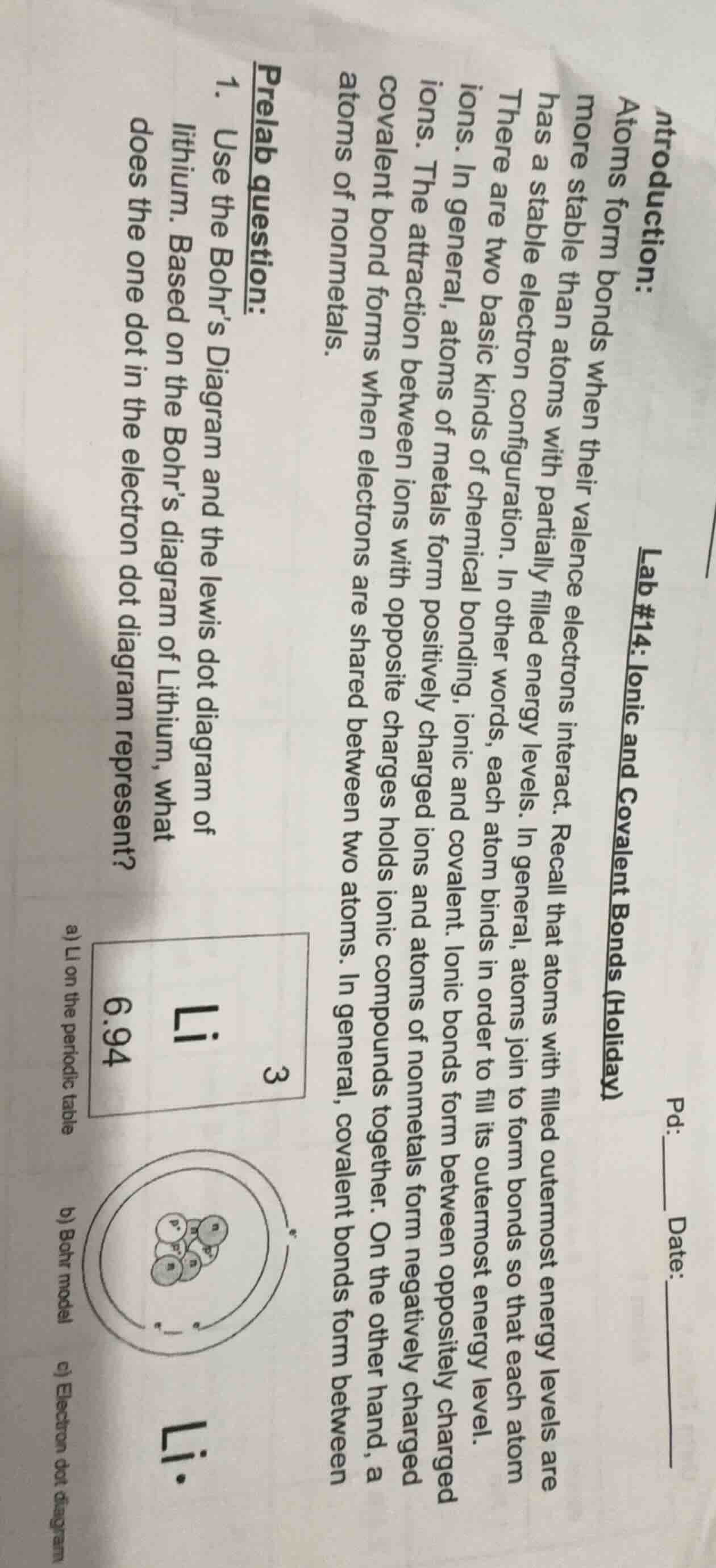
- use the bohr’s diagram and the lewis dot diagram of lithium. based on the bohr’s diagram of lithium, what does the one dot in the electron dot diagram represent?
a) li on the periodic table
image of lis periodic table info: 3, li, 6.94
b) bohr model
image of lis bohr model
c) electron dot diagram
image of lis electron dot diagram: li·
The Lewis dot diagram of an atom represents its valence electrons (the electrons in the outermost energy level). For lithium (Li), the atomic number is 3. Its electron configuration is \(1s^2 2s^1\), so it has 1 valence electron. The dot in the Lewis dot diagram (\( \text{Li} \cdot \)) represents this single valence electron. The Bohr model shows lithium with 2 electrons in the first shell and 1 in the second (valence) shell, confirming there's 1 valence electron, which matches the dot in the Lewis diagram.

Snap & solve any problem in the app
Get step-by-step solutions on Sovi AI
Photo-based solutions with guided steps
Explore more problems and detailed explanations
The dot in the Lewis dot diagram of lithium represents its valence electron (specifically, the 1 electron in its outermost (valence) energy level).