Sovi.AI - AI Math Tutor

Scan to solve math questions

QUESTION IMAGE

the inverse of a matrix in exercises 5, 6, 7, 8, 9, 10, 11, and 12, sho…

Question

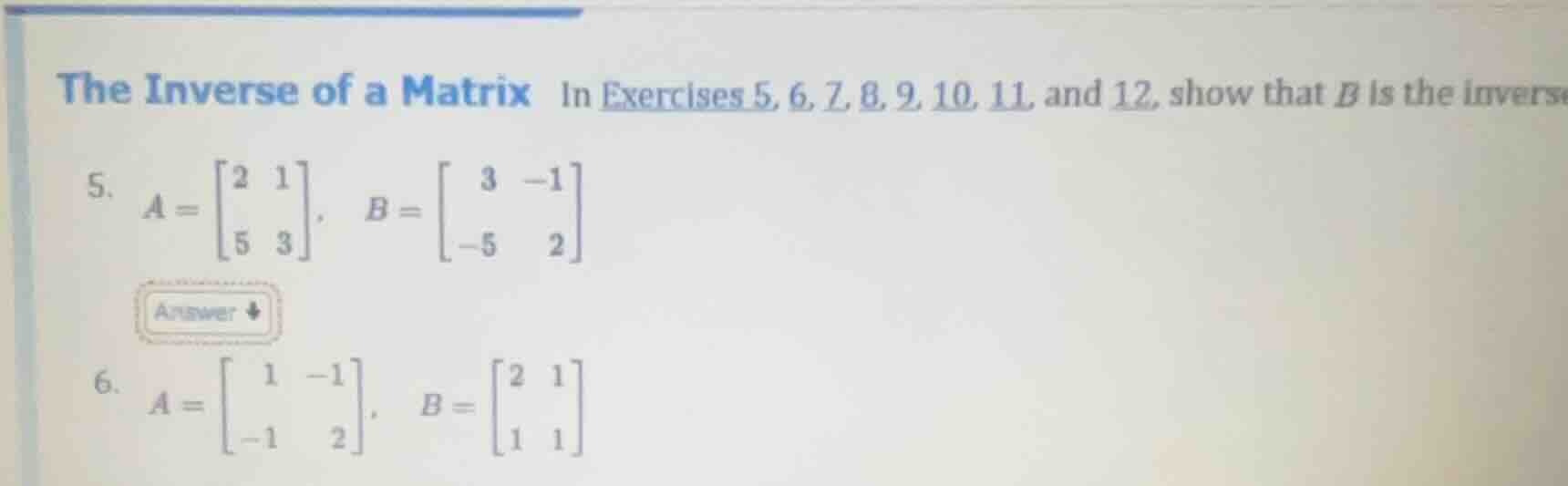
the inverse of a matrix in exercises 5, 6, 7, 8, 9, 10, 11, and 12, show that ( b ) is the inverse

  1. ( a = \begin{bmatrix} 2 & 1 \\ 5 & 3 end{bmatrix}, quad b = \begin{bmatrix} 3 & -1 \\ -5 & 2 end{bmatrix} )
  1. ( a = \begin{bmatrix} 1 & -1 \\ -1 & 2 end{bmatrix}, quad b = \begin{bmatrix} 2 & 1 \\ 1 & 1 end{bmatrix} )

Explanation:

Response
Problem 5

To show that \( B \) is the inverse of \( A \), we need to verify that \( AB = I \) and \( BA = I \), where \( I \) is the identity matrix.

Step 1: Calculate \( AB \)

Given \( A =

$$\begin{bmatrix} 2 & 1 \\ 5 & 3 \end{bmatrix}$$

\) and \( B =

$$\begin{bmatrix} 3 & -1 \\ -5 & 2 \end{bmatrix}$$

\)

\[

$$\begin{align*} AB &= \begin{bmatrix} 2 & 1 \\ 5 & 3 \end{bmatrix} \begin{bmatrix} 3 & -1 \\ -5 & 2 \end{bmatrix} \\ &= \begin{bmatrix} 2 \cdot 3 + 1 \cdot (-5) & 2 \cdot (-1) + 1 \cdot 2 \\ 5 \cdot 3 + 3 \cdot (-5) & 5 \cdot (-1) + 3 \cdot 2 \end{bmatrix} \\ &= \begin{bmatrix} 6 - 5 & -2 + 2 \\ 15 - 15 & -5 + 6 \end{bmatrix} \\ &= \begin{bmatrix} 1 & 0 \\ 0 & 1 \end{bmatrix} \end{align*}$$

\]

Step 2: Calculate \( BA \)

\[

$$\begin{align*} BA &= \begin{bmatrix} 3 & -1 \\ -5 & 2 \end{bmatrix} \begin{bmatrix} 2 & 1 \\ 5 & 3 \end{bmatrix} \\ &= \begin{bmatrix} 3 \cdot 2 + (-1) \cdot 5 & 3 \cdot 1 + (-1) \cdot 3 \\ -5 \cdot 2 + 2 \cdot 5 & -5 \cdot 1 + 2 \cdot 3 \end{bmatrix} \\ &= \begin{bmatrix} 6 - 5 & 3 - 3 \\ -10 + 10 & -5 + 6 \end{bmatrix} \\ &= \begin{bmatrix} 1 & 0 \\ 0 & 1 \end{bmatrix} \end{align*}$$

\]

Since \( AB = I \) and \( BA = I \), \( B \) is the inverse of \( A \).

Problem 6

To show that \( B \) is the inverse of \( A \), we need to verify that \( AB = I \) and \( BA = I \), where \( I \) is the identity matrix.

Step 1: Calculate \( AB \)

Given \( A =

$$\begin{bmatrix} 1 & -1 \\ -1 & 2 \end{bmatrix}$$

\) and \( B =

$$\begin{bmatrix} 2 & 1 \\ 1 & 1 \end{bmatrix}$$

\)

\[

$$\begin{align*} AB &= \begin{bmatrix} 1 & -1 \\ -1 & 2 \end{bmatrix} \begin{bmatrix} 2 & 1 \\ 1 & 1 \end{bmatrix} \\ &= \begin{bmatrix} 1 \cdot 2 + (-1) \cdot 1 & 1 \cdot 1 + (-1) \cdot 1 \\ -1 \cdot 2 + 2 \cdot 1 & -1 \cdot 1 + 2 \cdot 1 \end{bmatrix} \\ &= \begin{bmatrix} 2 - 1 & 1 - 1 \\ -2 + 2 & -1 + 2 \end{bmatrix} \\ &= \begin{bmatrix} 1 & 0 \\ 0 & 1 \end{bmatrix} \end{align*}$$

\]

Step 2: Calculate \( BA \)

\[

$$\begin{align*} BA &= \begin{bmatrix} 2 & 1 \\ 1 & 1 \end{bmatrix} \begin{bmatrix} 1 & -1 \\ -1 & 2 \end{bmatrix} \\ &= \begin{bmatrix} 2 \cdot 1 + 1 \cdot (-1) & 2 \cdot (-1) + 1 \cdot 2 \\ 1 \cdot 1 + 1 \cdot (-1) & 1 \cdot (-1) + 1 \cdot 2 \end{bmatrix} \\ &= \begin{bmatrix} 2 - 1 & -2 + 2 \\ 1 - 1 & -1 + 2 \end{bmatrix} \\ &= \begin{bmatrix} 1 & 0 \\ 0 & 1 \end{bmatrix} \end{align*}$$

\]

Since \( AB = I \) and \( BA = I \), \( B \) is the inverse of \( A \).

Answer:

Problem 5

To show that \( B \) is the inverse of \( A \), we need to verify that \( AB = I \) and \( BA = I \), where \( I \) is the identity matrix.

Step 1: Calculate \( AB \)

Given \( A =

$$\begin{bmatrix} 2 & 1 \\ 5 & 3 \end{bmatrix}$$

\) and \( B =

$$\begin{bmatrix} 3 & -1 \\ -5 & 2 \end{bmatrix}$$

\)

\[

$$\begin{align*} AB &= \begin{bmatrix} 2 & 1 \\ 5 & 3 \end{bmatrix} \begin{bmatrix} 3 & -1 \\ -5 & 2 \end{bmatrix} \\ &= \begin{bmatrix} 2 \cdot 3 + 1 \cdot (-5) & 2 \cdot (-1) + 1 \cdot 2 \\ 5 \cdot 3 + 3 \cdot (-5) & 5 \cdot (-1) + 3 \cdot 2 \end{bmatrix} \\ &= \begin{bmatrix} 6 - 5 & -2 + 2 \\ 15 - 15 & -5 + 6 \end{bmatrix} \\ &= \begin{bmatrix} 1 & 0 \\ 0 & 1 \end{bmatrix} \end{align*}$$

\]

Step 2: Calculate \( BA \)

\[

$$\begin{align*} BA &= \begin{bmatrix} 3 & -1 \\ -5 & 2 \end{bmatrix} \begin{bmatrix} 2 & 1 \\ 5 & 3 \end{bmatrix} \\ &= \begin{bmatrix} 3 \cdot 2 + (-1) \cdot 5 & 3 \cdot 1 + (-1) \cdot 3 \\ -5 \cdot 2 + 2 \cdot 5 & -5 \cdot 1 + 2 \cdot 3 \end{bmatrix} \\ &= \begin{bmatrix} 6 - 5 & 3 - 3 \\ -10 + 10 & -5 + 6 \end{bmatrix} \\ &= \begin{bmatrix} 1 & 0 \\ 0 & 1 \end{bmatrix} \end{align*}$$

\]

Since \( AB = I \) and \( BA = I \), \( B \) is the inverse of \( A \).

Problem 6

To show that \( B \) is the inverse of \( A \), we need to verify that \( AB = I \) and \( BA = I \), where \( I \) is the identity matrix.

Step 1: Calculate \( AB \)

Given \( A =

$$\begin{bmatrix} 1 & -1 \\ -1 & 2 \end{bmatrix}$$

\) and \( B =

$$\begin{bmatrix} 2 & 1 \\ 1 & 1 \end{bmatrix}$$

\)

\[

$$\begin{align*} AB &= \begin{bmatrix} 1 & -1 \\ -1 & 2 \end{bmatrix} \begin{bmatrix} 2 & 1 \\ 1 & 1 \end{bmatrix} \\ &= \begin{bmatrix} 1 \cdot 2 + (-1) \cdot 1 & 1 \cdot 1 + (-1) \cdot 1 \\ -1 \cdot 2 + 2 \cdot 1 & -1 \cdot 1 + 2 \cdot 1 \end{bmatrix} \\ &= \begin{bmatrix} 2 - 1 & 1 - 1 \\ -2 + 2 & -1 + 2 \end{bmatrix} \\ &= \begin{bmatrix} 1 & 0 \\ 0 & 1 \end{bmatrix} \end{align*}$$

\]

Step 2: Calculate \( BA \)

\[

$$\begin{align*} BA &= \begin{bmatrix} 2 & 1 \\ 1 & 1 \end{bmatrix} \begin{bmatrix} 1 & -1 \\ -1 & 2 \end{bmatrix} \\ &= \begin{bmatrix} 2 \cdot 1 + 1 \cdot (-1) & 2 \cdot (-1) + 1 \cdot 2 \\ 1 \cdot 1 + 1 \cdot (-1) & 1 \cdot (-1) + 1 \cdot 2 \end{bmatrix} \\ &= \begin{bmatrix} 2 - 1 & -2 + 2 \\ 1 - 1 & -1 + 2 \end{bmatrix} \\ &= \begin{bmatrix} 1 & 0 \\ 0 & 1 \end{bmatrix} \end{align*}$$

\]

Since \( AB = I \) and \( BA = I \), \( B \) is the inverse of \( A \).