QUESTION IMAGE
Question
investigation 6
chemical bonding
jewelers use gems in jewelry because of their appearances
and how they can be shaped. the metals used in jewelry
have different uses and properties than gems. once you have
viewed the investigative phenomenon video and worked on
a first draft of a claim - evidence - reasoning exercise to explain
the phenomenon you observed, answer the following reflection
questions about the physical properties of gems and metals.
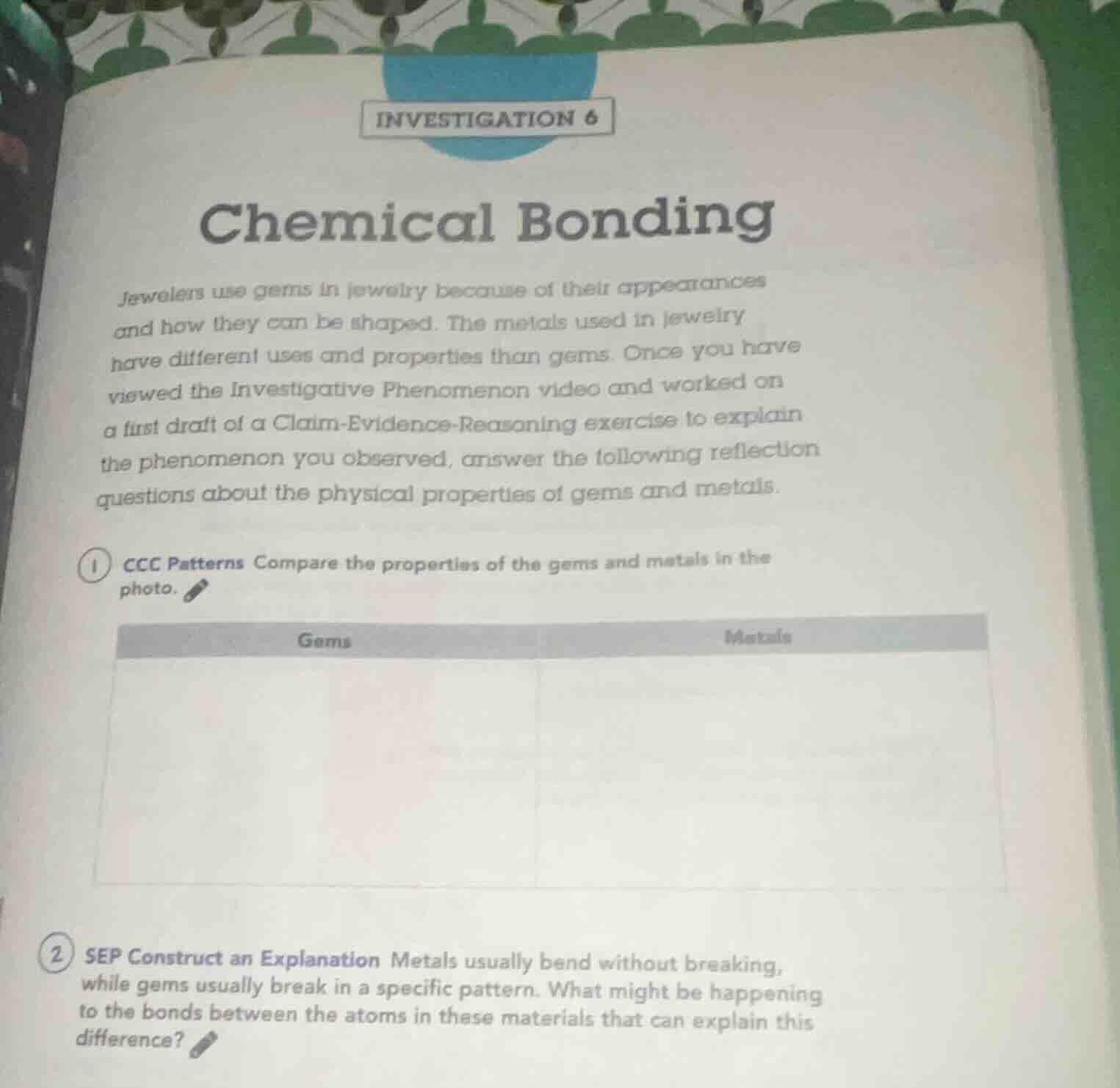
1 ccc patterns compare the properties of the gems and metals in the
photo.
gems metals
2 sep construct an explanation metals usually bend without breaking,
while gems usually break in a specific pattern. what might be happening
to the bonds between the atoms in these materials that can explain this
difference?
Question 1 (CCC Patterns: Compare properties of gems and metals)
To compare, we analyze typical physical properties. Gems (e.g., diamonds, rubies) are often hard, brittle, have distinct luster/color, and show cleavage/fracture. Metals (e.g., gold, silver) are malleable, ductile, shiny (metallic luster), and conduct heat/electricity. We list these in the table.
Metals have metallic bonding: atoms are in a lattice with delocalized electrons. When stress is applied, metal ions slide past each other (due to electron "sea" holding them), so they bend (malleability/ductility). Gems (e.g., ionic/covalent crystals like diamond, quartz) have strong directional bonds (ionic or covalent). When stressed, bonds break along planes of weakness (cleavage) or irregularly (fracture), as the rigid lattice can’t deform—bonds are too strong and directional to allow sliding, so they break in patterns.

Snap & solve any problem in the app
Get step-by-step solutions on Sovi AI
Photo-based solutions with guided steps
Explore more problems and detailed explanations
| Gems | Metals |
|---|